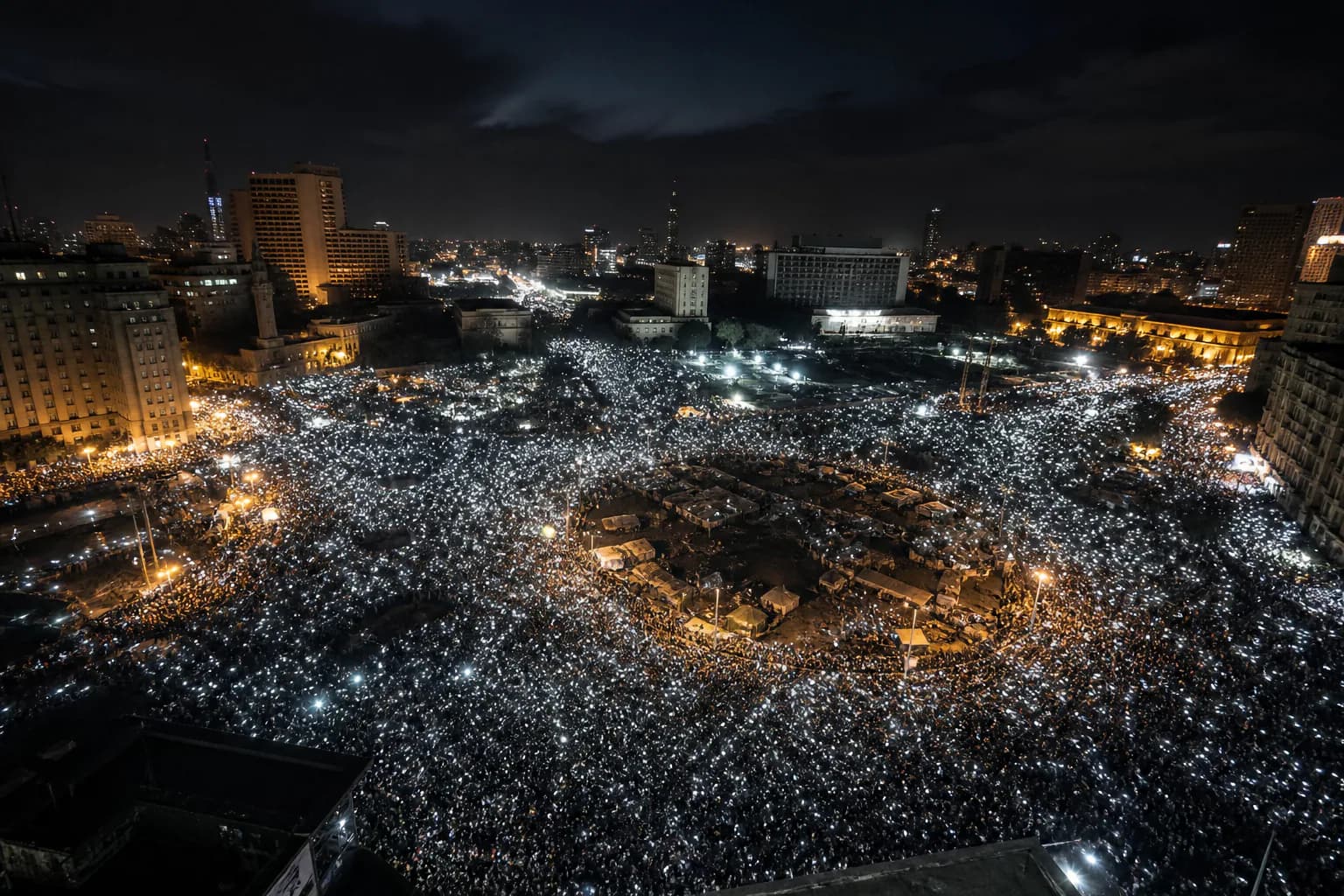
Beginning January 25, 2011 — deliberately chosen as Egypt's “Police Day” holiday — protesters filled Cairo's Tahrir Square demanding the end of Hosni Mubarak's 30-year rule; eighteen days later, on February 11, Vice President Omar Suleiman announced on state television that Mubarak had resigned and handed authority to the military, ending one of the Arab world's longest-standing governments in under three weeks.
The square itself became the protest's infrastructure: makeshift clinics, food distribution, and overnight security against pro-Mubarak counter-attacks — most notably the February 2 “Battle of the Camel,” when men on camels and horses charged the crowd — sustained a physically continuous occupation that could not be dispersed by a single night's crackdown, forcing the standoff to play out over weeks rather than hours.
The mechanism was spatial theater amplified by dual media channels: Al Jazeera's continuous live coverage made the square's persistence internationally visible in real time, while activist groups, including the April 6 Youth Movement, used Facebook and Twitter for organizing and marshaling that state media could not control after the government's five-day internet shutdown starting January 27 backfired by signaling panic rather than restoring order.
The Egyptian military, calculating that backing Mubarak risked its own institutional standing, declined to fire on protesters and ultimately eased him out — a choice that determined the outcome more than any single day's crowd size. What followed complicated any clean narrative: a military caretaker government, the Muslim Brotherhood's Mohamed Morsi winning the 2012 presidential election, and then a 2013 military coup led by General Abdel Fattah el-Sisi that restored authoritarian rule within roughly two and a half years of Mubarak's fall.
An Egyptian fact-finding commission later found at least 846 people were killed and roughly 6,000 injured during the eighteen days and their immediate aftermath, mostly by police and plainclothes security forces rather than the army — a distinction protesters drew carefully at the time, since it was the police, not the military, whose brutality had triggered the January 25 mobilization in the first place. Mubarak himself was later tried, convicted, acquitted on appeal, and ultimately died in 2020 without serving meaningful prison time, an outcome many of the original protesters considered a second, quieter defeat and one that fed a broader post-2013 sentiment among activists that the square's victory had been procedural rather than substantive, removing one leader while leaving the security apparatus that enforced his rule largely intact.
International commentary at the time favored “Facebook revolution” framing that credited social platforms disproportionately; the harder, less photogenic story — the military's institutional self-interest calculation, and the absence of any organized political alternative ready to govern once Mubarak left — received comparatively little attention until Morsi's ouster forced a reckoning with what the square's unity had actually obscured.
Occupy Wall Street later that year, Istanbul's Gezi Park protests in 2013, and Hong Kong's 2014 and 2019 demonstrations all borrowed Tahrir's visual grammar of sustained public occupation as a legitimacy meter, even though none produced Egypt's specific outcome, suggesting the tactic transmitted more successfully than any particular political result.
Egypt's eighteen days in Tahrir showed occupation of symbolic urban space, amplified by satellite TV and social platforms, could fracture a regime's aura of inevitability. The aftermath — military rule, elections, and later authoritarian restoration — warned that square revolutions do not automatically yield liberal orders.
Eighteen days in Tahrir Square compressed labor strikes, middle-class discontent, and military calculation into a televised occupation. Mubarak's resignation felt like people power; the SCAF interregnum and later coup showed how deeply the deep state could regroup. Social media accelerated assembly; it did not guarantee liberal outcomes.
Gulf monarchies and other autocracies drew opposite lessons: invest in surveillance, subsidies, and narrative control. Egyptian politics after 2013 hardened into a restored authoritarian model with different branding. Tahrir remains a global symbol precisely because the sequel was so contested.
Revolutionary tourism and documentary cameras made Tahrir a global stage; Egyptian outcomes reminded viewers that stages are not states. Brotherhood electoral wins and later repression reordered Islamist strategies region-wide. The square’s image outlived the coalition that filled it.
Egypt's current government, under Sisi, has restricted protest through a 2013 law requiring police permits for public gatherings — a direct institutional response designed to make another Tahrir-style occupation legally and logistically difficult, itself an acknowledgment of how effective the tactic proved to be.
Century Signals note: Contemporaneous Egypt uprising reporting; later human-rights and academic assessments of the transition and 2013 coup. Editorial judgment about what still structures the present — not a comprehensive history.