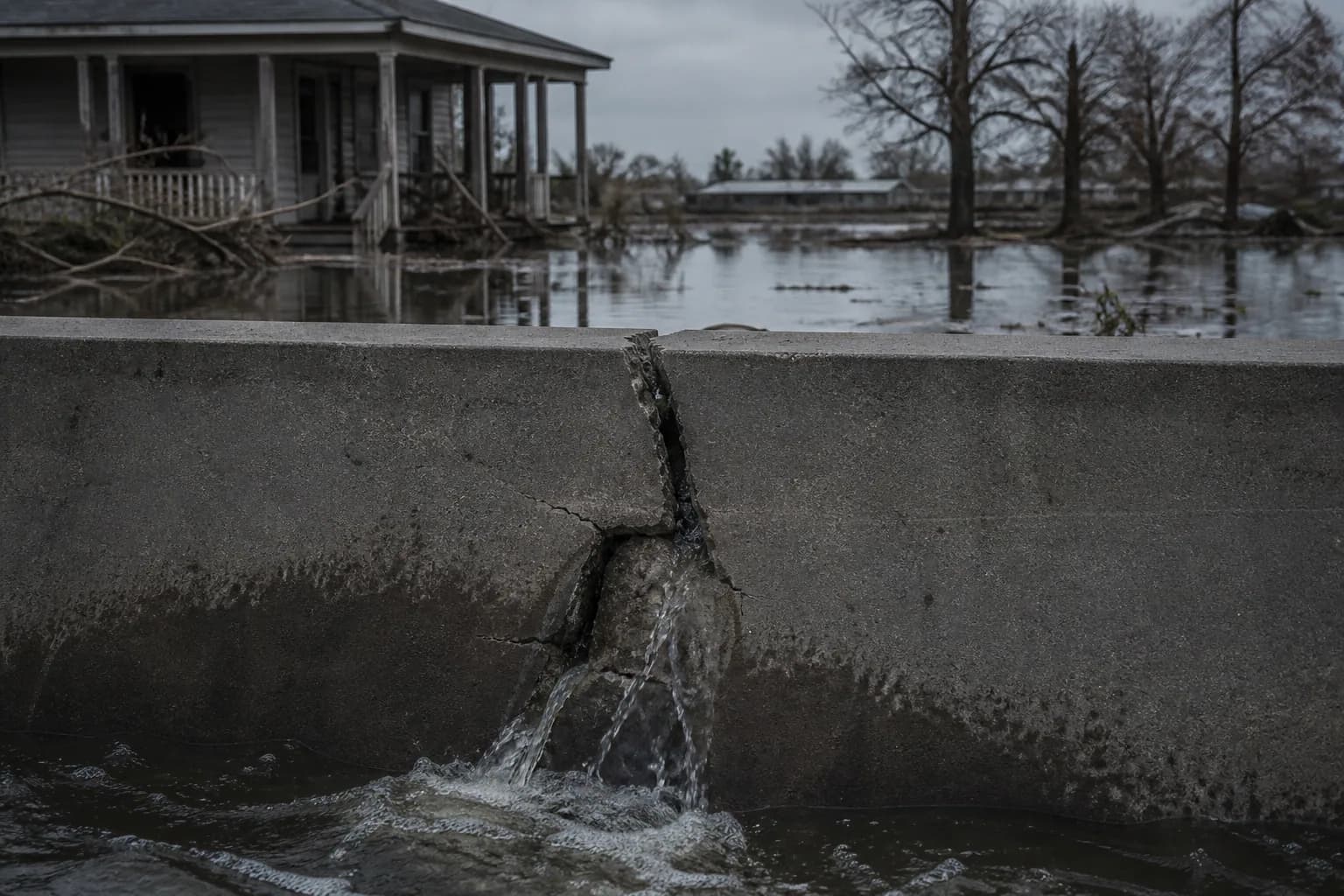
Hurricane Katrina made landfall near Buras, Louisiana, on August 29, 2005, as a Category 3 storm with sustained winds over 100 miles per hour, and within hours federal levees along the 17th Street, London Avenue, and Industrial canals breached in multiple locations, flooding roughly eighty percent of the city of New Orleans and ultimately killing an estimated 1,800 people across the broader Gulf Coast region.
Tens of thousands of residents sheltered at the Louisiana Superdome and the Ernest N. Morial Convention Center for days with grossly inadequate food, water, and medical care, while FEMA director Michael Brown — whom President Bush would soon publicly praise, to widespread later criticism, as doing 'a heckuva job' — struggled visibly and publicly to coordinate any coherent federal response, a moment that became lasting shorthand for institutional failure at the highest levels.
The mechanism was layered vulnerability: levees designed, built, and maintained by the U.S. Army Corps of Engineers to structural standards a subsequent official investigation found significantly inadequate for the actual storm surge experienced, an evacuation plan that implicitly assumed near-universal car ownership in a city where roughly a quarter of all households had none, and decades of historic underinvestment in the majority-Black, lower-lying wards that ultimately flooded worst and longest.
Wealthier residents with private cars and financial resources largely evacuated before landfall and later returned to intact, adequately insured homes. Lower-income residents of the Lower Ninth Ward and similarly situated neighborhoods lost their homes entirely in many cases, and a great many never returned at all to a city whose overall population dropped by roughly 29 percent between the 2000 and 2010 U.S. censuses.
Cable news coverage in the storm's immediate aftermath emphasized contested looting narratives and shifting political blame passed between local, state, and federal officials. Slower, more durable investigative reporting, including the Army Corps of Engineers' own formal 2006 investigation into the levee failures, documented specific engineering miscalculations and decades of budget tradeoffs that had left the entire levee system meaningfully under-built relative to well-documented, known flood risk.
FEMA underwent significant institutional reform after Katrina, including passage of the 2006 Post-Katrina Emergency Management Reform Act, which gave the agency's administrator direct, guaranteed access to the president during declared disasters — a targeted fix for exactly the coordination failures Katrina had exposed so publicly.
Hurricane Katrina devastated the U.S. Gulf Coast in August 2005; New Orleans' levee failures turned a severe storm into a catastrophic urban flood. Images of stranded residents at the Superdome and delayed federal response became a lasting indictment of emergency management and racialized neglect.
The Army Corps of Engineers' levee system, FEMA's performance, and state-local coordination failures were dissected in official reports. Infrastructure was reframed publicly as a civil-rights and inequality issue: who is protected by engineering investments, and whose neighborhoods flood first when systems fail. That frame still shapes climate-adaptation politics in American cities.
Displacement scattered New Orleans residents across the United States; return migration was uneven by race and income. The storm's demography became inseparable from its hydrology — a fact housing, insurance, and school-rebuild policies had to confront for years afterward.
Levee breaches flooded roughly eighty percent of New Orleans; failure modes traced to design and maintenance, not only storm intensity — findings detailed in later engineering assessments. The Superdome and Convention Center became symbols of a state that could not protect its poorest citizens in real time.
The Stafford Act machinery, National Guard deployment delays, and FEMA leadership failures produced bipartisan investigations. Insurance redlining debates and the Road Home rebuilding program showed recovery itself could reproduce inequality. Climate adaptation discourse in U.S. cities still uses Katrina as the domestic reference disaster.
Diaspora communities in Houston and Atlanta remade demographics; New Orleans culture survived in strained, contested form. Engineers rebuilt with higher specs; politics rebuilt with familiar inequities. Katrina remains the U.S. proof that infrastructure failure is a social sorting machine.
Levee certification and coastal restoration became multi-decade appropriations fights. Music and food culture carried the city’s brand while neighborhoods stayed unevenly rebuilt. Infrastructure failure writes demographic destiny.
Coastal Louisiana's ongoing, accelerating land-loss crisis, national policy debates over federal flood-insurance program reform, and the broader argument that chronic infrastructure neglect functions in practice as a political policy choice with a measurable body count all still cite Katrina explicitly as their central reference case two decades later.
Century Signals note: Official engineering assessments of levee failure; Congressional Katrina investigations; contemporaneous reporting; later scholarship on recovery and displacement. Editorial judgment about what still structures the present — not a comprehensive history.