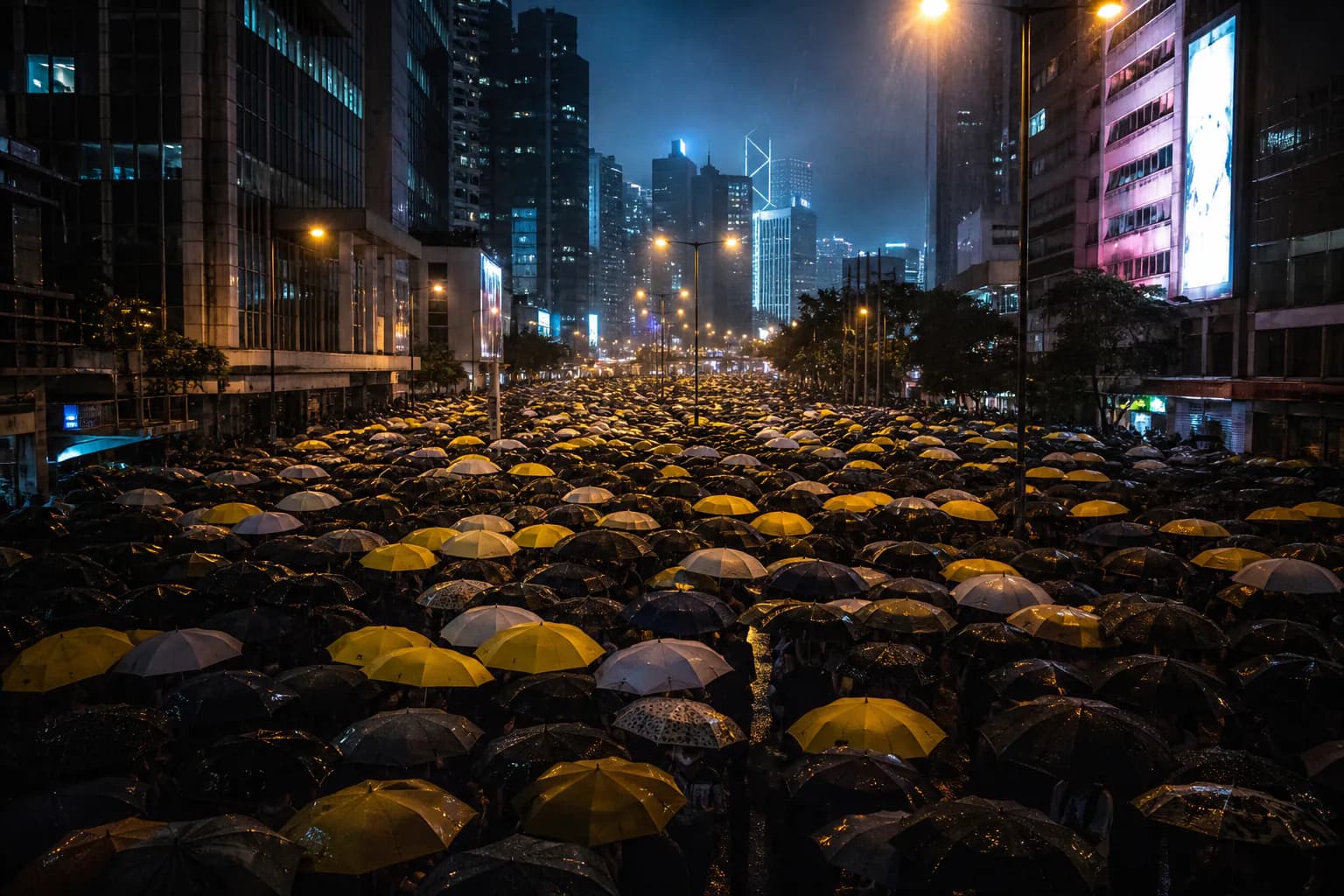
In March and June 2019, mass protests erupted in Hong Kong against a proposed extradition bill that would have allowed the territory to send criminal suspects to mainland China for trial, a change many residents saw as an existential threat to the legal firewall separating Hong Kong's common-law system from the mainland's. A June 9 march drew organizers' estimates of over a million people out of a population of roughly 7.5 million, and a June 16 march drew even larger crowds, estimated by organizers at nearly two million, after police used tear gas on protesters days earlier.
The movement's demands crystallized into "five demands, not one less": full withdrawal of the extradition bill, an independent inquiry into police conduct, release of arrested protesters, retraction of the official "riot" characterization of demonstrations, and universal suffrage for Hong Kong's leadership elections, which had never been fully implemented despite promises in the territory's Basic Law. On July 1, 2019, the anniversary of the 1997 handover, protesters stormed and vandalized the Legislative Council building, a symbolic escalation that marked the shift from peaceful mass marches toward more confrontational tactics on both sides of the standoff.
The protests sustained themselves through a largely leaderless, decentralized structure organized via encrypted messaging apps like Telegram and coordination boards like LIHKG, deliberately avoiding the single-leader vulnerability that had let authorities dismantle the 2014 Umbrella Movement by targeting its identifiable figureheads such as Joshua Wong and Benny Tai. Chief Executive Carrie Lam formally withdrew the extradition bill in September 2019, but by then the demands had broadened well beyond a single piece of legislation to encompass police accountability and electoral reform.
Protesters gained global visibility and, briefly, a genuine sense that Beijing might negotiate, particularly after pro-democracy candidates won a landslide in November 2019 district council elections on record turnout; police faced sustained accusations of excessive force, including widespread tear gas use exceeding 16,000 rounds fired over the year and a two-week November 2019 siege of Hong Kong Polytechnic University. Hong Kong's economy, heavily dependent on tourism and its status as a financial gateway to China, contracted for the first time in a decade as protests and later COVID-19 disrupted business activity through 2019 and 2020.
Coverage through mid-2019 often framed the protests within a hopeful narrative of grassroots resistance reshaping Beijing's calculus, underweighting how limited Hong Kong's actual leverage was once China's central government decided the territory's autonomy was negotiable rather than guaranteed — a judgment call Beijing made explicit within a year, overriding the district council election result entirely.
In June 2020, China's National People's Congress imposed a National Security Law on Hong Kong that criminalized secession, subversion, terrorism, and collusion with foreign forces in broad and, critics argued, deliberately vague terms, bypassing the territory's own legislature entirely by inserting the law directly into Hong Kong's Basic Law annex. Prominent activists including Joshua Wong were imprisoned, pro-democracy media outlet Apple Daily was forced to close in June 2021 after police froze its assets and arrested its founder Jimmy Lai, and dozens of pro-democracy figures were prosecuted or fled into exile in the UK, Canada, and elsewhere.
The 47 pro-democracy figures arrested in a single January 2021 sweep under the new law, in what became the largest mass prosecution under the security legislation, illustrated the law's practical reach: most were charged simply for having organized an unofficial primary election to select opposition candidates, an act that would have been legal political organizing before 2020.
Extradition-bill protests scaled into a broader autonomy movement with leaderless tactics, black-bloc clashes, and airport shutdowns. Beijing's national-security law afterward rewired the city's legal and media environment with remarkable speed relative to 'one country, two systems' expectations.
Capital and talent outflows, university chill, and diaspora activism followed. Western governments offered pathways for Hong Kongers; businesses reassessed legal risk. The episode showed how quickly a global financial hub's political software can be rewritten.
International finance recalibrated legal-risk premiums for a city that had sold rule-of-law as its product. Families split migration decisions across generations. Hong Kong’s story is now cited whenever ‘autonomy guarantees’ are written into treaties elsewhere.
The security law effectively ended the ambiguity in "one country, two systems," the framework under which Hong Kong had operated since the 1997 handover, and it remains the operative legal reality governing the territory today — a template other authorities have cited when justifying their own responses to sustained protest movements as security threats rather than political disputes.
Century Signals note: Contemporaneous Hong Kong reporting 2019–2020; national-security law text and analyses; migration and business-risk coverage. Editorial judgment about what still structures the present — not a comprehensive history.