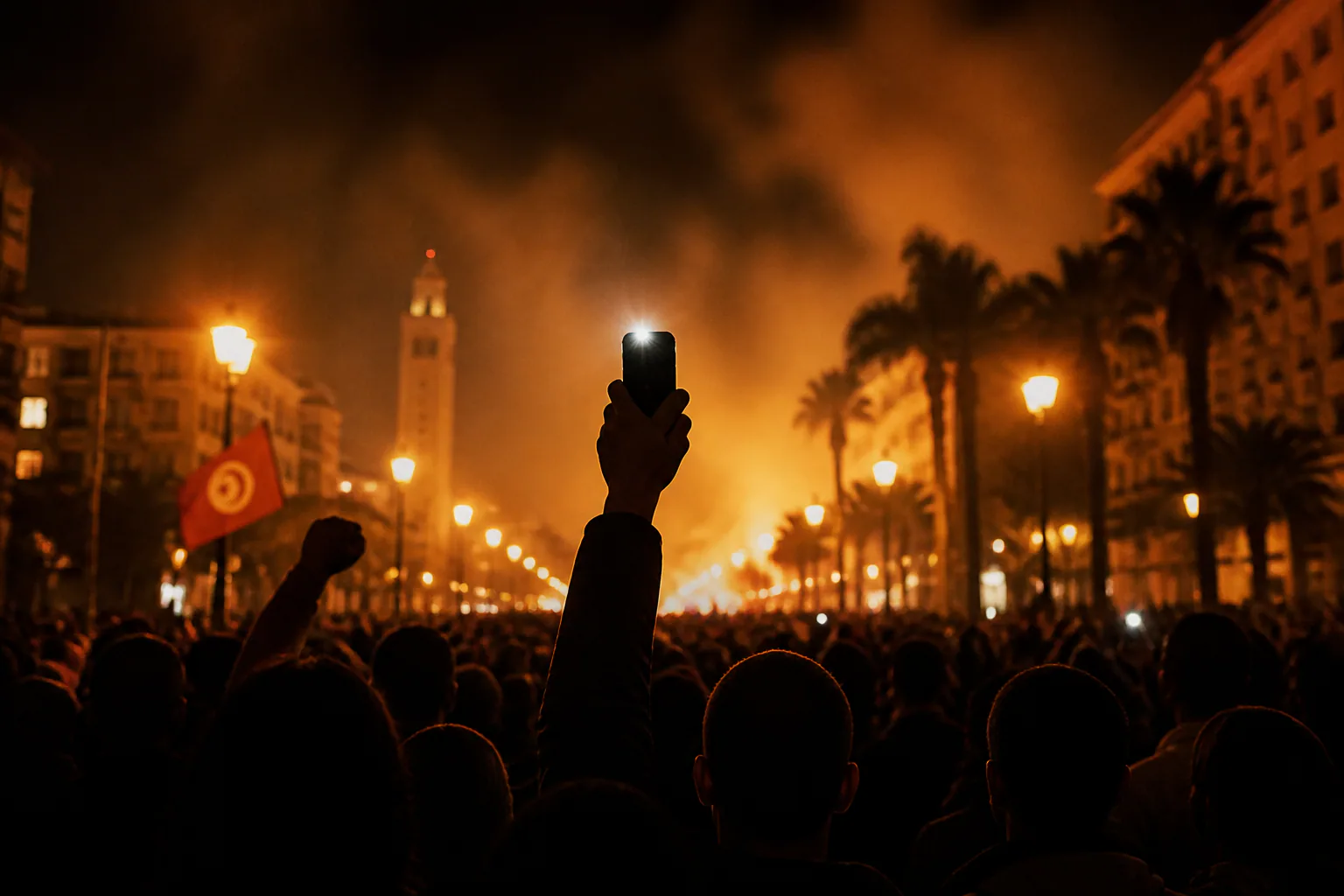
On December 17, 2010, street vendor Mohamed Bouazizi set himself on fire in Sidi Bouzid, Tunisia, after municipal officials confiscated his produce cart and, by his family's account, a policewoman slapped him — a personal humiliation that, within four weeks, produced protests large enough to end Zine el-Abidine Ben Ali's 23-year rule, the first ouster of a long-ruling Arab autocrat in what became known as the Arab Spring.
Protests spread from Tunisia's economically neglected interior to the capital along lines of preexisting labor organizing — the UGTT trade union federation's local branches provided infrastructure and legitimacy protests elsewhere lacked — while mobile phone footage and Facebook pages carried images past state media censorship to a regional audience already primed by satellite channels like Al Jazeera.
Leaked U.S. diplomatic cables published weeks earlier by WikiLeaks, describing the extravagant wealth of Ben Ali's extended family amid high youth unemployment, circulated inside Tunisia just as protests began, giving demonstrators specific, citable detail for corruption grievances that had previously been common knowledge but rarely documented in writing anyone could point to. Tunisia's own internet-freedom crackdown had, ironically, trained a generation of bloggers and activists in circumvention tools years before 2010, infrastructure that proved directly useful once mass mobilization began, since state censors who had spent years blocking dissident websites found themselves unable to keep pace with mobile video and encrypted messaging in a fast-moving crisis, an asymmetry between fixed censorship infrastructure and mobile improvisation that repeated in nearly every uprising that followed across the region.
The mechanism was contagious legitimacy without central command: once one long-ruling autocrat looked removable, the calculation facing other regimes' populations and even their own security services changed, and activists across the region shared specific tactics — square occupations, general strikes, using medical volunteers to sustain protests — without any coordinating organization, a genuinely decentralized diffusion rare in prior uprisings.
Ben Ali fled to Saudi Arabia on January 14, 2011, and Tunisia went on to hold competitive elections and adopt a new constitution in 2014, becoming the Arab Spring's rare durable democratic outcome — while similar uprisings in Libya, Syria, and Yemen produced civil war, and Egypt's produced a military-backed reversal within three years, showing the same spark did not guarantee the same ending.
Western coverage in early 2011 leaned heavily on “Twitter revolution” and “Facebook revolution” framing that overstated social media's causal role relative to labor organizing, economic grievance over youth unemployment near 30 percent, and military institutions' specific choices about whether to fire on crowds — choices that varied country to country and determined outcomes more than any platform did.
Tunisia's 2021 constitutional crisis, when President Kais Saied suspended parliament and later concentrated power through a rewritten constitution, complicated the triumphant 2011 narrative considerably, demonstrating that toppling an autocrat is a necessary but insufficient condition for durable democratic institutions — a lesson the initial coverage's focus on the dramatic ouster moment largely missed.
Mohamed Bouazizi's self-immolation in December 2010 catalyzed protests that toppled Zine El Abidine Ben Ali within weeks. A fruit vendor's death became a regional political technology: humiliation plus connectivity could threaten police states faster than parties alone.
Mohamed Bouazizi's self-immolation after a confrontation with local officials became the spark; decades of corruption, youth unemployment, and police abuse were the tinder. Ben Ali's flight to Saudi Arabia proved a dictator could fall in weeks without a classic military coup — a demonstration effect that raced across Arabic media.
Tunisia's relatively successful democratic experiment later frayed, a reminder that uprising is not consolidation. Still, 2010–2011 reset the region's political imagination: publics had seen the ceiling crack. Successor regimes elsewhere studied Tunisia to prevent, not emulate, the outcome.
Tourism and phosphate politics collided with youth expectations shaped by satellite TV and Facebook. The uprising’s speed surprised regimes that had perfected slow repression. Tunisia showed the match could light; it could not guarantee the house that followed would stand.
Later movements from Hong Kong to Sudan to Iran's 2022 protests continue to reference Tunisia's specific playbook — decentralized organizing, labor-movement infrastructure, diaspora amplification — even as each has learned, from Tunisia's subsequent decade, that removing a leader is the easy half of the problem and building institutions that outlast the crowd is the hard half.
Century Signals note: Contemporaneous Tunisian and international reporting 2010–2011; later analyses of Tunisia's transition; regional media chronologies. Editorial judgment about what still structures the present — not a comprehensive history.