Before a Waymo vehicle drives a single real mile in a new city, its software has already driven millions of simulated ones, generated by a learned model that predicts how other cars, pedestrians, and cyclists are likely to behave in situations the real fleet has never encountered. The simulation is not a video game rendering pre-set physics. It is a model that inferred those physics from data, running underneath the visible output.
A world model earns its name by generalizing beyond memorized examples to situations it was never directly trained on — inferring that an object will fall when unsupported, or that a plan's third step depends on the second completing correctly. Google DeepMind's Genie, which generates an interactive, playable environment from a single still image, demonstrates the same underlying capability in a more visible form: it never memorized that environment, it inferred a plausible one.
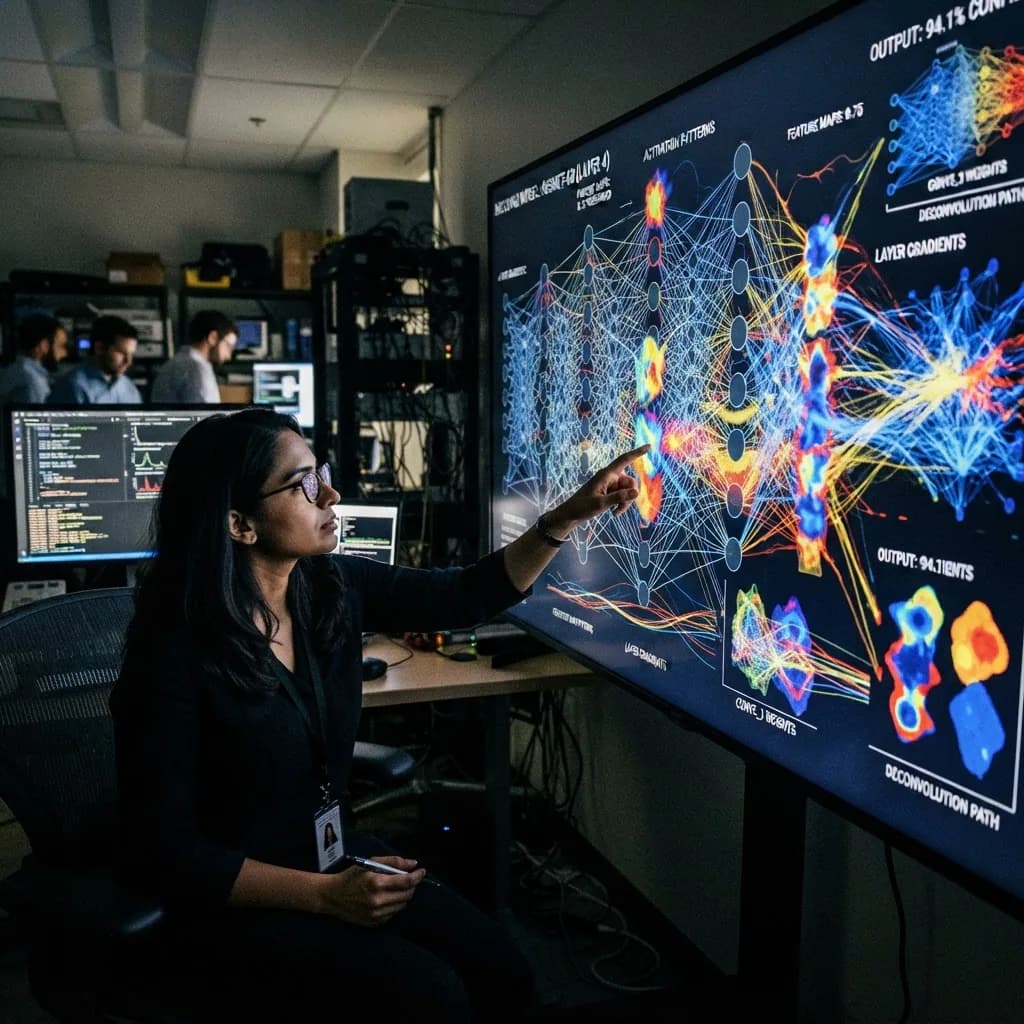
That generalization is what makes a world model useful, and it is also what makes it hard to inspect, because the representation was never written down as an explicit set of rules a person could review. A more capable world model is, by construction, a less legible one — its failure modes are novel and hard to predict in advance, unlike a hand-coded simulator whose rules a person can at least read line by line.
The risk concentrates wherever a world model's simulation gets used to make decisions with real consequences before its blind spots are mapped — autonomous driving, robotics, scientific hypothesis generation — domains where a plausible but wrong internal model can produce confidently wrong outputs that look identical to correct ones from the outside.
Interpretability research aimed specifically at world models, rather than language models generally, is becoming its own subfield, attempting to answer a narrower and more tractable question — not what a system knows broadly, but what it believes will happen next in a specific class of situation. NVIDIA's Cosmos platform, built for training robots and autonomous systems on synthetic physical scenarios, is a bet that this narrower question is answerable enough to build products on now rather than later.
The deployment pattern likely to hold up is staged exposure — letting a world model operate in simulation or in a low-stakes shadow mode before it touches anything consequential, which is precisely the discipline Waymo has built its entire safety case around. It trades speed of adoption for a chance to catch the gap between what the model has learned and what is actually true before that gap causes damage.
Building a system that models the world is a different kind of achievement than building one that answers questions about it. Waymo's simulated miles are the evidence that the industry already understands this distinction operationally, even where it has not yet solved it scientifically.