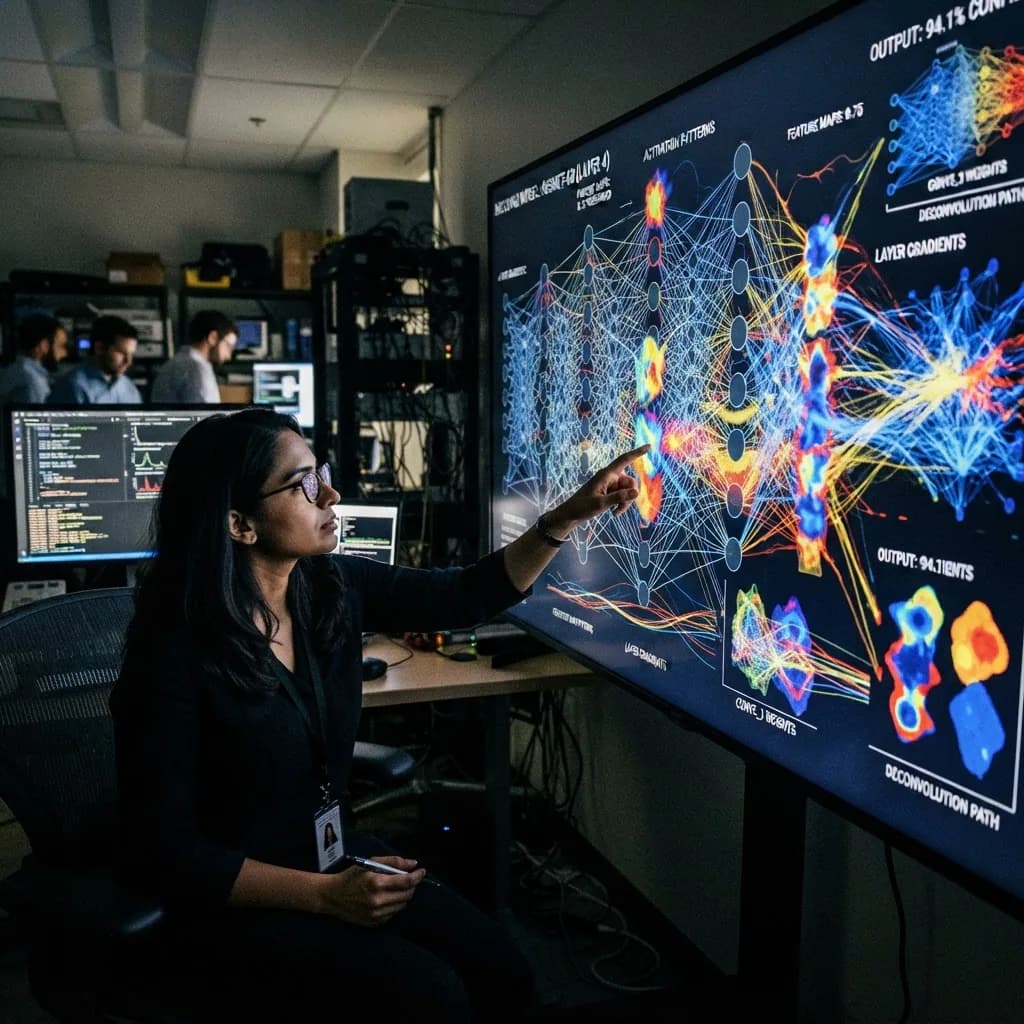
A materials scientist pulls a ranked shortlist from DeepMind's GNoME project, which in 2023 used a learned model to propose 2.2 million new candidate inorganic materials, and picks the handful worth actually attempting to synthesize this quarter. A decade ago the equivalent shortlist would have come from intuition and slow trial and error across a far smaller set of guesses.
This is the same broader pattern that won AlphaFold, DeepMind's protein-structure model, a share of the 2024 Nobel Prize in Chemistry: narrowing a search space too large to test exhaustively down to a ranked, testable shortlist. Isomorphic Labs, DeepMind's drug-discovery spinoff, is applying the identical logic to molecules aimed at pharmaceutical targets.
The mechanism works by training a model on existing experimental data to predict which untested candidates are likely to have a desired property, stability, binding affinity, conductivity, and ranking candidates before committing to the slow, expensive step of physical experimentation. This does not replace the experiment. It changes which experiments get run first.
Experimental scientists are not being replaced by this shift so much as repositioned. Their expertise increasingly sits in designing which experiments will most efficiently validate or correct a model's predictions, rather than in generating the candidate list themselves.
What breaks is the intuition that discovery is fundamentally rate-limited by the availability of good ideas. In many of these domains the limiting factor was never a shortage of hypotheses but the cost of testing them.
This also changes what counts as a result worth publishing. GNoME's 2.2 million candidates are predictions, not discoveries, until synthesized, and only a small fraction have been physically validated so far. Mistaking the ranked list for the finished result is the exact failure mode institutions with slower lab throughput are most exposed to.
AlphaFold's Nobel Prize was for solving a computational problem that had stood for fifty years. It is worth remembering that the prize went to the prediction, not to a single new drug or material that prediction has yet to produce. That gap, between a correct prediction and a validated result, is exactly where GNoME's 2.2 million candidates currently sit.