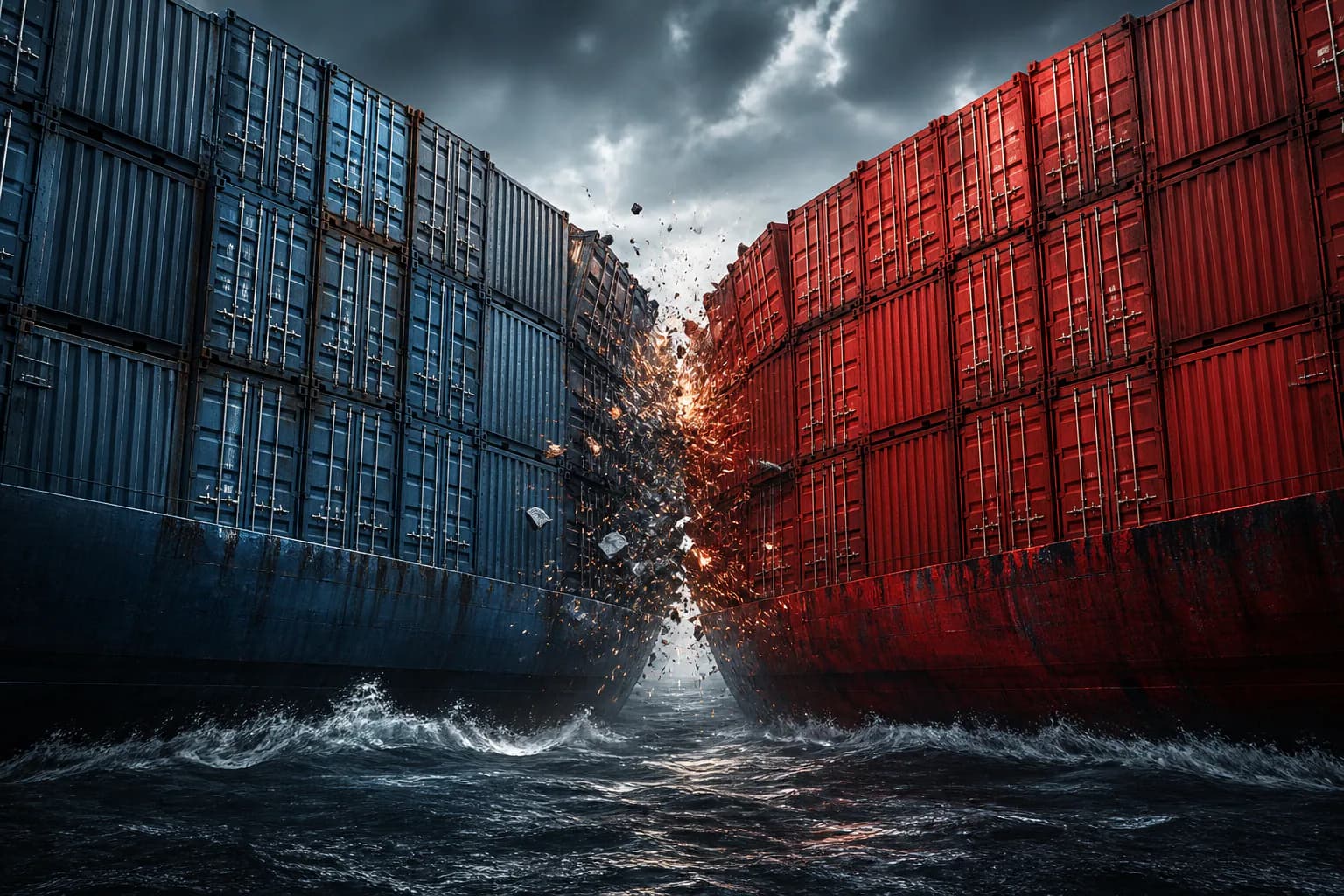
In March 2018, the Trump administration imposed tariffs of 25 percent on steel and 10 percent on aluminum imports citing national security under Section 232, followed within months by tariffs under Section 301 of the Trade Act targeting roughly $50 billion, then eventually more than $360 billion, in Chinese goods over allegations of intellectual property theft and forced technology transfer documented in a lengthy USTR investigation. China retaliated with tariffs targeting politically sensitive U.S. exports, particularly soybeans, hitting farm states that had backed Trump in 2016 and cutting U.S. soybean exports to China by more than 50 percent within a year.
The dispute's mechanism extended beyond tariffs into direct targeting of Chinese technology champions: the U.S. Commerce Department placed telecom giant Huawei on its Entity List in May 2019, restricting its access to American chip technology and software including Google's Android services, months after Canada arrested Huawei CFO Meng Wanzhou in December 2018 on a U.S. extradition request tied to Iran sanctions violations — an arrest China called explicitly political and responded to by detaining two Canadian citizens on espionage charges.
Both governments built new institutional infrastructure around the standoff: the U.S. expanded the Committee on Foreign Investment in the United States (CFIUS) under the 2018 FIRRMA Act to screen Chinese acquisitions more aggressively, while China accelerated its "Made in China 2025" self-sufficiency push in semiconductors and other strategic sectors, treating the trade war as confirmation that dependence on U.S. technology was a vulnerability rather than an efficiency to be optimized around.
American consumers and companies reliant on Chinese manufacturing absorbed most tariff costs directly, according to multiple Federal Reserve and academic studies, including research from the National Bureau of Economic Research, finding tariffs were passed through nearly dollar-for-dollar to U.S. importers rather than paid by Chinese exporters as intended. U.S. farmers received over $60 billion in federal subsidies between 2018 and 2020 to offset lost Chinese soybean and pork purchases. Chinese exporters diversified supply chains toward Vietnam and Mexico to route around tariffs, a shift that measurably boosted both countries' export volumes to the U.S. in subsequent years.
Coverage at the time treated the conflict largely as a bilateral trade dispute over deficits, underweighting its deeper character as a technology and security competition; the framing didn't fully shift toward "strategic decoupling" until Huawei's targeting and, later, the 2022 CHIPS and Science Act made clear that semiconductors, not soybeans, were the war's real center of gravity.
A Phase One deal signed in January 2020 modestly eased tensions and committed China to increased purchases of U.S. goods it ultimately did not fully meet, achieving roughly 58 percent of the pledged targets according to Peterson Institute tracking, but did not roll back the core tariff structure or resolve the technology-access disputes underlying the conflict. The Biden administration kept most Trump-era tariffs in place and added its own sweeping export controls on advanced semiconductors and chipmaking equipment in October 2022, extending rather than reversing the decoupling trajectory.
The second Trump administration escalated further still, imposing a fresh round of tariffs in 2025 that pushed the average U.S. tariff rate on Chinese goods to its highest level in nearly a century, underscoring that the 2018 opening moves had become a permanent structural feature rather than a temporary negotiating posture, regardless of which party controlled the White House.
Section 301 tariffs, retaliatory lists, and agricultural hostage-taking replaced decades of WTO-centric dispute habits with bilateral tariff brinkmanship. Firms redesigned supply chains toward Vietnam, Mexico, and dual-sourcing — 'China plus one' as board strategy.
Phase One purchases papered over structural fights on subsidies and tech transfer. Export controls later proved sharper than tariffs for semiconductors. The trade war normalized economic statecraft as routine great-power competition rather than emergency exception.
Farmers received aid patches; manufacturers received tariff exclusion puzzles. MBA curricula added geopolitical risk modules that used to be elective color. Decoupling is incomplete by design — too expensive to finish, too risky to reverse entirely.
The trade war's lasting inheritance is a bipartisan U.S. consensus, unusual on almost any other issue, that economic interdependence with China carries strategic risk requiring active government intervention — a premise that now underwrites chip export controls, subsidized domestic manufacturing, and supply-chain "friend-shoring" policies across both parties.
Century Signals note: USTR Section 301 reports; tariff schedule announcements; trade-flow and supply-chain reporting. Editorial judgment about what still structures the present — not a comprehensive history.