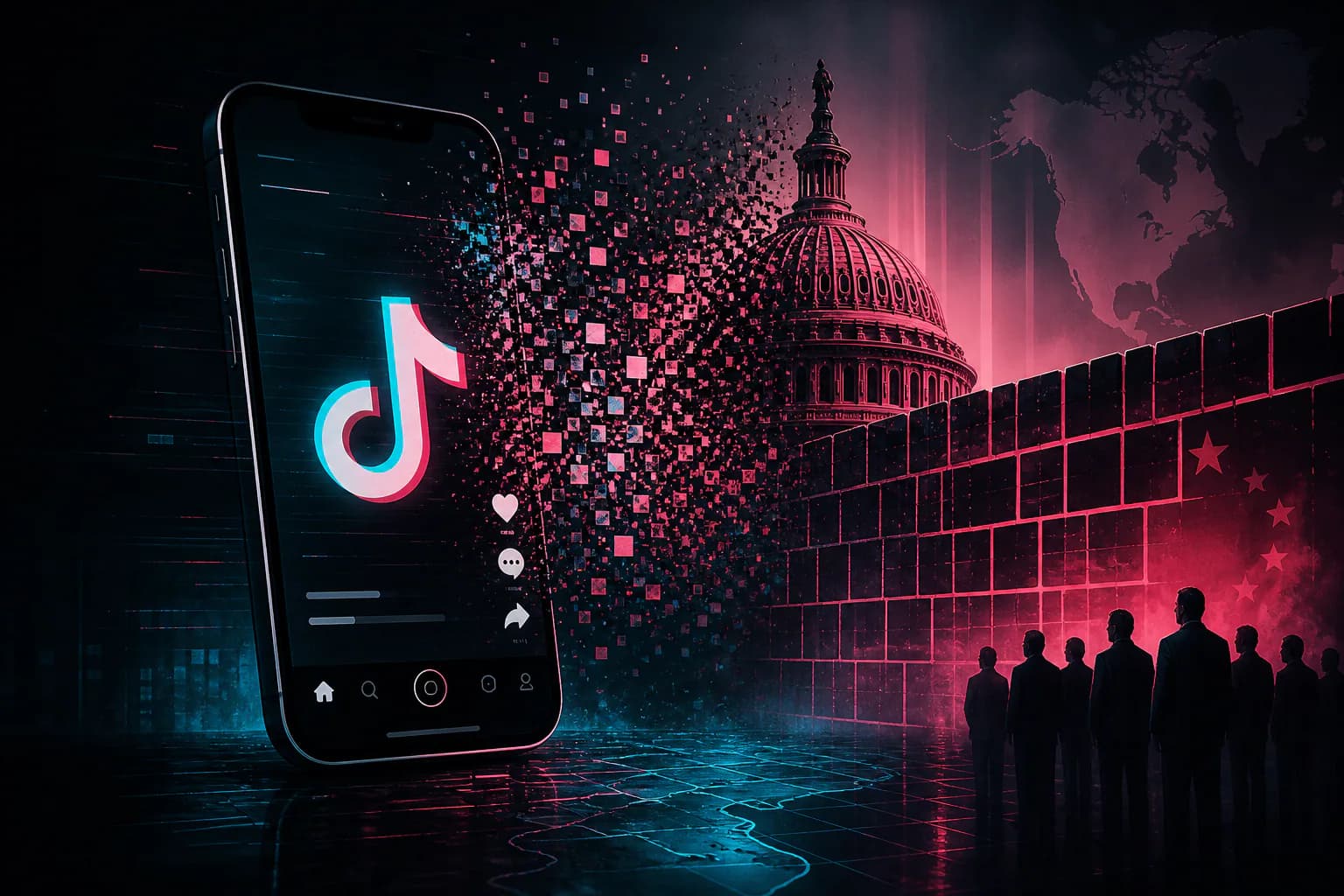
President Biden signed legislation in April 2024, folded into a broader foreign-aid package, giving ByteDance, TikTok's Chinese parent company, roughly nine months to divest the platform's U.S. operations or face removal from American app stores and web-hosting services. The law reflected years of bipartisan national-security concern, building on a Trump-era 2020 executive order attempt to force divestment that had failed in court, this time backed by explicit congressional statute rather than executive action alone.
The mechanism Congress relied on was data-access and algorithmic-influence risk rather than any documented specific harm: lawmakers and intelligence officials argued that Chinese law could compel ByteDance to hand over American user data or manipulate TikTok's recommendation algorithm for influence operations, a risk profile distinct from — and, backers argued, more structurally dangerous than — ordinary data-privacy violations that other social platforms also commit. TikTok sued to block the law, arguing it violated the First Amendment rights of the platform and its roughly 170 million American users.
The Supreme Court heard oral arguments on an expedited basis and ruled unanimously on January 17, 2025, upholding the law as a valid national-security measure that did not unconstitutionally target speech, reasoning that the law addressed foreign ownership and data control rather than content itself. TikTok went dark for U.S. users for several hours on January 19, 2025, the day before the law's enforcement deadline, displaying a message blaming the ban before restoring service after President-elect Trump signaled he would delay enforcement once in office.
Trump signed an executive order shortly after taking office in January 2025 delaying enforcement, having reversed his earlier 2020 stance against the app after crediting it partly with reaching younger voters during his 2024 campaign; the delay left TikTok operating in legal limbo while ByteDance, the Trump administration, and potential U.S. buyers including Oracle continued negotiating structures that could satisfy the divestment requirement without fully severing ByteDance's underlying technology.
Coverage through the fight emphasized the political spectacle — a president who once sought to ban the app now protecting it — over the harder structural question the case actually resolved: that the U.S. government could, with a unanimous Supreme Court's blessing, force divestment of a major consumer platform on national-security grounds tied to foreign ownership, a precedent with implications well beyond TikTok for any foreign-owned technology platform reaching significant U.S. scale.
Free-speech advocates and some technology-policy scholars who otherwise supported stronger data-privacy regulation split with national-security hawks over the case, arguing that singling out one platform by name for legislative divestment, rather than passing comprehensive data-broker or privacy legislation covering all companies regardless of ownership, set an uncomfortably narrow and nationality-based precedent for regulating speech platforms.
Content creators and small businesses that had built revenue streams on TikTok, an economy studies estimated supported billions of dollars in creator and merchant income, faced sustained uncertainty through the delay period, while competitors including Instagram Reels and YouTube Shorts absorbed users and advertiser spending during the periods of outage risk and legal ambiguity.
ByteDance's TikTok became a U.S. national-security object: data access, recommendation influence, and reciprocal platform bans. Legislative forced-sale attempts, court stays, and creator lobbying turned a consumer app into a sovereignty dispute. Other countries watched the template.
Younger cohorts' news diets migrated to short video regardless of corporate parent — a media fact that outruns any single ban. Divestiture debates continue to ask whether algorithms and data can be meaningfully separated from ownership. Soft power now ships as For You pages.
Creators became lobbyists; national-security lawyers became product managers. Teen culture and great-power rivalry rarely shared a docket before this app. Whatever the ownership outcome, short-video attention infrastructure is now treated as strategic terrain.
Allied capitals copied pieces of the U.S. debate without identical legal tools. Advertisers hedged campaigns against sudden bans. Culture apps had been treated as toys; this one forced legislatures to admit toys can be infrastructure.
The case's inheritance is precedential and geopolitical: the divestment framework — distinguishing foreign platform ownership as a distinct, addressable national-security category separate from ordinary antitrust or privacy law — has since been cited in policy discussions about other Chinese-owned apps and hardware, cementing platform ownership nationality as a permanent axis of U.S. technology policy rather than a one-time TikTok-specific dispute.
Century Signals note: U.S. legislative and court materials on TikTok; contemporaneous national-security and creator-economy reporting; allied-country policy responses. Editorial judgment about what still structures the present — not a comprehensive history.