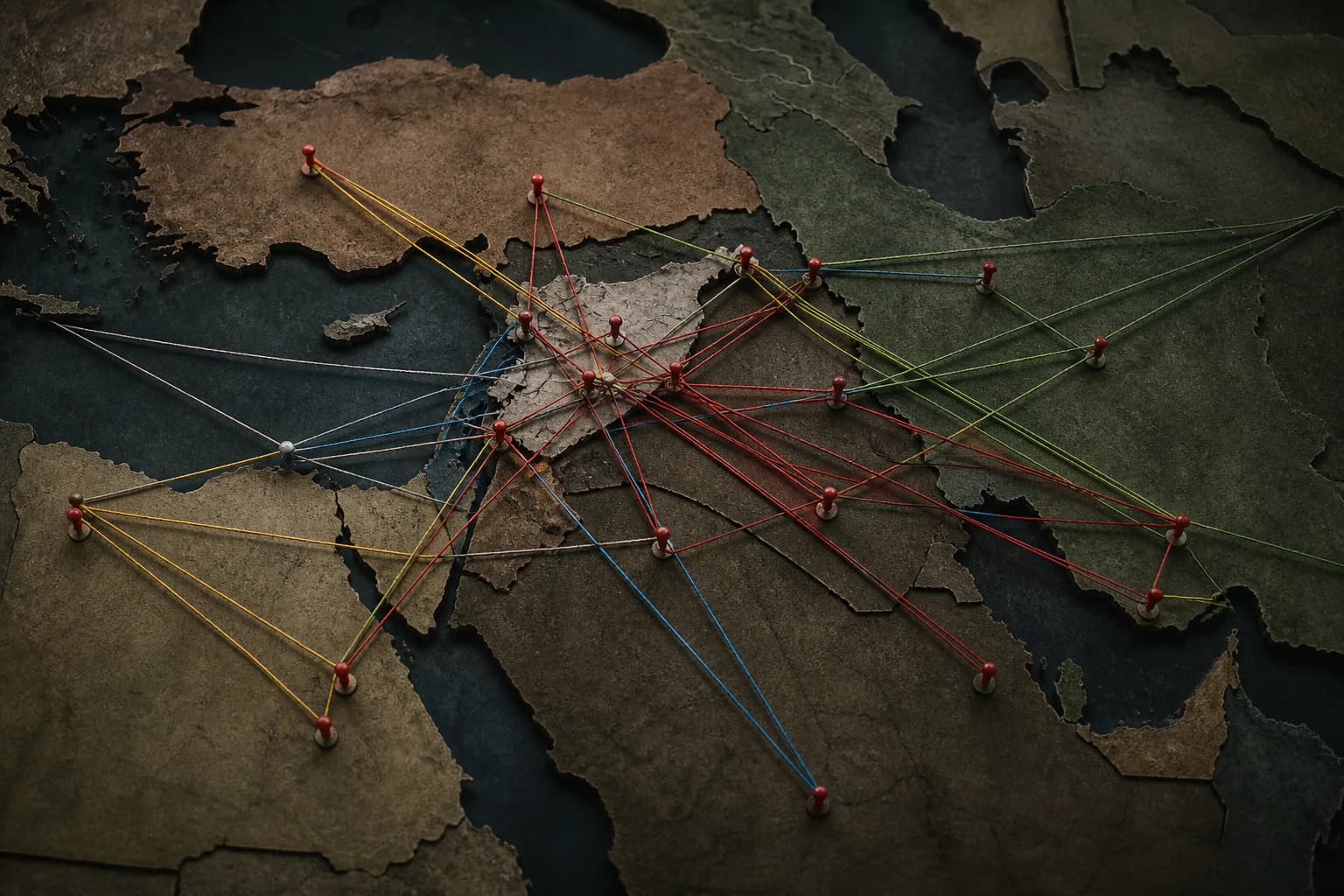
By March 2012, a year after protests began in Deraa against President Bashar al-Assad's government, peaceful demonstrations had hardened into armed insurgency; the Free Syrian Army, formed by defected officers, held territory in contested cities while Assad's forces used artillery against populated neighborhoods, and UN-Arab League envoy Kofi Annan's ceasefire plan, announced that month, collapsed within weeks, signaling diplomacy could not keep pace with the conflict's militarization.
What distinguished Syria from other Arab Spring uprisings was the speed and depth of external involvement: Iran and Hezbollah provided the Assad government fighters and financing to prevent the fall of a critical regional ally, Gulf states and Turkey funneled arms and support to various rebel factions with competing agendas, and Russia used its UN Security Council veto repeatedly to block resolutions, turning a domestic uprising into a proxy battlefield within its first year.
The mechanism was state collapse with permeable borders: as Assad's control fractured, ungoverned space allowed the Islamic State to expand from Iraq into eastern Syria by 2013, while refugee flows — eventually more than 6.8 million people displaced abroad, according to UNHCR figures — strained Lebanon and Jordan's public services and reshaped European migration politics when large numbers of Syrian refugees reached Germany, Sweden, and other EU states in 2015.
Assad ultimately retained power for over a decade with Russian military intervention beginning in 2015 tipping the war's momentum decisively; rebel factions and civilian populations in besieged cities like Aleppo and Homs bore the war's heaviest costs, with the UN eventually stopping its official death toll count near 400,000 given the impossibility of precise verification. The chemical weapons attacks Assad's forces conducted, most notably near Damascus in August 2013, crossed a “red line” President Obama had drawn but did not, in the end, trigger the U.S. military response initially threatened.
Turkey alone eventually hosted more than 3.5 million registered Syrian refugees, the largest refugee population of any country in the world for most of the decade, while successive rounds of UN-brokered Geneva peace talks, beginning in 2012, failed repeatedly to produce a political transition, leaving military facts on the ground rather than diplomacy to determine the war's actual trajectory. Russia vetoed Syria-related Security Council resolutions more than a dozen times over the following decade, each veto reinforcing the point that great-power patronage, not battlefield outcomes alone, would decide how long the war could continue.
Early coverage tracked battle lines, defections, and atrocity videos circulated on social media, often the only documentation available from besieged areas; longer analyses of the limits of humanitarian intervention, the UN Security Council's structural paralysis when a permanent member backs one side, and the specific failure of chemical-weapons deterrence arrived more slowly and less prominently than the daily casualty coverage.
The war produced what analysts call a frozen conflict with live fire — de facto partition among government, Kurdish, Turkish-backed, and until 2019 Islamic State-controlled zones — that persisted for over a decade until Assad's own sudden fall to a rebel offensive in December 2024, a collapse most analysts had stopped expecting after years of stalemate.
What began as protest after Daraa became a multi-sided war drawing in Iran, Russia, Turkey, Gulf funders, Hezbollah, and U.S.-backed factions. Chemical-weapons red lines, refugee flows into neighboring states, and the rise of jihadist spoiler groups internationalized a domestic uprising.
Aleppo's fall and Idlib's enduring limbo showed how stalemate can be a strategy. Reconstruction politics later traded normalization for leverage. The regional order that emerged treats Syria less as a sovereign transition than as a permanently contested buffer.
Proxy funding turned neighborhoods into overlapping front lines with incompatible endgames. Refugee hosts bore costs Western capitals debated as headlines. Regional order after Syria is less a settlement than a set of frozen bargains waiting for the next shock.
Captagon trafficking and refugee host fatigue became secondary wars with primary political effects. Neighboring capitals bargain over Syria as geography and as burden. Regional order here is managed instability.
European migration politics, the rise of populist parties partly organized around refugee resistance, war-crimes tribunal debates over accountability for chemical attacks, and great-power competition dynamics between Russia, Iran, Turkey, and the U.S. across the wider Middle East all still carry Syria's imprint as the clearest example of how a civil war becomes, structurally, everyone's war.
Century Signals note: UN and OPCW materials; contemporaneous war reporting from major outlets; ICRC/UNHCR displacement data. Editorial judgment about what still structures the present — not a comprehensive history.