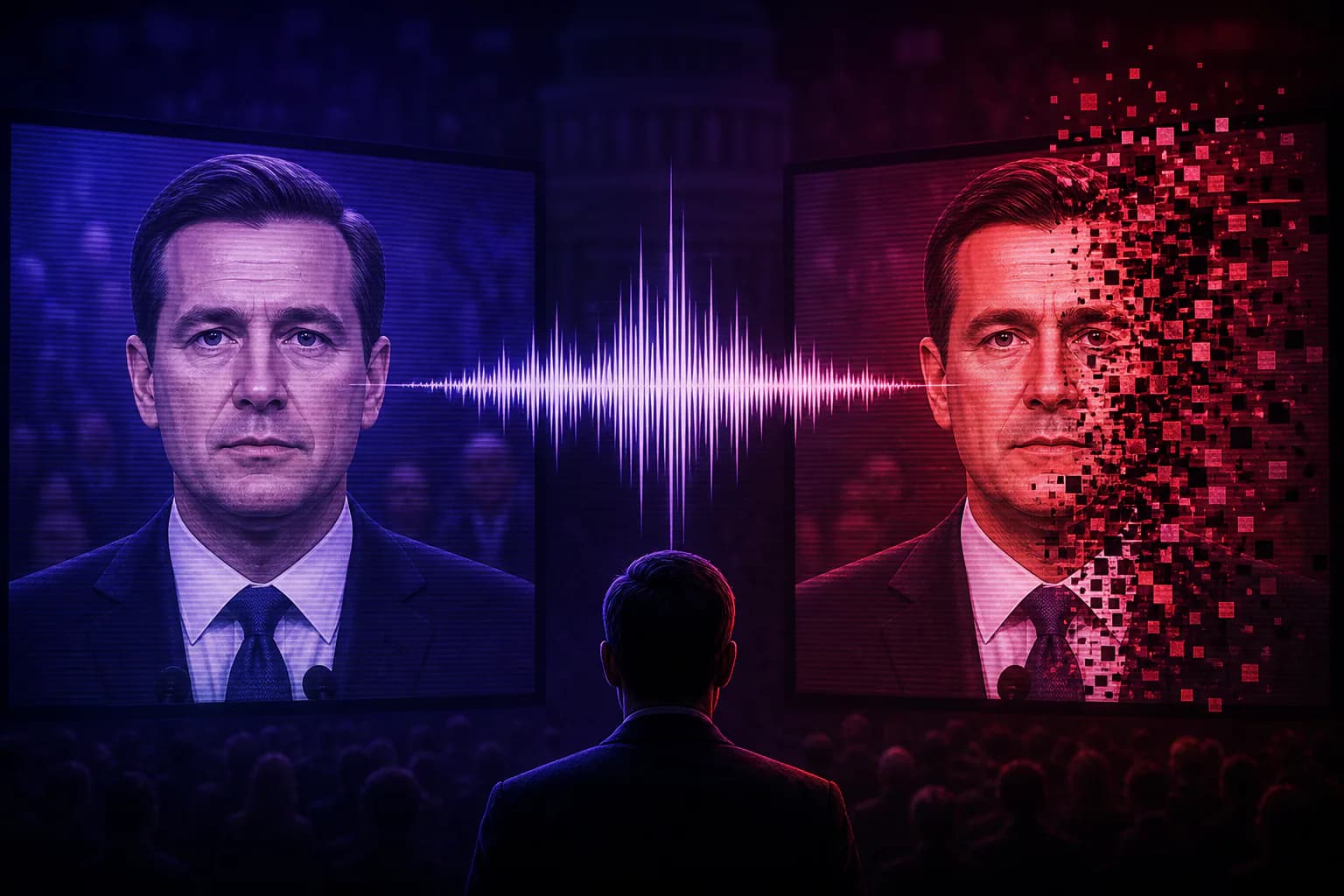
Days before New Hampshire's January 2024 presidential primary, thousands of voters received a robocall featuring an AI-generated voice closely mimicking President Biden, telling recipients to 'save your vote for the November election' and not to vote in the primary. The call was traced to political consultant Steve Kramer, working for a rival Democratic campaign, who later said he had commissioned the deepfake to draw attention to AI's risks to elections — an explanation that did not spare him prosecution.
The mechanism the episode exposed was regulatory: no law explicitly banned AI-generated voice cloning in political robocalls at the time, but the Federal Communications Commission determined the call violated existing prohibitions on caller-ID spoofing, since the call falsely displayed a number associated with a New Hampshire political operative to mask its origin. The FCC fined Kramer $6 million in May 2024 and separately ruled that AI-generated voices in robocalls fall under the Telephone Consumer Protection Act's existing restrictions, closing a gap using decades-old telecom law rather than new AI-specific legislation.
Synthetic political media was not confined to the U.S. that year: an AI-generated audio clip purporting to capture a Slovak opposition leader discussing vote-rigging spread in the closing days of Slovakia's September 2023 parliamentary election, too close to the vote for fact-checkers to debunk it broadly before polls closed. Deepfake audio and video of Indian Prime Minister Narendra Modi and Pakistani politicians circulated during their respective 2024 election cycles, in some cases used by campaigns themselves to translate candidate speeches into multiple regional languages using AI-cloned voices, blurring the line between deceptive use and legitimate campaign tooling.
Voters and election officials in affected races bore the direct cost of the resulting uncertainty: distinguishing authentic from synthetic media required specialized forensic tools that most local election offices and news outlets lacked, and the 'liar's dividend' — public figures dismissing genuine incriminating audio or video as AI-generated — emerged as a documented secondary harm, letting real misconduct hide behind a plausible deniability that did not exist before synthetic media became widely credible.
Coverage emphasized the novelty of the New Hampshire robocall as a warning shot for the 2024 U.S. general election specifically, and predictions of a deepfake-dominated November proliferated. The predicted deepfake-driven collapse of the U.S. general election's information environment did not fully materialize on the scale forecast; the more consequential and underweighted trend was the steady, less dramatic erosion of default trust in any unverified audio or video clip, regardless of whether it was faked.
Election administrators, rather than national campaigns, absorbed much of the practical burden: state and local election officials fielded a growing volume of voter inquiries about the authenticity of viral clips involving polling-place instructions or candidate statements, a task few election offices had budget or training to handle before 2024 made it a routine part of election administration.
Platforms and AI developers accelerated provenance tooling in response: OpenAI, Google, and Meta expanded content-labeling commitments for AI-generated media through 2024, and the Coalition for Content Provenance and Authenticity (C2PA) standard, backed by Adobe, Microsoft, and camera manufacturers, gained adoption as a technical mechanism for embedding tamper-evident origin metadata into images and video at the point of capture or generation.
Cheap voice clones, face swaps, and LLM-generated persuasion content entered electioneering toolkits faster than watermarking standards. Platforms and election officials issued guidance that often lagged viral incidents. Authenticity became a scarce civic resource.
Detection arms races and media-literacy campaigns are partial answers; procedural hardening — slower viral amplification, verified candidate channels — may matter more. The structural shift is epistemic: publics must assume some audiovisual political content is synthetic until proven otherwise.
Local races may be more vulnerable than presidential ones: less scrutiny, cheaper fakes. Newsrooms ration verification labor under flood conditions. Democracies that cannot afford authenticity infrastructure will import someone else’s epistemic chaos.
The episode's durable inheritance is regulatory and infrastructural rather than any single election outcome: the FCC's robocall ruling established that existing telecom and election law could be extended to cover AI-generated impersonation without waiting for new statutes, while the broader push toward content provenance standards that began accelerating in 2024 became a permanent, ongoing arms race between generation and detection rather than a problem any single ruling or standard fully resolved.
Century Signals note: Election-integrity and platform transparency reports; contemporaneous deepfake incident journalism; NIST/watermarking research coverage. Editorial judgment about what still structures the present — not a comprehensive history.