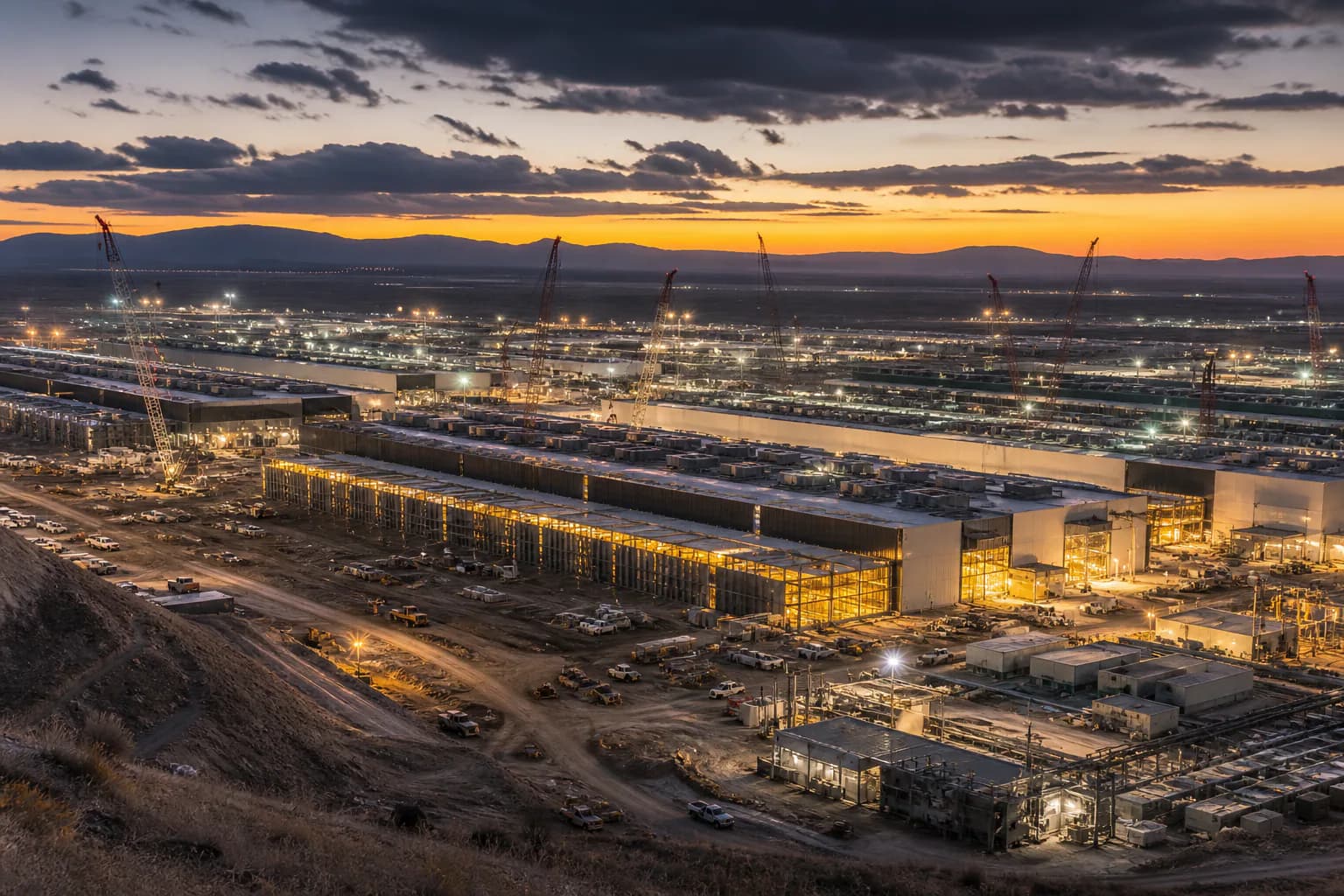
OpenAI, SoftBank, and Oracle announced the Stargate joint venture on January 21, 2025, President Trump's first full day in office, pledging to invest up to $500 billion over four years building AI data center infrastructure across the United States, with an initial $100 billion committed for immediate deployment and a first flagship site under construction in Abilene, Texas. Trump appeared alongside OpenAI CEO Sam Altman, SoftBank's Masayoshi Son, and Oracle's Larry Ellison at the White House announcement, explicitly framing the initiative as domestic industrial policy rather than a purely private business decision.
The mechanism behind Stargate's structure reflected how thoroughly AI infrastructure had outgrown any single company's balance sheet: training and running frontier AI models at scale requires data centers with power demands comparable to small cities, and no single firm — not even OpenAI or Microsoft — could finance that buildout alone, pushing the industry toward joint ventures pooling capital from technology companies, sovereign-linked investment vehicles, and private equity. The UAE-backed investment firm MGX also joined as a funding partner, drawing scrutiny over foreign sovereign capital's role in critical U.S. AI infrastructure.
Elon Musk, who had co-founded OpenAI before departing acrimoniously in 2018 and remained a vocal critic, publicly questioned within days of the announcement whether the participating companies actually possessed the committed capital, prompting Altman to respond directly on social media — an unusually public rift playing out between two of the industry's most prominent figures over the credibility of a $500 billion pledge.
Local communities near planned Stargate sites, beginning with Abilene, faced immediate practical questions the announcement itself did not resolve: data centers at this scale require enormous water for cooling and electricity that can strain regional grids built for far smaller industrial loads, and Texas grid operator ERCOT, still recovering its reputation after 2021's deadly winter grid failure, faced new pressure to accommodate massive new baseload demand on an accelerated timeline.
Coverage of the announcement emphasized the headline dollar figure and the political spectacle of a new president appearing alongside tech executives on his first day. It underweighted the harder infrastructure questions — power procurement, water rights, permitting timelines, and grid interconnection queues that in many U.S. regions already ran multiple years long — that would determine whether the pledged capital could actually be deployed on the announced schedule.
Skeptics noted that OpenAI itself was, by public reporting, not yet profitable and dependent on continued external fundraising, raising questions about how a company still burning cash on model training could simultaneously anchor a $500 billion infrastructure commitment — a tension Altman addressed by emphasizing that partners including SoftBank and Oracle, not OpenAI alone, would carry the bulk of the direct capital financing.
Through 2025, Stargate-linked construction proceeded at the Abilene site and additional locations were announced, while competing hyperscalers — Microsoft, Google, Amazon, and Meta — each separately announced their own AI data center capital expenditure plans exceeding tens of billions of dollars annually, treating Stargate less as a singular initiative than as confirmation that the entire industry had entered a capital-intensive infrastructure race requiring policy support rather than pure private financing.
Multi-hundred-billion-dollar AI infrastructure announcements — data centers, power deals, chip supply — reframed AI as an energy and construction problem as much as a software one. Utilities and landowners became AI stakeholders. Capex guidance from major clouds confirmed the arms race is physical.
Local permitting, water use, and grid interconnection queues are now AI bottlenecks. Geopolitical pairing of capital consortia follows. Stargate-scale projects make 'compute' a visible industrial policy object on the landscape, not an invisible cloud metaphor.
Construction trades and turbine manufacturers entered AI supply chains beside GPU makers. Community hearings about data centers now sound like fights over factories. Intelligence scaled to industrial park dimensions — with all the politics that implies.
The initiative's lasting inheritance is the normalization of direct executive-branch involvement in AI infrastructure siting and financing, a departure from the more arms-length relationship between government and computing infrastructure that characterized earlier internet-era buildouts; energy and grid policy discussions at the state and federal level now routinely treat AI data center demand as a named planning variable rather than an unanticipated shock, a direct legacy of Stargate's framing as declared national industrial strategy.
Century Signals note: Corporate and White House-era infrastructure announcements; utility and data-center reporting; hyperscaler capex disclosures. Editorial judgment about what still structures the present — not a comprehensive history.