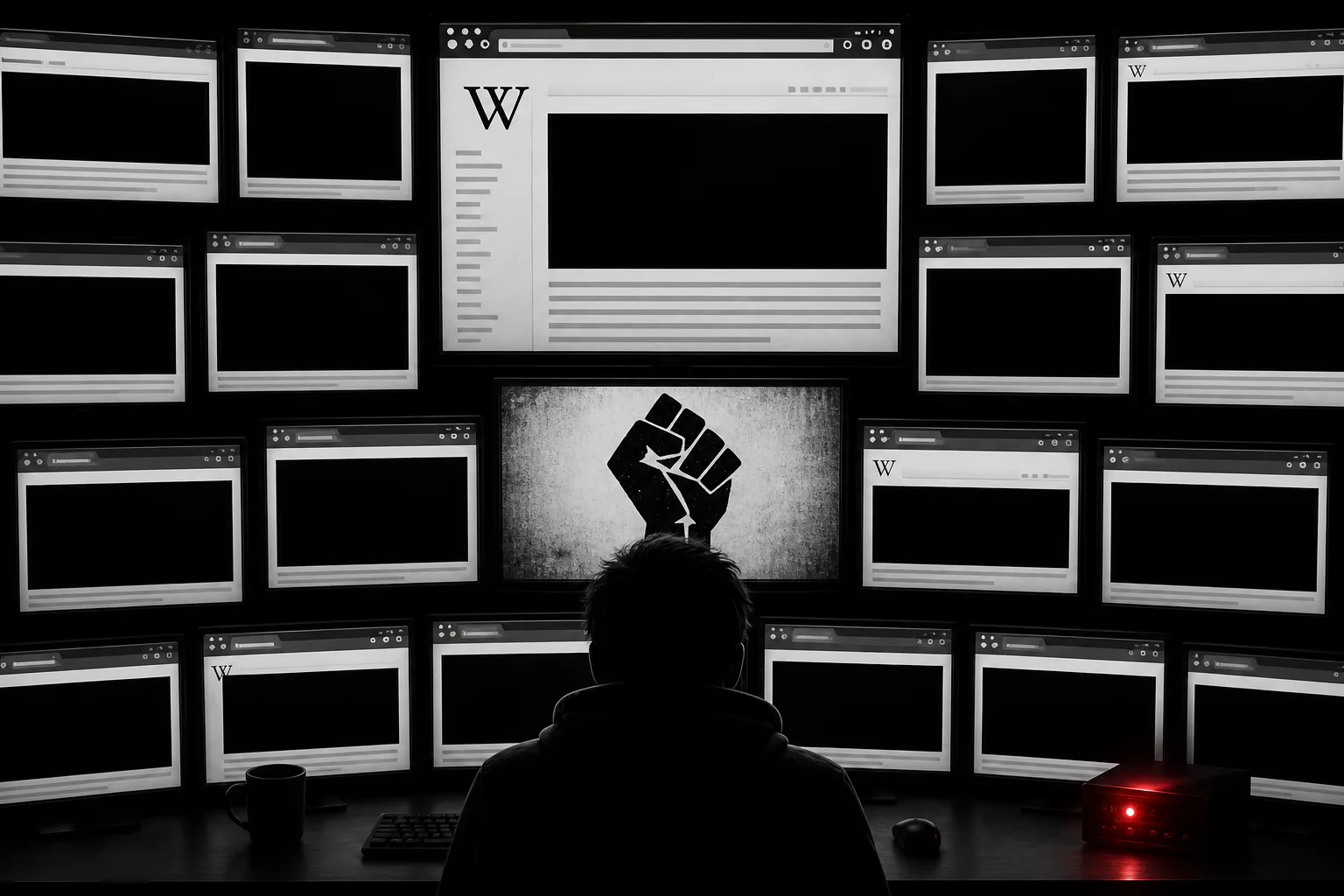
On January 18, 2012, Wikipedia went dark for 24 hours, Reddit blacked out its content, and Google placed a censor bar over its logo on the homepage, joining thousands of sites in coordinated protest against two pending bills — the Stop Online Piracy Act in the House and the PROTECT IP Act in the Senate — that would have let the Justice Department seek court orders forcing ISPs to block access to sites accused of hosting pirated content.
The bills had entered Congress with broad, bipartisan support and heavy backing from the Motion Picture Association and the recording industry, targeting foreign piracy sites but drafted broadly enough that critics, including major tech companies and internet engineers, argued the DNS-blocking mechanism would fragment how the internet's naming system worked globally and expose ordinary platforms to liability for user-uploaded content they couldn't fully police.
The mechanism was collective action delivered through default infrastructure rather than a march: when Wikipedia, an unremarkable daily tool for millions, displayed a blackout screen instead of an encyclopedia entry, users encountered the abstract legislative fight as a broken tool in the middle of homework or research, converting an obscure copyright bill into an estimated 8 million emails and 3 million tweets directed at Congress within a single day, according to figures cited afterward by participating organizations.
Within a week, both bills lost sponsors and were shelved indefinitely by their own authors, including SOPA sponsor Lamar Smith and PIPA sponsor Patrick Leahy; the entertainment industry, which had assumed the bills' broad bipartisan co-sponsorship guaranteed passage, lost a legislative fight decisively for the first time against a coordinated technology-industry and grassroots response, while the technology industry discovered its collective lobbying capacity for the first time at this scale.
Programmer and activist Aaron Swartz, a Reddit co-founder, was among the organizers who helped build the coalition opposing the bills through the group Demand Progress; his subsequent 2011 prosecution for downloading academic articles from JSTOR, and his suicide in January 2013 while facing decades of potential prison time, became a separate but related rallying point for the same open-internet coalition that had defeated SOPA a year earlier, deepening the movement's suspicion that federal prosecutors and content industries were, functionally, allied against the open web's looser norms.
Coverage before the blackout largely accepted the entertainment industry's piracy-loss framing at face value; after January 18, discussion incorporated concerns from internet engineers about DNS security, from startups about compliance costs that would favor incumbents able to afford content-moderation staff, and from civil-liberties groups about takedown standards broad enough to remove legitimate speech alongside infringing content.
The European Union's own Article 13/17 copyright directive fight in 2018–2019, and subsequent disputes over platform safe-harbor reform in the U.S. and EU Digital Services Act negotiations, all replayed elements of the SOPA fight's coalition, with technology platforms and civil-liberties groups again organizing against content industries, though later fights produced narrower tactics as governments learned to avoid single dramatic votes.
Wikipedia's blackout and coordinated site protests taught Congress that internet constituencies could mobilize faster than Hollywood lobbyists expected. DNS-blocking and intermediary-liability proposals died amid fears of breakage and censorship overreach. The tech industry discovered advocacy muscle it later used on net neutrality and privacy fights.
Rights-holders did not vanish; they shifted toward site-blocking abroad, Content ID-style systems, and trade agreements. The 2012 battle remains the template for 'internet blackout' politics — and a warning that copyright enforcement design can become a general-purpose speech-control debate overnight.
Hollywood did not stop seeking enforcement tools; it learned to avoid bills that unify engineers against them. Technologists learned lobbying is product work. The blackout’s legend still gets cited whenever platforms want to look like civil society.
Site-blocking proposals returned in other countries with quieter politics. The U.S. fight’s legend still raises the cost of blunt DNS remedies. Copyright enforcement learned to prefer platform cooperation over congressional spectacle.
The open web's practical lesson from January 2012 — that interrupting routine, widely used tools converts abstract policy into felt personal stakes faster than any lobbying campaign — remains a template political organizers across causes have tried, with limited success, to replicate; SOPA and PIPA's defeat proved to be a high point of coordinated tech-industry political power that later fights over antitrust and content moderation have struggled to match.
Century Signals note: Congressional hearing records on SOPA/PIPA; contemporaneous blackout coverage; later analyses of copyright enforcement strategies. Editorial judgment about what still structures the present — not a comprehensive history.