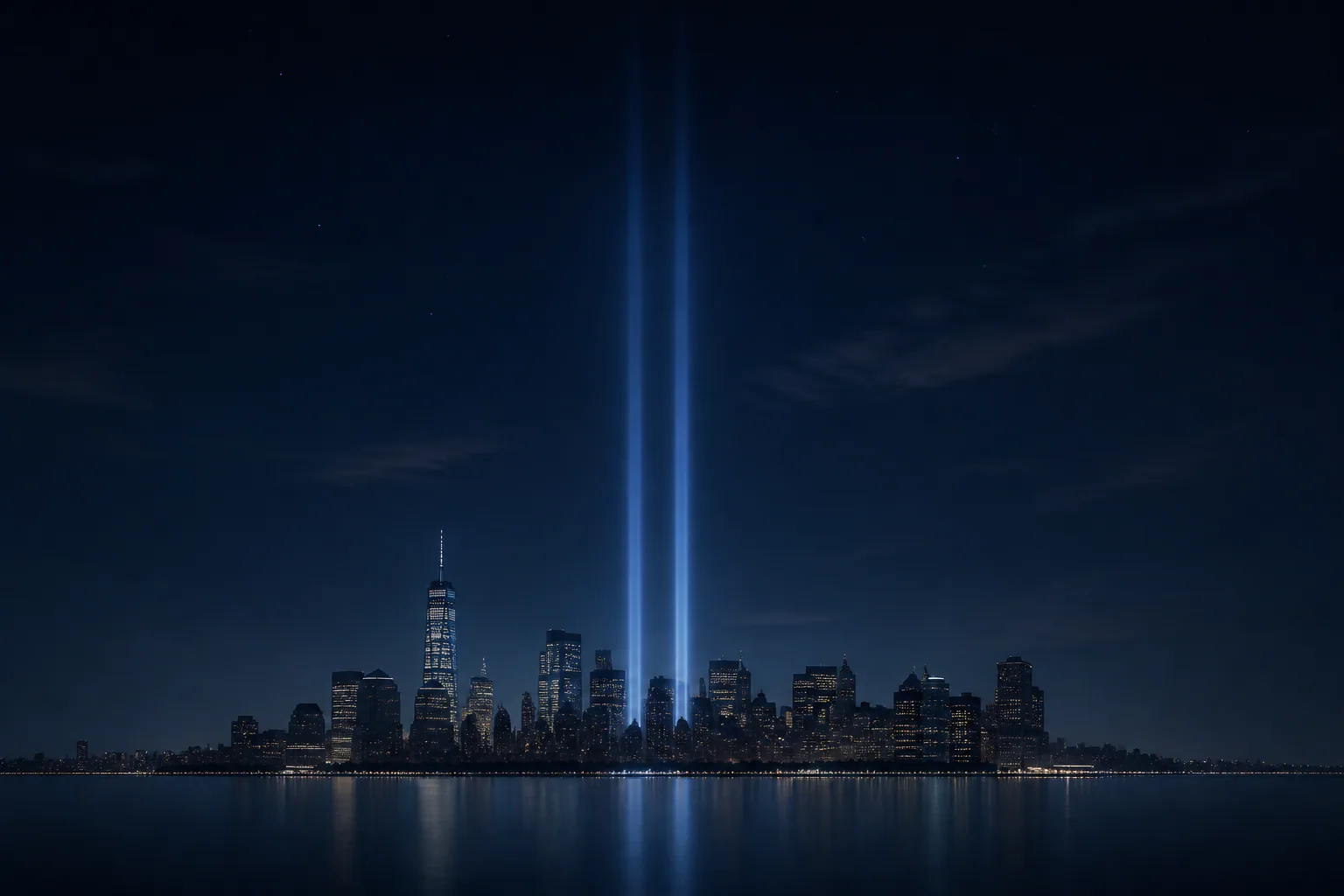
Nineteen hijackers seized four commercial aircraft on the morning of September 11, 2001, crashing American Airlines Flight 11 and United Airlines Flight 175 into the World Trade Center's twin towers, American Airlines Flight 77 into the Pentagon, and forcing United Airlines Flight 93 into a field near Shanksville, Pennsylvania, after passengers stormed the cockpit. Nearly 3,000 people died. Television carried the towers' collapse live to a global audience, and the first news cycle was, understandably, dominated by grief, disbelief, and calls for retaliation.
The structural response rebuilt everyday infrastructure with unusual speed. Congress created the Transportation Security Administration under the Aviation and Transportation Security Act that November, federalizing airport screening within a year and replacing the low-bid private contractors who had staffed checkpoints beforehand. The USA PATRIOT Act, signed October 26, 2001, just forty-five days after the attacks, lowered legal barriers to surveillance and expanded information-sharing between the FBI, CIA, and NSA in ways civil-liberties groups had opposed for years under calmer circumstances.
The mechanism was normalization: procedures introduced under acute threat — shoe removal after Richard Reid's failed December 2001 shoe-bomb attempt aboard a Paris-to-Miami flight, liquid restrictions imposed after a 2006 transatlantic liquid-explosives plot was disrupted in London, no-fly watchlists, and fusion centers linking local police departments to federal intelligence databases — persisted as background friction long after the acute threat had passed, because unwinding a security procedure carries more political risk for an official than simply keeping it in place indefinitely.
Airport-security contractors, biometrics vendors, and a growing homeland-security-industrial base of consultancies and technology firms gained durable, recurring federal revenue streams. Ordinary travelers, immigrants, and Muslim Americans in particular absorbed the costs: longer lines, watchlist misidentification cases that took years to correct, and a surveillance apparatus that outlived by two decades the specific war it was originally built to fight.
Coverage in the following months favored the frame of civilizational conflict and national resilience, epitomized by President Bush's September 20 address to Congress framing the response as a war on terror without national borders. It gave comparatively little attention to how permanently travel, financial-compliance rules aimed at money laundering under the PATRIOT Act's Title III, and the balance between civil liberties and executive power would shift for millions of people who had no connection whatsoever to the plot.
The bipartisan 9/11 Commission's 2004 report catalogued specific intelligence failures — including missed communications between the CIA and FBI about hijacker Khalid al-Mihdhar — that let the plot proceed undetected; several of its recommendations, including the creation of a National Counterterrorism Center and a Director of National Intelligence position, remain the scaffolding of U.S. intelligence coordination today.
The wars that followed — Afghanistan beginning in October 2001, Iraq in March 2003 — absorbed trillions in later budget tallies and reshaped a generation of American foreign policy, but the quieter change was domestic procedure. Authorization for Use of Military Force resolutions, expanded material-support statutes, and the normalization of indefinite detention debates moved from emergency improvisation into standing legal architecture. Courts, Congress, and successive administrations argued over edges; they rarely dismantled the core.
Internationally, allied airports and border systems converged on similar checkpoint logics, often under pressure from U.S. security standards for inbound flights. What began as an American response became a partially globalized template for how states treat aviation as critical infrastructure rather than ordinary commercial transport. That is why the sensory experience of flying still feels like a security ritual first and a travel service second.
Within weeks, NATO invoked Article 5 for the first time; within months, the Authorization for Use of Military Force gave the executive a durable legal instrument still cited in later counterterror operations. The Homeland Security Advisory System's color codes entered airports and news chyrons, training the public to live inside a graded threat meter even when the underlying intelligence was opaque.
Muslim Americans, South Asian communities, and visa holders absorbed disproportionate scrutiny through registration programs and watchlist errors that took years to contest. The security state expanded as a labor market too: contractors, linguists, and analysts filled a permanent demand that outlasted any single battlefield announcement.
Architecturally, cities hardened street furniture and glass; culturally, a generation learned to empty pockets for strangers in uniform. The deeper inheritance is procedural: emergency powers, watchlists, and threat vocabularies that expand easily and contract slowly. Every later crisis borrowed that grammar of permanent exception.
Airport screening, no-fly lists, and the working assumption that states may collect communications data at scale, later confirmed in dramatic detail by Edward Snowden's 2013 disclosures about NSA bulk-collection programs, are now simply how the world operates. September 11 did not only change foreign policy — it changed the texture of moving through an airport, a border, or a phone network for everyone, indefinitely.
Century Signals note: The 9/11 Commission Report; Aviation and Transportation Security Act records; contemporaneous reporting on watchlists and AUMF use. Editorial judgment about what still structures the present — not a comprehensive history.