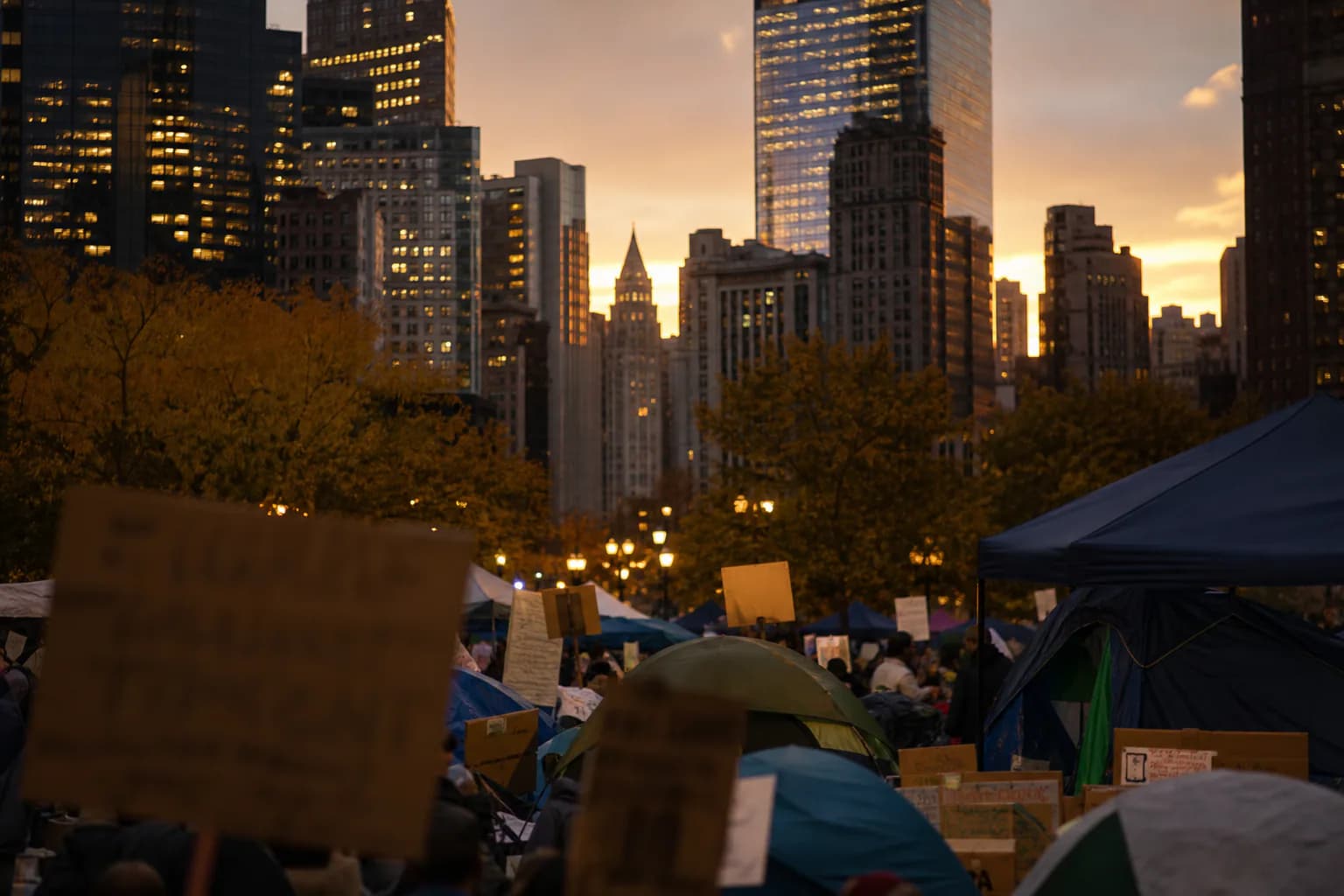
On September 17, 2011, several hundred protesters, responding to a call from the Canadian magazine Adbusters, occupied Zuccotti Park in Manhattan's financial district, beginning a roughly two-month encampment that never articulated a single formal demand yet produced a phrase — “We are the 99 percent” — that reshaped American political vocabulary for a decade.
The slogan drew on a specific, citable statistic: economist Emmanuel Saez's widely reported analysis, building on work with Thomas Piketty, showing the top 1 percent of U.S. earners had captured a disproportionate share of income growth since the 1970s, giving activists a number precise enough to feel factual and simple enough to fit on a cardboard sign.
The mechanism was linguistic capture rather than legislative victory: general assemblies, the “human microphone” technique for amplifying speech without electronics banned by park rules, and decentralized working groups modeled a prefigurative, leaderless politics — but the encampment's lasting effect came from handing media, politicians, and economists a shorthand for inequality that survived long after police cleared the park on November 15, 2011.
The phrase gained rhetorical traction across the political spectrum — invoked by figures as different as Bernie Sanders and, eventually, some Republican populists — while Occupy's own organizational structure, deliberately built without leaders or formal demands, dissolved without producing lasting institutions of its own, a common critique from historians of the movement.
Occupy encampments spread to hundreds of cities within weeks, including Occupy Oakland, where police use of tear gas and beanbag rounds critically injured Iraq War veteran Scott Olsen, and international offshoots in London, Madrid, and Hong Kong; a viral video of a University of California, Davis officer casually pepper-spraying seated, non-resisting students in November 2011 became one of the movement's most widely shared images, doing more to sustain public sympathy than any policy document the movement produced. The Fight for $15 minimum-wage campaign, which began among New York City fast-food workers in 2012, drew directly on Occupy's inequality vocabulary even as it organized around a specific, achievable policy demand the park encampments had deliberately avoided, eventually helping push a wave of state and city minimum-wage increases across the following decade, a concrete legislative legacy the encampments themselves, by design, never tried to claim credit for.
Coverage during the encampment concentrated heavily on sanitation conditions, drum circles, and clashes with police, often treating the movement as unserious or unfocused because it declined to issue a policy platform; that framing underweighted how effectively the movement's core statistic and slogan would outlive the tents, resurfacing in wealth-tax proposals, CEO-to-median-worker pay-ratio disclosure rules the SEC adopted in 2015, and corporate “stakeholder capitalism” statements explicitly responding to inequality critique.
Elizabeth Warren's Senate campaign and subsequent banking-oversight work, along with Bernie Sanders's 2016 and 2020 presidential runs, both drew directly on Occupy's inequality framing even though neither candidate had formal ties to the encampments, illustrating how a movement's vocabulary can outlast and outperform its own organizational structure.
'We are the 99%' migrated from encampments into ordinary political speech, giving inequality a memeable class map. Policy results were uneven; vocabulary change was not. Media and campaigns still reach for that frame when wages and asset prices diverge.
Zuccotti Park's encampment popularized 'the 99%' as a vernacular class map after the financial crisis. Without a conventional leadership structure, the movement struggled to convert attention into legislation — yet it shifted media baselines on inequality, student debt, and bank power for years afterward.
Police clearances and city permitting fights became part of the story. Later progressive campaigns borrowed Occupy's language even when they rejected its process. The durable output was a frame, not a statute: inequality re-entered mainstream politics as a structural charge, not a niche left concern.
Campus and city copycat camps proved the meme traveled even when demands stayed fuzzy. Media learned to cover inequality as conflict theater; activists learned that frames can outlast organizations. The 99% language still appears in fights Occupy never staffed.
Contemporary debates over billionaire wealth taxes, stock buyback regulation, and executive compensation ratios all still reach for “the 1 percent” as shorthand more than a decade after the park was cleared — evidence that Occupy's most durable achievement was not a policy but a frame so sticky that opponents, not just supporters, now argue on its terms.
Century Signals note: Contemporaneous Occupy reporting 2011; later political-science and journalistic assessments of its framing legacy. Editorial judgment about what still structures the present — not a comprehensive history.