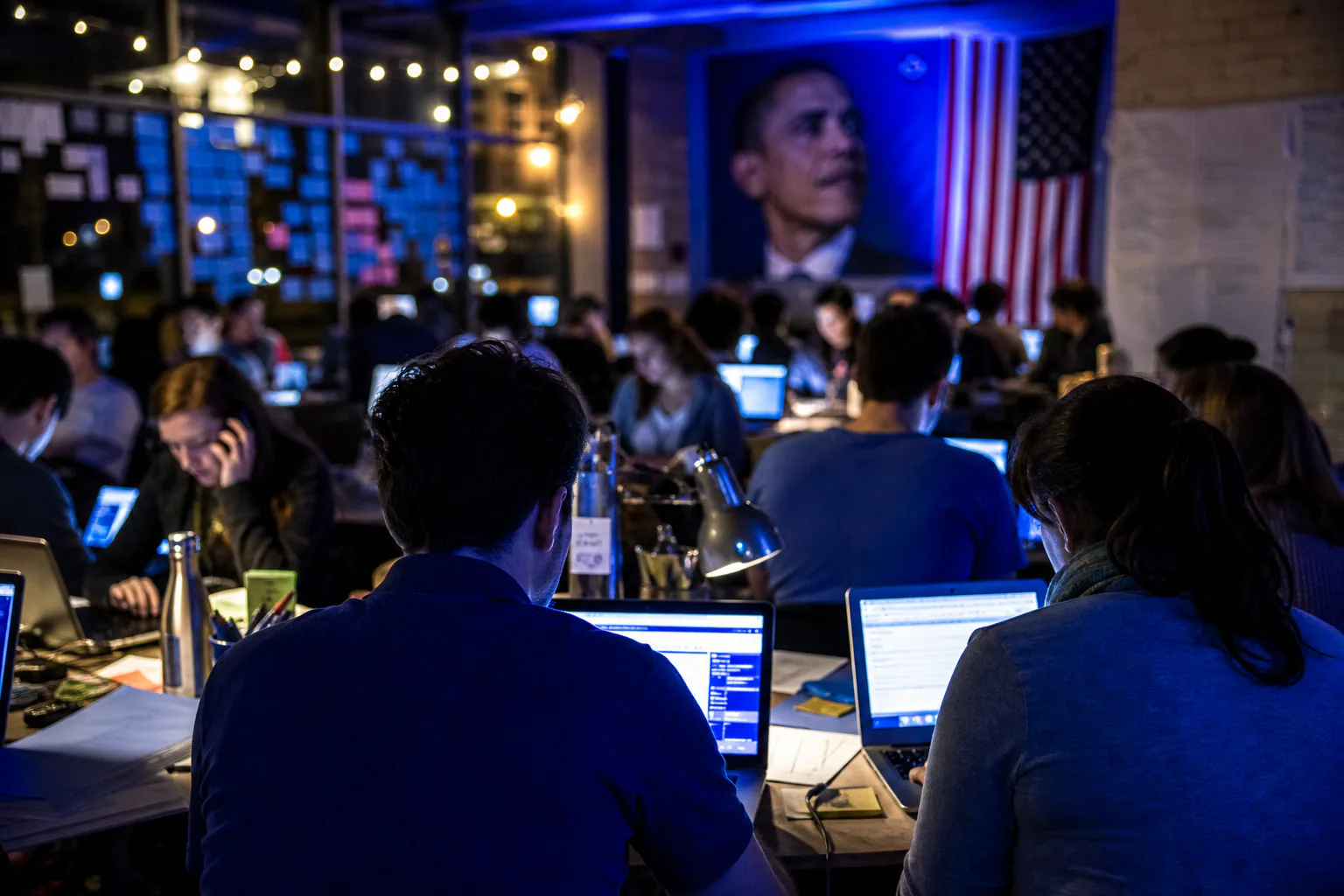
Barack Obama's 2008 campaign raised roughly $750 million, a record shattered mainly through small-dollar online donations, and built MyBarackObama.com — a platform, not just a website — that let supporters create their own fundraising pages, phone-banking lists, and neighborhood events without waiting for headquarters to organize them.
The mechanism was persistent, addressable identity: every signup, donation, and volunteer shift fed a central database in Chicago that campaign staff used to target emails, later to test subject lines and donation-page layouts against each other, and eventually to route millions of individually tailored messages instead of one broadcast message to everyone.
This borrowed directly from consumer internet companies rather than prior campaigns: hiring a Facebook co-founder, Chris Hughes, to help design the organizing platform, and running rigorous A/B tests on fundraising emails the way an e-commerce company tests checkout pages, turning political persuasion into a measurable, iterable product discipline for the first time at national scale.
Obama's operation gained a reusable asset that outlasted the election: a list of millions of donors and volunteers that fed his 2012 re-election, and a generation of campaign technologists who went on to found firms selling the same targeting infrastructure to campaigns, corporations, and advocacy groups. Traditional direct-mail and phone-bank vendors lost relative influence as digital operations captured both budget and strategic priority.
By 2012, the campaign's technology team had built “Narwhal,” a unified data platform merging separate field, fundraising, and voter-file systems into one queryable database — a project vendor Blue State Digital and in-house engineers had spent months building, and one campaign officials credited with letting field organizers see, in real time, exactly which doors still needed knocking in swing-state precincts on election day itself.
Fundraising emails were tested obsessively even in 2008: internal accounts later described subject-line experiments as blunt as “I will be outspent” outperforming more polished alternatives by wide margins, a discovery that shifted campaign email writing away from a communications-department craft and toward a data-driven discipline judged purely on open and conversion rates. The campaign's small-donor base, averaging roughly $86 per gift according to Federal Election Commission filings, also gave it a fundraising floor immune to the individual contribution caps that constrained rivals reliant on maximum-dollar checks from wealthy donors, letting Chicago return to the same donor list repeatedly across a two-year campaign rather than exhaust it after one large ask.
Coverage in 2008 emphasized symbolism — turnout among young and Black voters, the historic nature of the candidacy — and treated the technology as a colorful footnote. Tactical journalism on list-building, microtargeting, and what would happen to all that voter data after the election arrived only years later, once Cambridge Analytica made the same techniques a scandal rather than an innovation story.
Every major campaign since has built a CRM-style data operation as a baseline requirement rather than a novelty, and voters now expect — or resent — being individually modeled for persuasion likelihood, turnout probability, and donation potential, a normalization that traces directly to the infrastructure Chicago built in 2007 and 2008.
MyBO and email lists turned small-dollar donors into a recurring revenue engine that rivaled traditional bundlers. Field organizers used voter-file data and neighborhood walk lists at a scale that made prior campaigns look artisanal. The technology was less magical than the operational discipline around it.
Consultants and vendors exported the stack to future races and abroad. Microtargeting's legitimacy collapsed later under Cambridge Analytica headlines, but the infrastructure of CRM politics remained. Every serious campaign since has been measured against the 2008 digital bar — and against the privacy backlash it helped invite.
Email list hygiene and A/B-tested subject lines became as serious as TV ad buys. The campaign proved software could organize hope at scale — and that the same software could later organize rage. Digital politics kept the CRM; it did not keep the affect.
Opponent campaigns reverse-engineered the stack within a cycle. Vendors productized what volunteers once improvised. Digital organizing became table stakes — and later a vector for the same polarization it once mobilized against.
The privacy backlash that followed — Cambridge Analytica's harvesting of Facebook data for the 2016 Trump and Brexit campaigns, and the regulatory scrutiny of political micro-targeting that followed in the EU and parts of the U.S. — is the mirror image of 2008's celebration: the same data practices, judged differently once their scale and opacity became visible.
Century Signals note: Campaign memoirs and contemporaneous tech reporting on MyBO; FEC fundraising data; later analyses of digital field organizing. Editorial judgment about what still structures the present — not a comprehensive history.