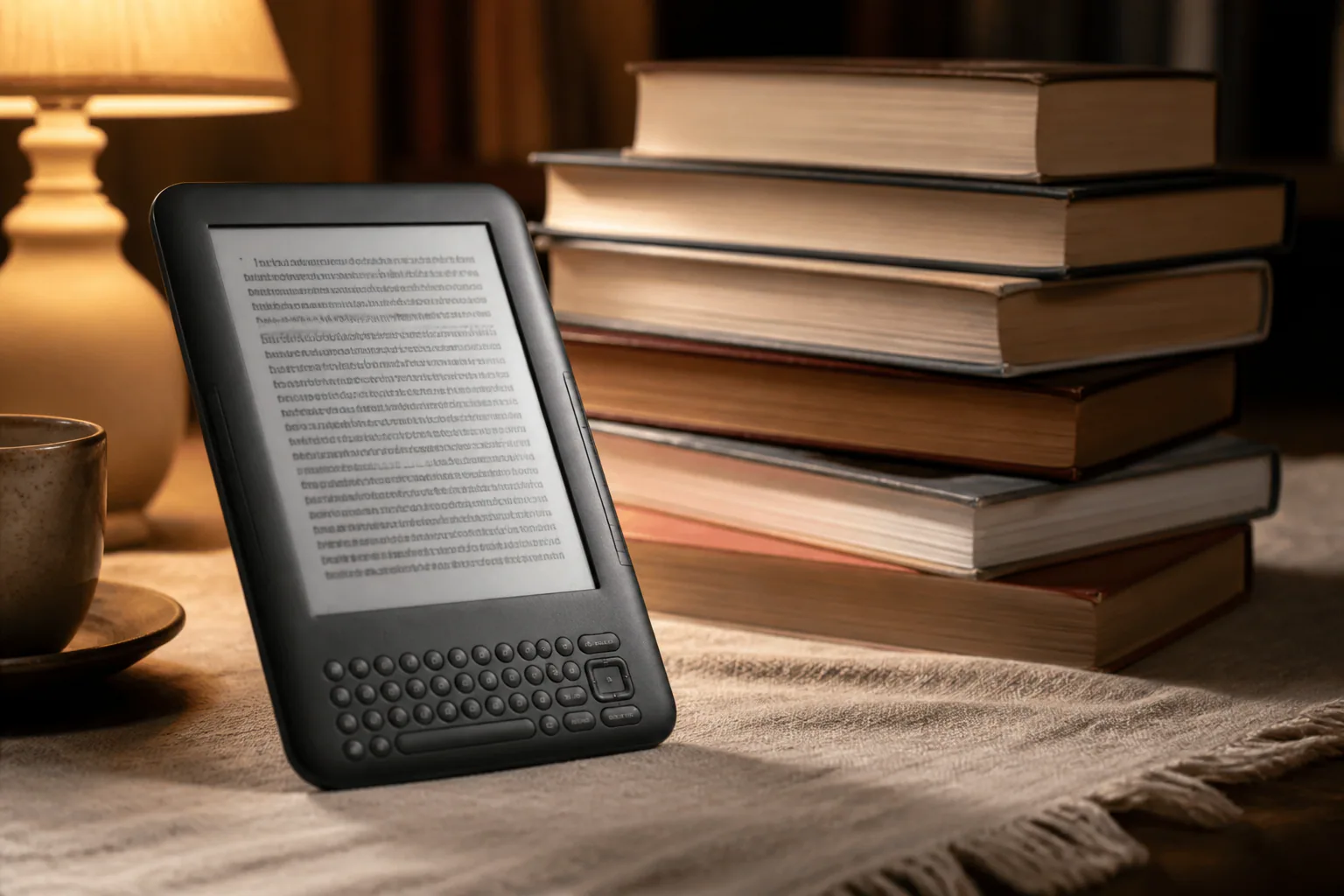
Amazon released the original Kindle on November 19, 2007, priced at $399, featuring a six-inch grayscale E Ink display and a genuinely free built-in cellular connection over Sprint's national network, marketed under the name Whispernet, that let a buyer purchase a book and have it appear directly on the device within about a minute, with no computer, cable, or ongoing subscription fee required at all. It sold out entirely within five and a half hours of launch.
Publishers confronted Amazon's considerable pricing power almost immediately: Amazon deliberately sold many new-release e-books at a flat $9.99, often pricing them below its own wholesale acquisition cost, specifically to seed early consumer demand for the hardware itself — a practice that led directly to a bitter 2010 pricing dispute with several major publishers and, later, a formal Department of Justice antitrust case against Apple and five major publishers over an alleged coordinated agreement to raise e-book prices in response.
The underlying mechanism was account lock-in: a customer's entire purchased library lived permanently in Amazon's cloud, tied to a personal account rather than to any physical shelf, fully annotated and re-downloadable across multiple devices, which made switching to a competing e-reader platform genuinely costly even after Barnes & Noble's Nook and other rival devices later launched their own comparable hardware.
Amazon gained a dominant and remarkably durable position in overall book retail that extended its commercial leverage over traditional publishers for years afterward. Independent authors gained an entirely new self-publishing channel through Kindle Direct Publishing, launched in 2007 and significantly expanded in 2009, that bypassed traditional publishing-house gatekeepers entirely, creating a genuinely new tier of commercially viable genre authors who had never signed a contract with any traditional publishing house.
Literary and technology press coverage in 2007 focused heavily on the device's admittedly ungainly physical design and on whether readers would ever meaningfully accept a backlit or reflective screen over traditional paper. Far less attention went to the specific licensing terms buried deep in the purchase flow — namely, that a Kindle 'purchase' was in most legal respects merely a revocable license rather than true ownership, a distinction that became painfully public in 2009 when Amazon remotely deleted purchased copies of George Orwell's novel 1984 from customers' devices over an unrelated publishing-rights dispute.
Audible, which Amazon acquired outright in 2008, and Kindle Unlimited, a flat-rate subscription reading service launched in 2014, both extended this same underlying account-based logic from individual one-time purchases to bundled recurring access, closely mirroring the broader subscription shift already well underway in recorded music and, somewhat later, in video streaming.
Amazon launched the Kindle in November 2007 with Whispernet cellular delivery and a store deeply integrated into the device. E-books stopped being a hobbyist format and became a one-click retail habit for a mass audience.
Publishers fought over pricing agency models and windowing; authors gained self-publishing paths through KDP; bookstores absorbed another channel shock after big-box retail pressure. The durable stack — device or app, storefront, file format politics, and Amazon's customer relationship — still mediates how a huge share of English-language digital reading is sold.
Whispernet's cellular delivery meant a book could arrive on a train without Wi-Fi — a logistical detail that made impulse purchases feel magical. Publishers who had feared e-books as piracy vectors confronted a retailer that owned both the store and the dominant reading device.
Agency pricing fights with Amazon, the Department of Justice's e-book case involving major publishers, and the rise of Kindle Direct Publishing rewired author leverage. Independent bookstores survived by becoming community spaces; they could not win on SKU breadth against infinite shelf space.
Authors gained a direct channel and lost some bargaining leverage with a single dominant storefront. Libraries negotiated digital lending under publisher friction. Reading did not die; ownership of the file quietly did, replaced by a licensed beam of light.
Page-flip metrics taught publishers what readers abandon. Self-published genre authors built middle-class incomes Amazon could also throttle. The stack made books liquid — and made the storefront the new imprint.
Reading itself became, in an important structural sense, a service-continuity problem rather than simply a one-time retail purchase — genuinely dependent on continued account standing, ongoing licensing terms, and a single company's own long-term corporate longevity, a fundamental shift the 2007 device's admittedly clunky hardware largely obscured but whose underlying business model quietly made permanent.
Century Signals note: Kindle launch coverage (2007); publishing-trade press on agency pricing; DOJ e-books case materials; KDP ecosystem reporting. Editorial judgment about what still structures the present — not a comprehensive history.