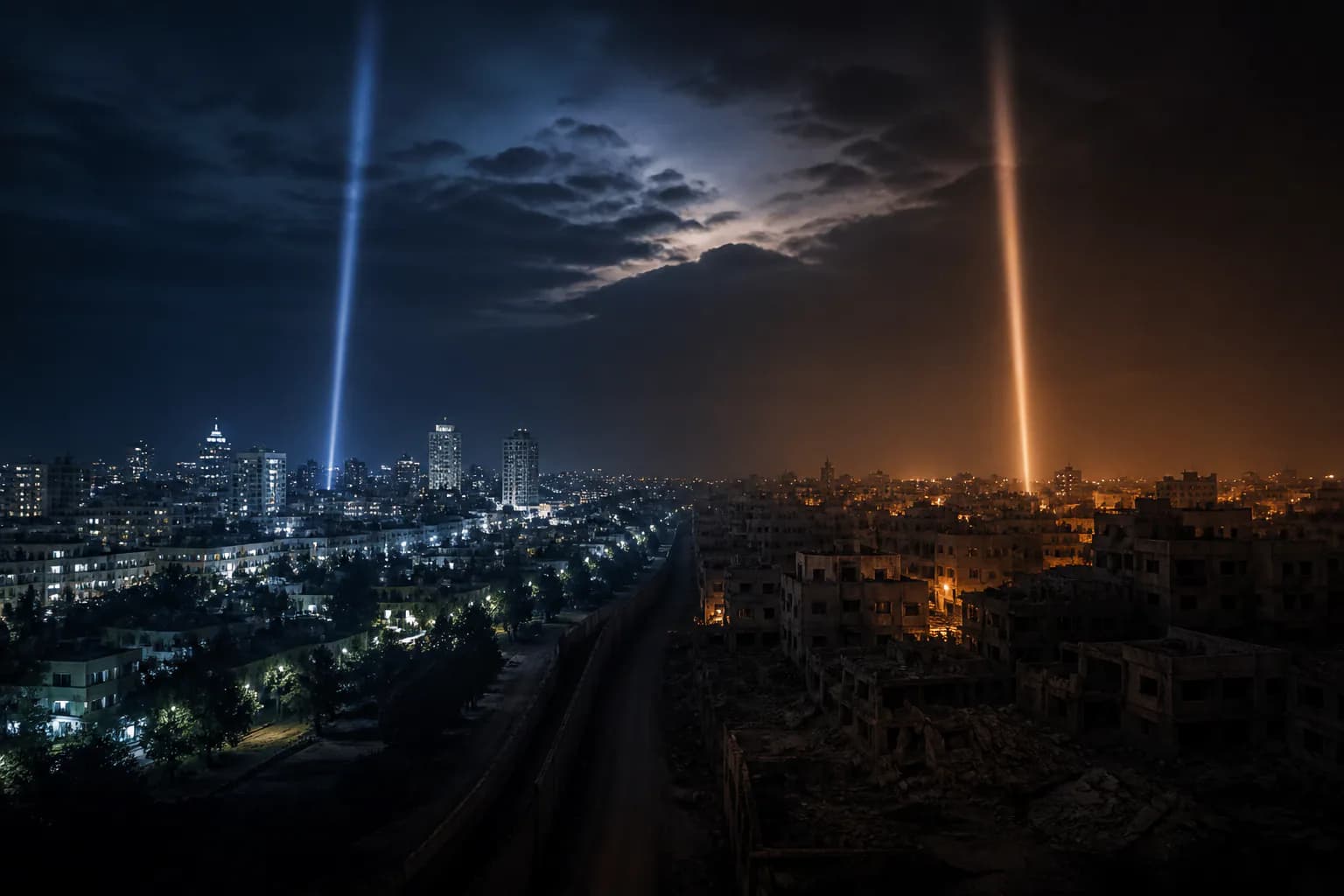
Hamas militants launched a coordinated assault from Gaza into southern Israel on October 7, 2023, killing approximately 1,200 people, mostly civilians, in the deadliest single day for Jews since the Holocaust, and taking roughly 250 hostages back into Gaza. The attack breached a heavily fortified border and surprised Israeli intelligence and military services that had, in years prior, treated Hamas as largely deterred and focused on governing rather than launching a major cross-border operation.
Israel responded with a sustained air and ground campaign in Gaza that, according to figures from the Hamas-run Gaza Health Ministry that international organizations have treated as broadly credible while noting they do not distinguish combatants from civilians, resulted in tens of thousands of Palestinian deaths over the following two years, alongside the displacement of the large majority of Gaza's roughly 2 million residents and the destruction of much of its housing and hospital infrastructure. Israel maintained the campaign aimed to dismantle Hamas's military and governing capacity and recover hostages, a subset of whom were freed in negotiated exchanges in November 2023 and subsequent deals.
The mechanism shaping international response was as much informational as military: verifying casualty figures, strike targets, and battlefield claims from a besieged territory with restricted independent media access became its own contested infrastructure, with satellite imagery analysis, open-source investigators, and international humanitarian organizations serving as partial substitutes for journalism access Israel restricted. South Africa filed a case at the International Court of Justice in December 2023 alleging Israel's campaign violated the Genocide Convention, and the ICJ issued provisional measures in January 2024 without ruling on the underlying merits.
The International Criminal Court's prosecutor sought arrest warrants in May 2024 for both Israeli Prime Minister Benjamin Netanyahu and Hamas leaders including Yahya Sinwar, an unusual step treating both sides as subject to war-crimes accountability; the court issued warrants for Netanyahu and then-defense minister Yoav Gallant in November 2024. Regional normalization efforts, including the Abraham Accords framework and nascent Saudi-Israeli talks that had been active before October 7, stalled as Arab public opinion hardened against any process that appeared to sideline Palestinian statehood.
Coverage in the war's early months concentrated heavily on the immediacy of atrocity footage from both October 7 and subsequent Gaza strikes, feeding an information environment where each side's supporters treated verified and unverified claims with similar confidence. Underweighted was the slower diplomatic unraveling: how thoroughly the war froze the broader Middle East normalization track that Washington had spent years building, and how quickly it became a defining fault line in Western domestic politics rather than a distant regional conflict.
University campuses across the U.S. and Europe saw sustained pro-Palestinian encampment protests beginning in spring 2024, most visibly at Columbia University in April 2024, drawing police responses, congressional hearings on campus antisemitism, and resignations of university presidents at Harvard and Penn — turning a foreign war into a domestic institutional crisis for American higher education that outlasted the news cycle around any single battlefield development.
Hamas's October 7, 2023 attacks and Israel's subsequent Gaza campaign produced mass casualties, hostage crises, and a regional escalation risk involving Hezbollah, Iran, and Red Sea shipping. International law arguments and campus/political polarization exported the war into distant domestic arenas.
Humanitarian corridors, ICJ cases, and ceasefire diplomacy became the parallel track to kinetic operations. Media verification collapsed under fog and propaganda. The conflict reopened Middle East alignments that Abraham Accords optimism had tried to close.
Diaspora communities abroad absorbed the conflict as local safety and speech crises. Aid agencies faced access nightmares under bombardment and suspicion. Regional diplomacy now prices Gaza outcomes into every normalization file — unfinished, and structuring.
Ceasefire proposals and hostage negotiations became the diplomatic metronome even when fighting continued. Regional actors priced escalation risk into energy and shipping lanes. The war’s map keeps changing; its capacity to reorder alliances does not.
The war's present inheritance includes a hardened, more openly contested global information environment around Israeli-Palestinian conflict specifically, where casualty verification, campus speech policy, and international court proceedings against a G7-aligned state have all become semi-permanent features rather than temporary wartime conditions, reshaping how Western institutions — universities, media outlets, and diplomatic bodies — navigate a conflict with no clear resolution in sight.
Century Signals note: UN and ICRC humanitarian reporting; contemporaneous war correspondence; ICJ/ICC procedural materials as applicable. Editorial judgment about what still structures the present — not a comprehensive history.