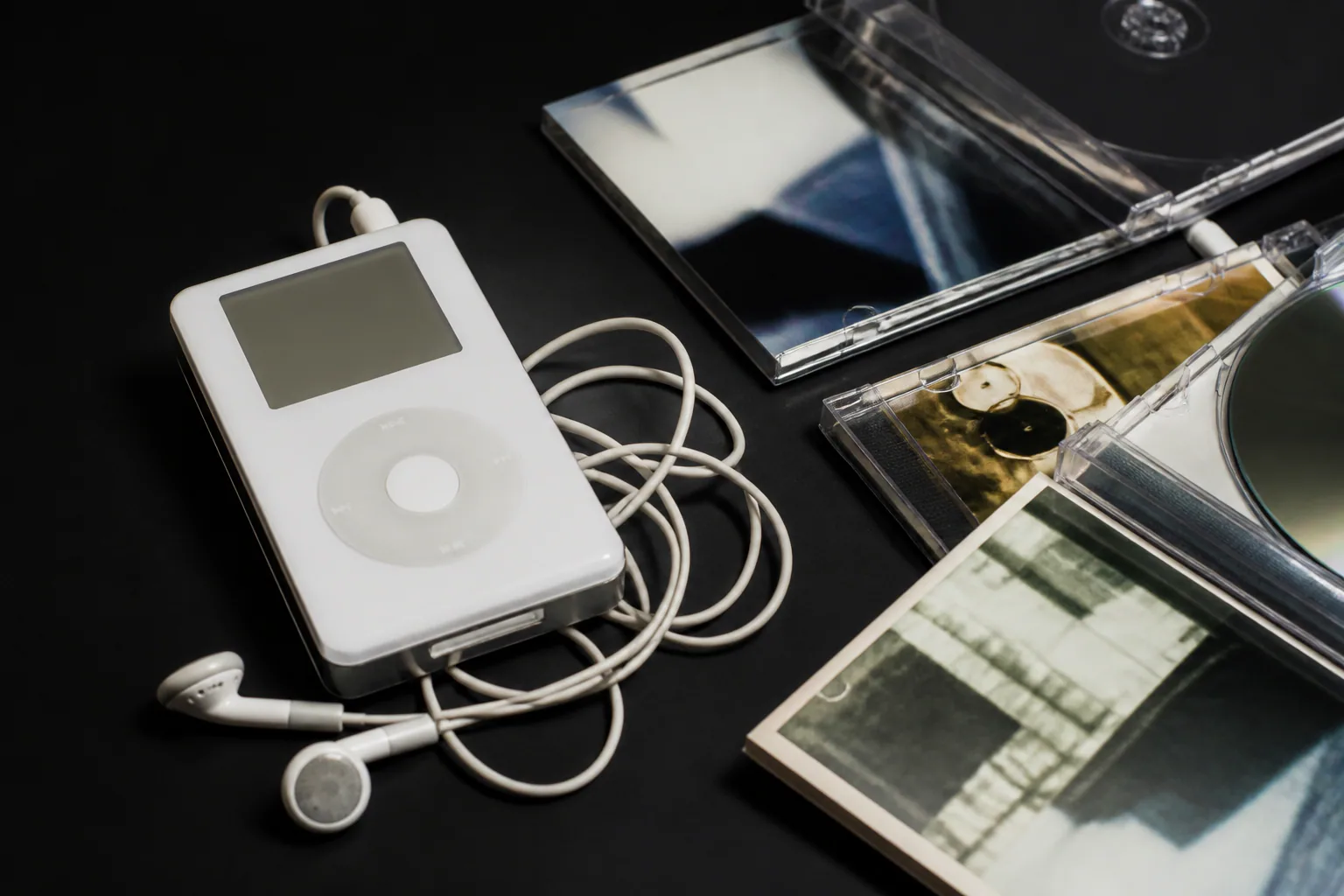
Apple introduced the iPod on October 23, 2001, a $399 device with a 5-gigabyte hard drive, a mechanical scroll wheel, and a FireWire cable that only connected to Macintosh computers, which at the time held under five percent of the personal-computer market. Reviewers largely treated it as a niche accessory for a niche machine, priced well above rival MP3 players from SonicBlue and Creative that offered comparable storage for less.
The shift was experiential before it was commercial. The promise of 'a thousand songs in your pocket' taught listeners that a music library could be portable, searchable by artist and album, and genuinely personal rather than tied to a shelf of physical discs or a car's single CD changer. When the iTunes Music Store opened in April 2003, selling tracks at 99 cents apiece under licensing terms Steve Jobs personally negotiated with all five major labels, the album's role as the default unit of sale began to erode in a way piracy alone never managed to force.
Record labels had built their economics around bundling: a hit single subsidized by an album's worth of filler tracks, sold as one $15 to $18 object at retail. Per-track pricing broke that bundle even before streaming finished the job a decade later, forcing labels to renegotiate mechanical-licensing rates and artist royalty structures that had gone largely unchanged since the compact-disc era began in the 1980s.
Apple gained a new, high-margin revenue category on its way to eventually becoming the world's most valuable public company by market capitalization. Labels gained a legal, licensed alternative to Napster-era piracy, which had cost the industry billions in the years after Napster's 1999 launch, but lost meaningful pricing control over their own catalogs to a single retail gatekeeper. Musicians whose careers depended on album sales rather than singles or touring — a shrinking category as the decade progressed — lost the most durable revenue model they had.
Press coverage in 2001 focused heavily on the price point, the small Mac-only addressable market, and Jobs's now-famous stage presence unveiling the device. It substantially underweighted how quickly rights-management negotiations happening behind closed doors would reshape what counted as a commercial hit and how much of each dollar actually reached a performing artist versus a label or distributor.
Streaming services from Spotify, founded in Sweden in 2006, to Apple Music, launched in 2015, inherited the iPod's core proposition — access to an entire catalog on demand — and extended it from per-track ownership to flat-rate rental. The recurring 'creator economy' argument over how little musicians earn per stream, often cited in fractions of a cent, traces directly back to this initial unbundling of the album.
Digital rights management on early iTunes tracks — FairPlay encryption that locked purchases to Apple's ecosystem — revealed a second mechanism: platforms would trade convenience for control. Consumers accepted friction that looked minor next to piracy's legal risk. Competitors later fought and sometimes abandoned similar DRM schemes, but the precedent that a store could define playback rules had been set.
Hardware margins on iPods also subsidized Apple's retail and brand expansion, teaching the company that cultural objects could pull customers into a wider product family. The path from white earbuds to iPhone lock-in was not inevitable in 2001, but the iPod proved that design, software, and media licensing could compound into market power that pure PC makers struggled to match.
iTunes Music Store's 2003 launch at ninety-nine cents a track, after bruising label negotiations, legalized a unit of music the CD era had bundled away. Jobs's insistence on simplicity — buy, sync, go — beat competing DRM storefronts that felt like homework. The industry accepted a smaller per-unit price to regain a legal channel after Napster-era piracy.
Portable hard-disk players from other brands existed; none matched Apple's integration of hardware, software, and retail. That stack became the rehearsal for the App Store economy: control the device, the store, and the sync ritual, and you control the customer's media habit.
Artists discovered that unbundling could raise single-track revenue while destroying album-era middle-class careers for anyone outside the hits. The industry’s later streaming fights were arguments about rent on a consumer habit the iPod first trained: music as a personal library you carry, not a shelf you visit.
The iPod itself is gone from Apple's product lineup, formally discontinued in May 2022 after twenty-one years, but the industrial logic it introduced — price and sell the individual unit the customer actually wants, rather than the bundle the label prefers to sell — still governs how music, video, software, and increasingly journalism itself gets priced and distributed online.
Century Signals note: Apple product announcements 2001–2003; music-industry trade press on iTunes licensing; later retrospectives on FairPlay DRM and streaming transitions. Editorial judgment about what still structures the present — not a comprehensive history.