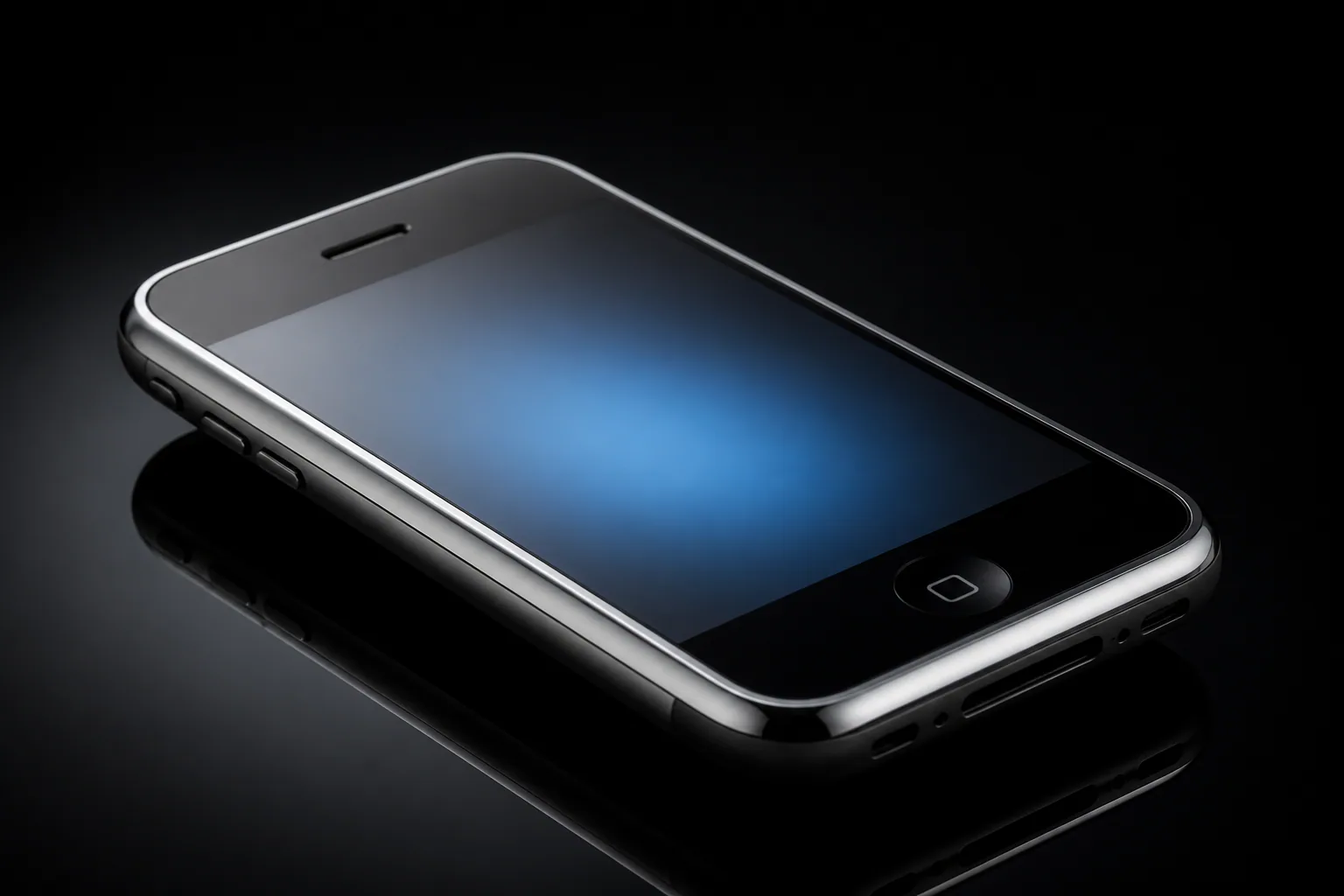
Steve Jobs unveiled the original iPhone at the Macworld conference on January 9, 2007, memorably describing it as 'a widescreen iPod with touch controls, a revolutionary mobile phone, and a breakthrough internet communicator' combined into a single device. It went on sale June 29, 2007, priced at $499 or $599 depending on storage, sold exclusively through AT&T's network, and shipped with no third-party app store of any kind.
Multitouch scrolling gestures, pinch-to-zoom, and genuinely full desktop-style web browsing on a handheld phone together set an entirely new interaction grammar that established competitors spent years struggling to meaningfully catch up to. Apple did not actually open the device to outside third-party developers until the App Store launched in July 2008 alongside the follow-up iPhone 3G, a full eighteen months after the original device had already shipped to consumers.
The underlying mechanism was substitution: a single pocketable object gradually began replacing dedicated digital cameras, standalone GPS navigation units, and portable music players outright, and eventually, as mobile payment and digital-identification features matured over the following decade, physical wallets and keys as well — competing purely on convenience against an entire shelf of previously separate dedicated devices people already owned individually.
Apple gained what became the single most profitable product line in the history of consumer electronics; by the 2010s, iPhone sales alone generated more quarterly revenue in some periods than many entire national economies' worth of aggregate consumer spending. Nokia and BlackBerry, the clear market leaders in mobile handsets back in 2007, lost their dominant market positions within roughly five years, fundamentally unable to match Apple's software-first design approach.
Launch-week coverage extensively debated Apple's perceived arrogance in bypassing established carrier customization norms and its exclusive, restrictive deal with AT&T. Remarkably few contemporary pieces forecast how completely mobile devices would soon become the primary internet access point for billions of people worldwide, fundamentally reshaping digital advertising, gig-economy labor dispatch systems, and two-factor authentication practices around a single phone carried in every pocket.
The App Store's 30 percent commission structure on most digital transactions, largely unchanged in its basic shape for well over fifteen years, became the central subject of Epic Games' high-profile 2020 antitrust lawsuit and subsequent regulatory action in the European Union under the Digital Markets Act, both legal fights rooted directly in commercial decisions made when the store first launched back in 2008.
Apple unveiled the iPhone in January 2007 and shipped it in June with multitouch, Mobile Safari, Visual Voicemail, and a closed hardware design that rejected the stylus and physical keyboard orthodoxy of BlackBerry-era smartphones. AT&T exclusivity in the U.S. was a constraint that also guaranteed carrier marketing muscle.
The 2008 App Store turned the phone into a software platform; GPS, cameras, and sensors made it a context computer. Regulators later scrutinized App Store fees and default browser engines, but they were arguing inside an order the iPhone created: pocket-sized general-purpose computing as the primary screen for billions of people.
Carriers that once controlled handset menus lost the software layer almost overnight; Apple and later Google owned the customer relationship above the SIM. That power shift still defines fights over messaging standards, app fees, and who sets mobile privacy defaults.
The 2007 keynote's 'widescreen iPod, phone, internet communicator' framing understated the OS bet: a full Cocoa Touch stack capable of hosting third-party apps once the App Store opened in 2008. AT&T exclusivity was a U.S. bottleneck that also funded nationwide marketing.
BlackBerry and Nokia learned that keyboard comfort and carrier relationships could not defeat multitouch software velocity. Regulators later focused on App Store fees and browser-engine rules — disputes that only exist because the pocket computer became the primary computing surface for billions.
Maps, cameras, payments, and identity migrated into a glass rectangle that charged nightly. Entire industries — cameras, GPSes, music players — compressed into apps. Regulators arrived late because the product felt like a phone until it was already the operating system of daily life.
Every mobile-first product design decision made today, every public debate over children's screen time, and every ongoing argument over app-store commission fees still assumes the foundational template this single device set in early 2007: computing genuinely left the desk that year and, in any meaningful sense, has not returned.
Century Signals note: Apple iPhone keynote and launch coverage (2007–2008); App Store launch reporting; later antitrust and DMA materials on mobile platform rules. Editorial judgment about what still structures the present — not a comprehensive history.