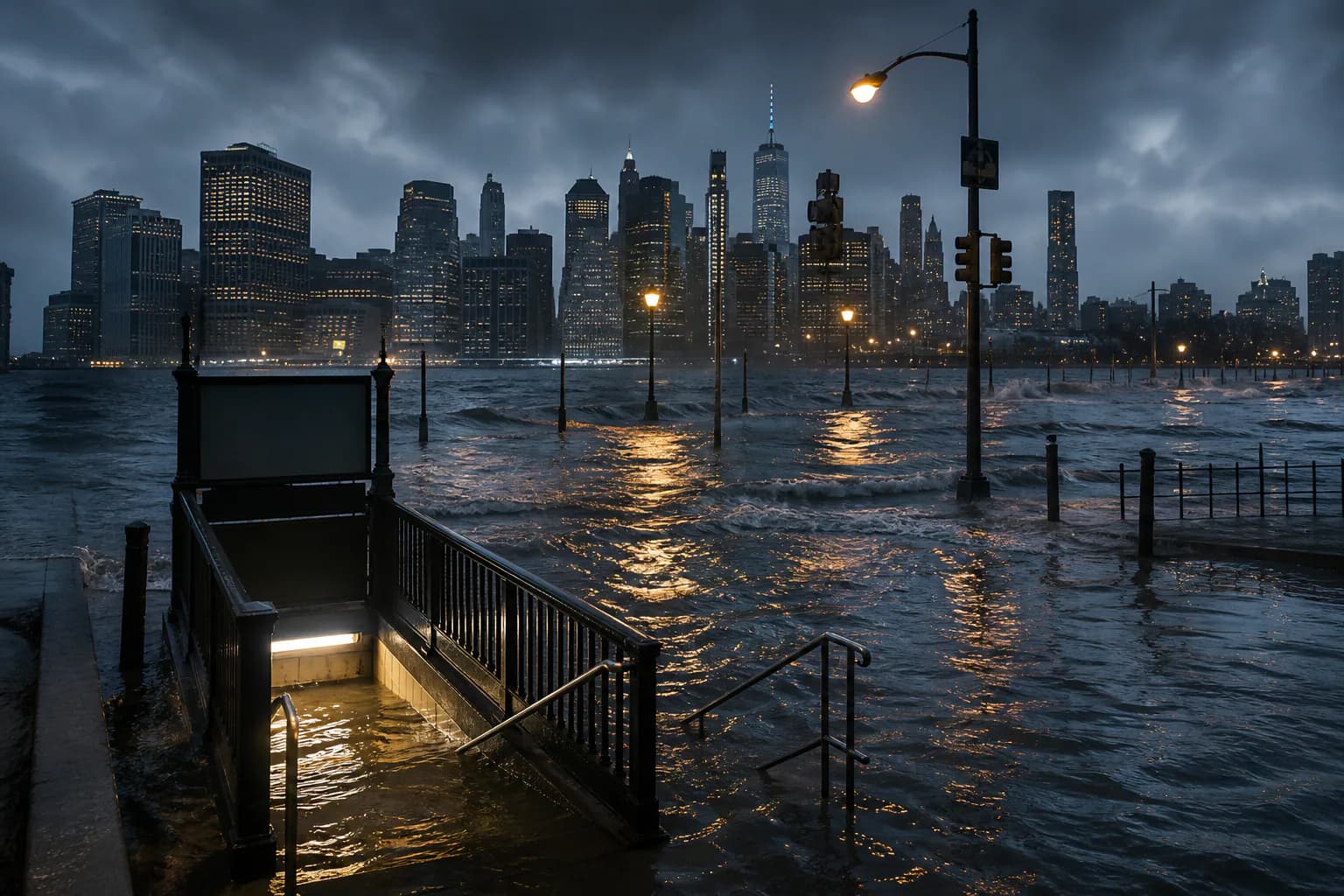
Hurricane Sandy made landfall near Atlantic City, New Jersey, on October 29, 2012, arriving during an unusually high astronomical tide and merging with a separate winter storm system in a configuration meteorologists rarely see, pushing a storm surge that reached nearly 14 feet in parts of Lower Manhattan and Staten Island — the highest recorded there since at least the 1800s.
Seawater flooded seven subway tunnels under the East River and disabled the South Ferry station so thoroughly it took years and roughly $600 million to fully rebuild; more than 8 million customers lost power, some for weeks, and images of a darkened Lower Manhattan skyline beside a still-lit Midtown, split along the flood line, became the storm's defining picture — infrastructure divided not by neighborhood wealth but by elevation.
The mechanism was legacy infrastructure meeting a climate baseline it was never designed for: New York's sewer system, subway ventilation grates, and flood-zone maps dated to engineering assumptions from the mid-20th century, before accounting for the sea-level rise and storm intensity that climate science had already, by 2012, identified as an accelerating trend rather than a future hypothetical.
New York City and New Jersey received roughly $60 billion in federal disaster aid, funding seawalls, floodgates, and the still-ongoing East Side Coastal Resiliency Project; homeowners in flood-prone areas without flood insurance — a large share, since FEMA flood maps had understated risk in many neighborhoods — absorbed losses federal aid never fully covered, while private insurers began pulling back from coastal markets in the years following, a retreat that accelerated dramatically in Florida and California by the 2020s.
Sandy killed at least 233 people across the Caribbean and the United States and caused an estimated $70 billion in damage, making it, at the time, the second-costliest hurricane in U.S. history after Katrina; the storm also pushed the National Flood Insurance Program deeper into debt, since payouts for New York and New Jersey claims alone exceeded $8 billion against a program Congress had already been forced to bail out repeatedly. New York City's revised building code afterward required emergency generators and electrical equipment in flood-prone buildings to be relocated above ground-floor flood levels, a retrofit thousands of buildings undertook over the following decade.
Initial coverage focused, appropriately, on emergency response — hospital evacuations at NYU Langone when backup generators failed, fuel shortages producing gas-station lines that stretched for blocks; slower to develop was quantitative analysis of uninsured losses, FEMA's own strained capacity managing simultaneous disasters, and the politically difficult question of “managed retreat” — relocating people permanently away from the most vulnerable coastline — which remained largely undiscussed in the immediate recovery period and remains contentious today.
Sandy directly accelerated municipal resilience planning nationally: New York's post-Sandy stormwater and building-code updates, resilience-bond financing structures piloted afterward, and FEMA's revised flood-insurance rate maps all trace to lessons drawn from a single storm's specific failure points rather than abstract climate modeling, giving policymakers concrete infrastructure failures to design against.
Storm surge flooded Manhattan subway tunnels and coastal New Jersey; a modern financial capital looked temporarily medieval. ConEd outages and hospital generator failures exposed interdependent infrastructures. Federal disaster declarations met densest-city logistics constraints that rural hurricane playbooks did not cover.
Rebuild by Design competitions and resilience bonds entered urban planning vocabularies. Sandy made 'climate adaptation' a capital-budget line in places that had treated it as environmental rhetoric. Every subsequent coastal megacity plan quietly asks whether it can survive its own Sandy night.
Insurance markets and bond raters began pricing coastal resilience as credit risk. Subway pumps and seawall designs entered mayoral politics beside schools and crime. Sandy’s inheritance is bureaucratic: climate moved from NGO language into capital plans.
Hospital generators and fuel contracts entered emergency checklists beside sandbags. Coastal condo finance quietly repriced. Sandy made climate adaptation a CFO problem in cities that once left it to NGOs.
A decade later, insurance-market pullbacks in Florida, Louisiana, and California, debates over who finances seawalls for wealthy coastal property versus inland public transit, and continuing fights over whether to rebuild or retreat from repeatedly flooded neighborhoods all extend Sandy's central lesson: cities are financial instruments as much as physical ones, and climate risk now shows up first on insurance and municipal bond balance sheets before it shows up in any political debate.
Century Signals note: NHC Sandy reports; NYC and NJ after-action assessments; contemporaneous infrastructure-failure reporting. Editorial judgment about what still structures the present — not a comprehensive history.