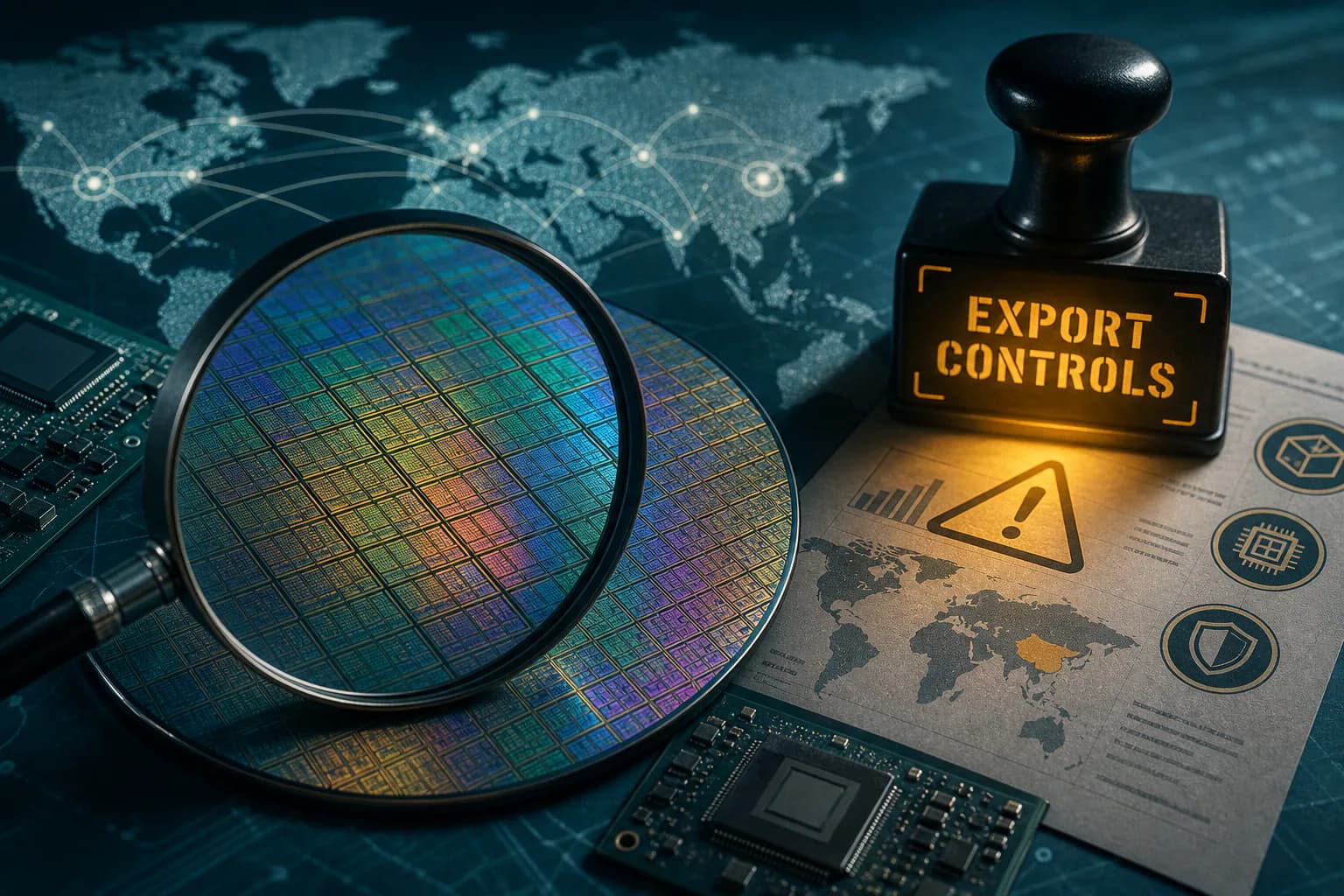
The Commerce Department's Bureau of Industry and Security issued sweeping export controls in October 2022 restricting the sale of advanced semiconductors, chipmaking equipment, and related U.S. person support to China, targeting specifically the chips and lithography tools needed to train large AI models and to manufacture leading-edge processors domestically. The rules went further than prior sanctions regimes by controlling not just finished products but also the tools and know-how needed to produce them, and by restricting U.S. citizens and green-card holders from supporting Chinese chip fabrication facilities.
The mechanism reflected a strategic bet that compute, not algorithms, was the more controllable chokepoint in the AI race: unlike model weights or training techniques, advanced chip fabrication depends on an extremely narrow global supply chain concentrated in a handful of companies — Taiwan's TSMC for advanced fabrication, the Netherlands' ASML for extreme ultraviolet lithography machines, and Japan's Tokyo Electron for other critical equipment — making coordinated export restriction among just a few governments strategically viable in a way that controlling software never could be.
Washington expanded the rules in October 2023 to close loopholes that had let Nvidia sell modified, lower-performance chips (the A800 and H800) to Chinese customers that met the letter but not the intent of the original restrictions; the update tightened performance thresholds to capture those workaround chips as well. The Netherlands restricted ASML's exports of its most advanced lithography systems to China starting in 2023, and Japan imposed parallel controls on chipmaking equipment, turning what began as a unilateral U.S. policy into a coordinated multilateral regime.
Nvidia, whose data-center GPUs had become the default hardware for AI training worldwide, lost a meaningful share of a market it had spent years building in China, while designing new China-specific chips to comply with successive rule changes, a compliance treadmill that repeated through 2024. China retaliated by restricting exports of gallium and germanium, critical minerals used in semiconductor and defense manufacturing where China holds outsized global production share, and accelerated domestic investment in chip fabrication and lithography alternatives, with Huawei and SMIC producing more advanced domestic chips than U.S. planners had expected by 2023.
Coverage emphasized the trade-war framing — tit-for-tat retaliation, market share disputes — over the more consequential structural question of whether export controls could durably slow China's AI progress at all, or would instead accelerate Chinese self-sufficiency in chip manufacturing on a timeline measured in years rather than the intended delay. That question remained genuinely unresolved through the controls' first several years.
Allied governments did not always move in lockstep: the Netherlands initially resisted the full scope of U.S.-requested restrictions on ASML, citing its own economic interests and existing export licenses, before ultimately tightening rules under sustained diplomatic pressure — a reminder that the 'coalition' enforcing chip controls was negotiated country by country rather than dictated unilaterally from Washington.
The CHIPS and Science Act, signed into law in August 2022 with roughly $52 billion for domestic semiconductor manufacturing incentives, ran as a parallel domestic complement to the export controls, aiming to rebuild U.S.-based advanced fabrication capacity that had migrated to Taiwan and South Korea over prior decades. TSMC, Samsung, and Intel all announced major U.S. fabrication investments backed partly by CHIPS Act funding in the years following passage.
U.S. export controls on advanced semiconductors and manufacturing equipment, coordinated with allies, aimed to slow China's AI and military compute trajectory. Firms redesigned supply chains; smuggling and mature-node expansion became cat-and-mouse. CHIPS Act subsidies tried to reshore fabrication as the carrot beside the stick.
TSMC, ASML, and NVIDIA became geopolitical chokepoints discussed in security cabinets. Allies negotiated carve-outs while aligning on core lists. Chips ceased to be only an industry story; they are now instruments of statecraft with quarterly earnings attached.
Graduate students and equipment technicians became export-control subjects. Allied capitals discovered semiconductor diplomacy requires fabs, not only communiqués. Compute is now sanctioned like uranium — with quarterly earnings calls attached.
The chip-control regime now functions as the default template for technology-based great-power competition: subsequent debates over export restrictions on AI models themselves, biotechnology equipment, and quantum computing components have all referenced the chip-control precedent of controlling narrow physical chokepoints rather than broad categories of knowledge, making semiconductor policy a permanent fixture of U.S.-China relations rather than a temporary trade dispute.
Century Signals note: BIS export-control rules; CHIPS Act materials; semiconductor industry and allied-coordination reporting. Editorial judgment about what still structures the present — not a comprehensive history.