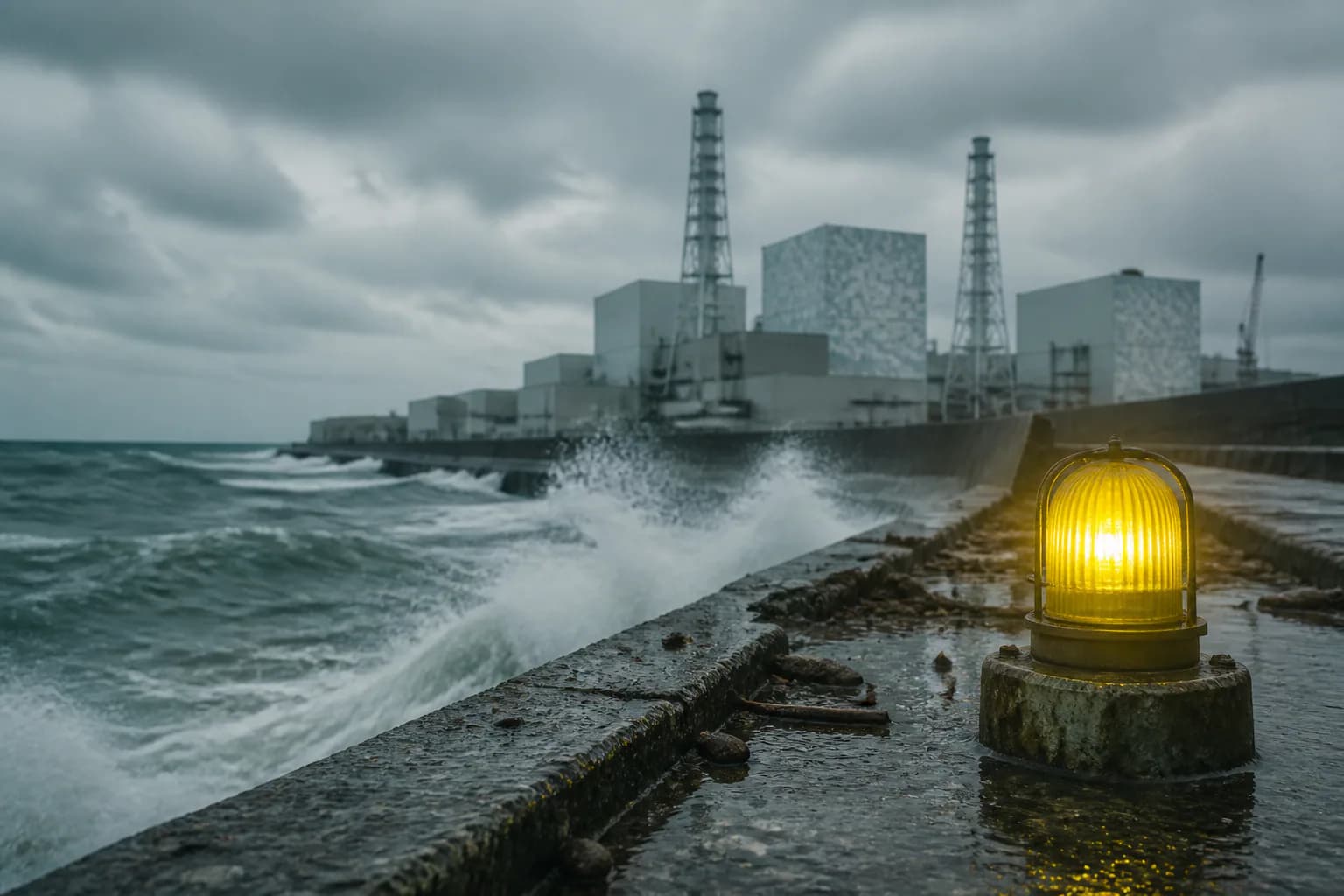
On March 11, 2011, a magnitude-9.0 earthquake off Japan's coast triggered a tsunami that overtopped seawalls at the Fukushima Daiichi nuclear plant, flooding emergency diesel generators and cutting power needed to cool three reactor cores, which began melting down within hours in the world's most severe nuclear accident since Chernobyl in 1986.
Hydrogen buildup from the melting fuel triggered explosions that blew the roofs off two reactor buildings on live television, while plant operator TEPCO and Japanese regulators gave conflicting radiation readings for days, undermining public trust before evacuation orders eventually cleared roughly 154,000 people from a 20-kilometer exclusion zone.
The mechanism was cascade failure built on underestimated assumptions: the plant's seawall had been designed for a smaller tsunami than historical records in the region actually supported, and the entire safety architecture assumed backup generators and their fuel supply would remain accessible — an assumption a single wave invalidated across the whole site simultaneously rather than one system at a time.
TEPCO ultimately estimated cleanup and compensation costs exceeding $200 billion, still ongoing more than a decade later; Japan idled its entire 54-reactor nuclear fleet within a year, a capacity gap it filled largely by importing liquefied natural gas, spiking energy costs and reversing decades of energy-independence policy overnight. Farmers and fishers near the plant lost markets for years even where radiation levels tested safe, a reputational rather than physical damage that outlasted the technical cleanup timeline.
Japan's Nuclear and Industrial Safety Agency rated the accident a level 7 on the International Nuclear Event Scale — the same maximum severity rating as Chernobyl, though Fukushima released roughly a tenth as much radioactive material by most estimates — and in 2023 Japan began releasing treated, diluted wastewater from the site into the Pacific over multiple years, a decision China and South Korea protested and that remains a live regional dispute more than a decade after the meltdown itself. Only about a dozen of Japan's pre-accident reactor fleet had restarted by the mid-2020s, under a stricter post-Fukushima regulatory regime that requires operators to demonstrate protection against tsunamis and station blackouts far exceeding what pre-2011 design standards had assumed possible, a bar several older reactors have simply been retired rather than upgraded to meet.
Early Western coverage struggled to translate radiation units into meaningful risk comparisons, producing coverage that alternated between alarmist and falsely reassuring; slower, more durable analysis came from IAEA and academic reviews documenting specifically how regulatory capture — Japan's nuclear regulator was housed inside the same ministry that promoted nuclear power — had weakened independent safety oversight for years before the accident.
Germany's government, under Angela Merkel, announced a complete nuclear phase-out within days of the accident, ultimately closing its last reactors in 2023; most Western regulators mandated new stress tests and backup-power requirements, treating the accident as evidence that “beyond design basis” events needed to be planned for rather than assumed away.
Germany accelerated its nuclear phase-out; Japan idled reactors and rewrote safety regulation; global nuclear finance grew more expensive overnight. A tsunami-triggered station blackout repriced a technology that climate policy still needs on the table.
The Tōhoku earthquake and tsunami overwhelmed Fukushima Daiichi's defenses; station blackout led to meltdowns and hydrogen explosions. Evacuation zones emptied towns; contaminated water management became a multi-decade obligation. Japan's energy mix pivoted hard toward imported fossil fuels as reactors idled.
Germany accelerated nuclear phase-out; other countries tightened stress tests and seawall assumptions. Public trust in probabilistic risk models took a hit: 'once in a thousand years' arrived on a clear calendar date. Nuclear's climate comeback years later still negotiates in Fukushima's shadow.
Seismic and tsunami hazard models were rewritten with harder tails. Utilities elsewhere ran stress tests that revealed similar cliff-edge dependencies on backup power. Nuclear’s climate case now always includes a paragraph that begins with Fukushima — whether advocates like it or not.
Contaminated water release debates years later showed the disaster’s half-life in politics exceeds isotopes’ headlines. Utilities elsewhere paid for thicker defenses. Nuclear’s social license now includes tsunami math by default.
Fifteen years on, small modular reactor proposals and climate-driven reconsideration of nuclear power as low-carbon baseload energy must all still answer Fukushima's specific question — not whether nuclear power is statistically safe in aggregate, but whether any single plant's local risk-benefit calculation survives a scenario planners rated as implausible until it happened.
Century Signals note: IAEA and Japanese Diet investigation reports; contemporaneous disaster coverage; national energy-policy responses in Japan, Germany, and elsewhere. Editorial judgment about what still structures the present — not a comprehensive history.