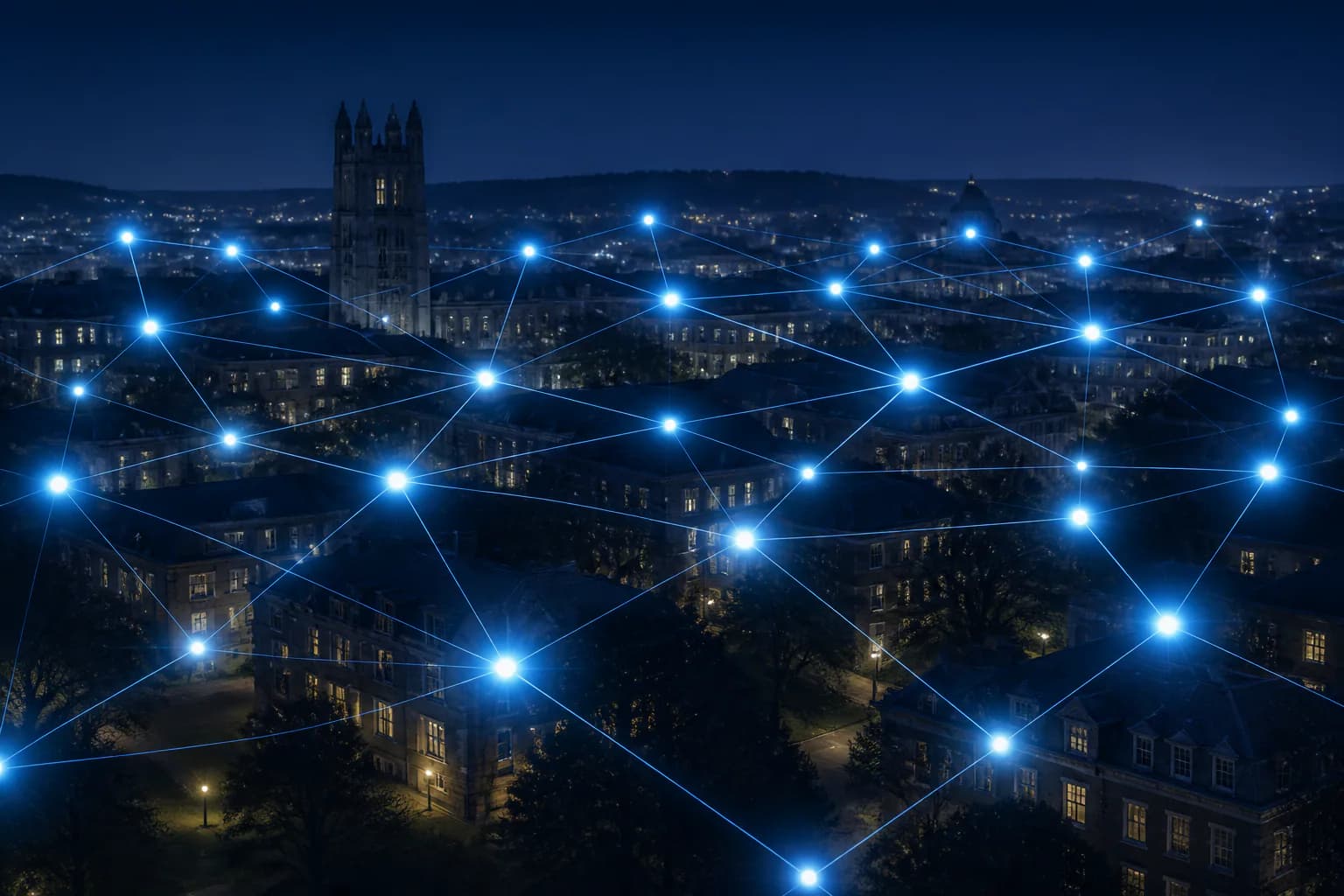
Mark Zuckerberg launched thefacebook.com from his Harvard dorm room on February 4, 2004, with co-founders Eduardo Saverin, Dustin Moskovitz, and Chris Hughes, restricting registration to students holding a verified harvard.edu email address — a scarcity model that made membership feel like an exclusive invitation rather than a routine online sign-up, echoing the university's own admissions mystique.
Unlike the pseudonymous forums and instant-messenger culture that dominated the internet beforehand, Facebook required real names and made friend connections mutually visible to both parties, creating social pressure to participate actively and present a coherent, verifiable identity to peers. Access expanded to other Ivy League schools within weeks, to most U.S. universities by the end of 2004, and finally to the general public in September 2006, dropping the .edu requirement entirely.
The mechanism was the graph itself: people represented as nodes, relationships as edges connecting them, and eventually a News Feed — introduced in September 2006 over vocal user protests that faded within months once the feature proved popular — that could algorithmically rank, surface, and ultimately sell targeted advertising against activity nobody had explicitly published with that commercial purpose in mind.
Zuckerberg and early investors, including venture capitalist Peter Thiel's initial $500,000 angel investment in 2004, gained a company that would eventually reach a trillion-dollar market capitalization under its 2021-renamed parent company, Meta. Early users gained a genuinely useful campus directory and communication tool; over the following decade, they also gained a permanent, searchable public record of their own younger selves, with real consequences for job applications, relationships, and reputations that nobody meaningfully anticipated at the moment of signing up.
Early press coverage focused heavily on campus exclusivity and dorm-room founding mythology, later dramatized commercially in David Fincher's 2010 film The Social Network. It gave far less serious attention to how a persistent, real-name identity graph at global scale would eventually come to underwrite third-party login systems, granular advertising targeting, and political organizing across most of the commercial internet.
The Cambridge Analytica data-harvesting scandal, revealed publicly in March 2018 and involving the improper collection of tens of millions of users' data through a personality-quiz app, and the years of congressional and parliamentary testimony Zuckerberg gave afterward, were direct downstream consequences of a design decision made in a Harvard dorm room: that identity and relationships were themselves the core product, and advertising against them was the underlying business model.
Facebook opened beyond college networks in the mid-2000s and treated friendship as a traversable data structure: profiles, edges, and eventually the News Feed that turned the graph into a ranked attention product. Identity became login infrastructure for the wider web through Facebook Connect.
Advertisers bought not just demographics but social context; developers built on Platform APIs until permissions tightened after successive privacy scandals. The company's later scale fights — from Cambridge Analytica coverage to antitrust cases — all presume the same underlying fact established early: a real-names graph with habitual daily return visits is a scarce and powerful asset.
Feed ranking replaced the social graph's raw chronology with engagement-optimized distribution, a shift Facebook accelerated in the late 2000s. That made the graph not only a directory of people but a machine for allocating attention — the feature that turned a campus utility into a political and commercial battleground.
The September 2006 News Feed revolt — users protesting the sudden broadcast of friend activity — revealed the product's true ambition: not a directory, but a personalized attention channel. Facebook kept the Feed and learned it could ride out UX outrage if retention recovered. That lesson hardened into a company habit.
Facebook Platform (2007) and Connect turned the graph into login and distribution infrastructure for other apps. When Cambridge Analytica later exploded, the scandal presupposed years of permissive API culture. The graph was never only social; it was an identity and advertising operating system.
Publishers who chased Facebook distribution built traffic on rented land; when ranking changed, newsrooms discovered they had outsourced discovery. The graph’s power was never only social bonding — it was the ability to sit between humans and every other institution that needed their attention.
'Login with Facebook' buttons embedded across thousands of unrelated third-party apps and websites, and the platform-regulation fights over antitrust enforcement and content moderation that intensified through the 2020s, all still assume the graph-first architecture this 2004 launch established as the default technical shape of a social network.
Century Signals note: Contemporaneous coverage of News Feed launch and Platform; later reporting on API permissions and Cambridge Analytica; company SEC filings on advertising revenue mix. Editorial judgment about what still structures the present — not a comprehensive history.