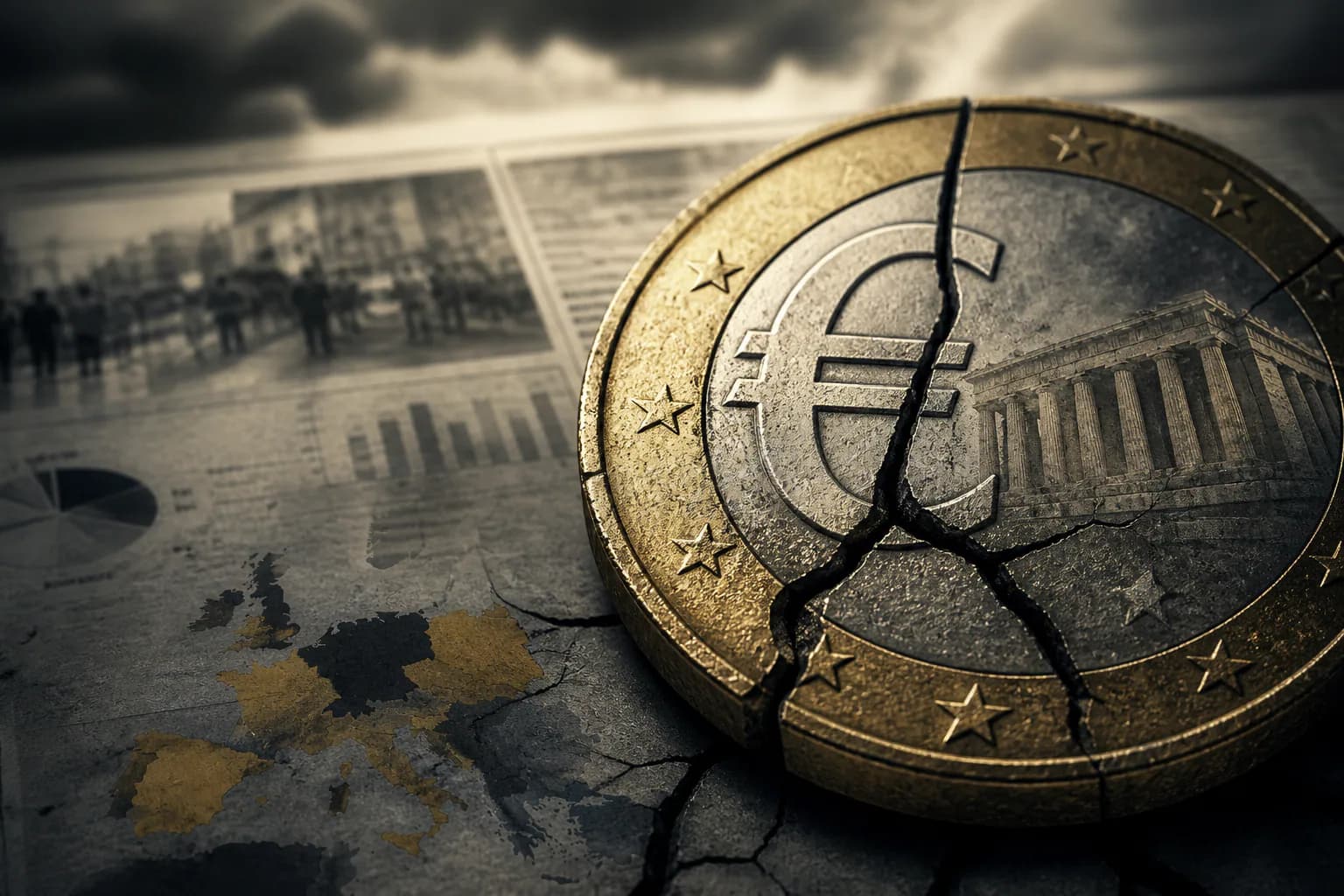
By June 2012, Greek bond yields had spiraled so far that the country held a second general election within six weeks — the June 17 vote functioned as an unofficial referendum on euro membership after the inconclusive May election left no government able to form — while Spanish and Italian borrowing costs climbed toward levels widely seen as unsustainable, and depositors in Greek and Spanish banks quietly moved savings north.
The core vulnerability was a “doom loop” linking banks and governments: when Spanish and Irish banks suffered massive losses on real-estate lending, governments absorbed those losses onto sovereign balance sheets to prevent banking collapse, which then made the sovereigns themselves look riskier, raising their borrowing costs and further weakening the banks that held their bonds — a self-reinforcing cycle with no obvious circuit breaker inside a currency union.
On July 26, 2012, European Central Bank President Mario Draghi told a London investment conference the ECB would do “whatever it takes” to preserve the euro — three words that, backed weeks later by the announced but never actually activated Outright Monetary Transactions bond-buying program, calmed markets more effectively than years of summit communiqués and bailout memoranda had managed, illustrating that a credible backstop can work partly through the threat of use rather than use itself.
Greece received two bailout packages totaling roughly €240 billion tied to austerity conditions — pension cuts, tax increases, public-sector layoffs — that shrank its economy by roughly a quarter over the crisis years, producing unemployment above 25 percent at its peak; Germany and other creditor nations gained leverage to impose fiscal discipline but absorbed lasting political blame across the eurozone periphery for prescriptions many economists later argued were excessively harsh relative to the debt relief actually delivered.
Cyprus's 2013 bailout went further still, imposing a direct “bail-in” that forced losses onto uninsured bank depositors themselves — a step eurozone officials had avoided elsewhere for fear of triggering deposit runs across the periphery — while Ireland and Portugal each accepted their own multi-year bailout programs earlier in the crisis, meaning by 2013 five of the currency union's nineteen members had required emergency external support, a proportion large enough that commentators seriously debated whether the euro itself, rather than any single member state, was the arrangement actually failing the stress test.
Coverage during the crisis concentrated on riot footage from Athens and marathon overnight summit sessions in Brussels; slower to develop was structural analysis of the currency union's incomplete design — a shared currency without shared fiscal transfers or a unified banking backstop — that forced adjustment through internal devaluation, wage and price cuts, rather than currency depreciation, a much more socially costly path that IMF economists themselves later admitted they had underestimated.
The crisis produced Europe's Banking Union, including common bank-supervision and resolution mechanisms, precisely to break the sovereign-bank doom loop, though full fiscal union — mutualized debt across member states — remained politically unattainable until COVID-19 forced the 2020 NextGenerationEU recovery fund, the eurozone's first significant step toward joint borrowing.
Greek debt statistics revisions, Irish bank guarantees, and Portuguese and Spanish spreads turned a currency union into a creditor-debtor political machine. Troika programs imposed austerity conditions that hollowed public services and employment in exchange for financing — a bargain protesters named as democracy's subordination to bond markets.
ECB innovations from SMP to OMT to later QE blurred the line between monetary and fiscal rescue. Banking union advanced incompletely. The crisis taught that without shared fiscal capacity, 'no bailout' clauses become improvisational theater under market pressure.
Youth emigration from crisis countries became a silent structural adjustment. Creditor narratives about ‘profligacy’ met debtor narratives about ‘democracy’; both partially true, neither sufficient. The euro survived by improvising solidarity tools it had sworn it would not need.
Bank-sovereign doom loops taught that national banking systems inside a shared currency can amplify panic. Banking union advanced because markets demanded it. Incomplete fiscal union remains the unfinished sentence of that decade.
Brexit's 2016 vote, driven partly by British voters' skepticism of European institutional overreach displayed during the crisis, and continuing Italian bond-spread anxiety whenever Rome's fiscal plans diverge from Brussels' expectations, both show the underlying tension the crisis exposed — who absorbs the cost of imbalance inside a currency union without full political union — remains unresolved rather than merely quieted by Draghi's 2012 pledge.
Century Signals note: Eurogroup and ECB program documents; contemporaneous FT/Economist crisis coverage; later IMF ex-post evaluations. Editorial judgment about what still structures the present — not a comprehensive history.