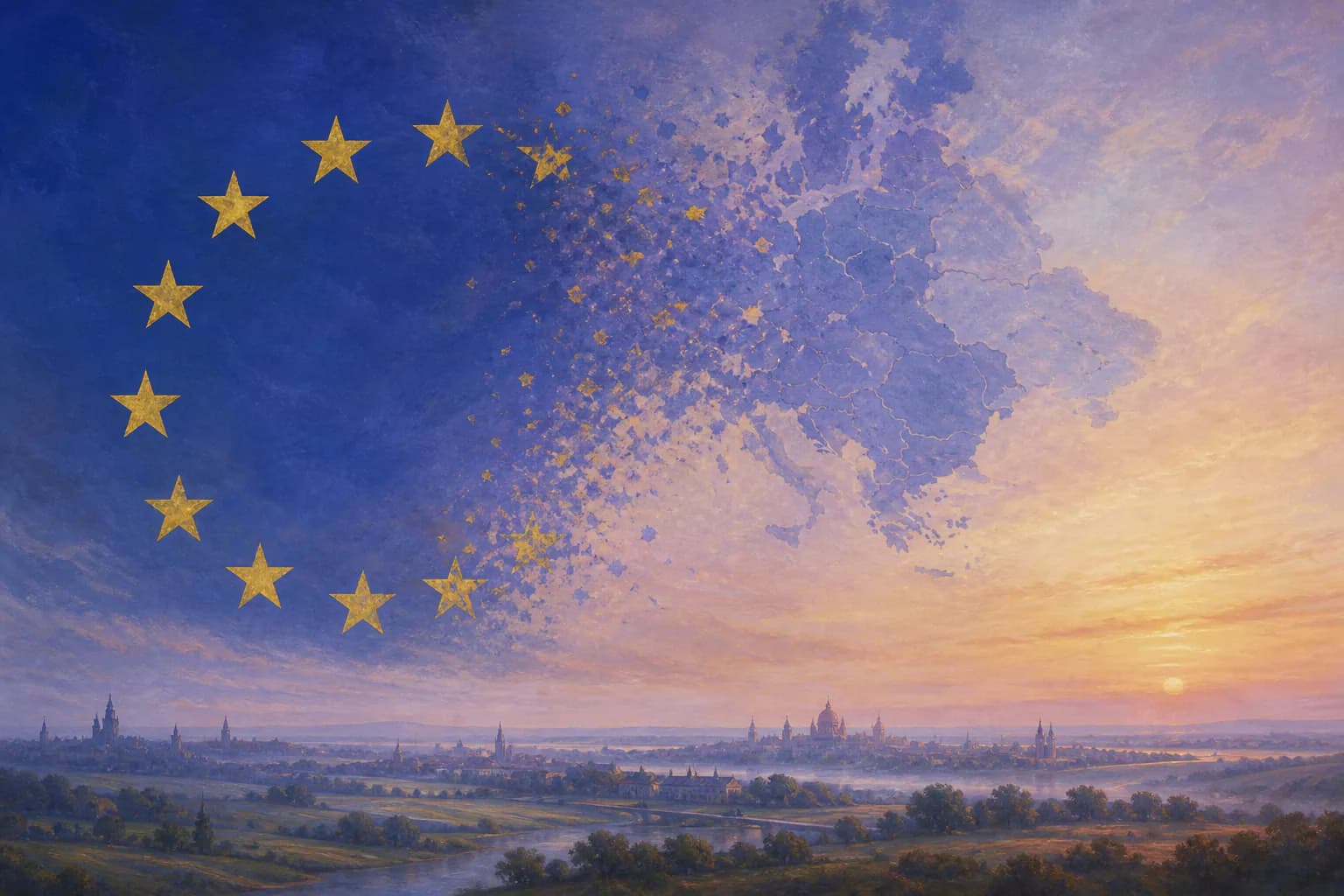
On May 1, 2004, the European Union admitted ten new member states in a single coordinated expansion — Poland, the Czech Republic, Slovakia, Hungary, Slovenia, Estonia, Latvia, Lithuania, Cyprus, and Malta — the largest enlargement in the bloc's history, adding roughly 75 million citizens after most of Central and Eastern Europe had spent nearly half a century behind the Iron Curtain under Soviet influence.
Accession required each candidate country to adopt the full acquis communautaire, the accumulated body of EU law spanning competition policy, environmental standards, food safety, and judicial independence — tens of thousands of pages of regulation that reshaped ministries, courts, and regulatory agencies from Warsaw to Bratislava under the Copenhagen criteria first established at a 1993 European Council summit.
Labor mobility followed almost immediately in the states that opened their labor markets earliest, notably the UK, Ireland, and Sweden, which did not impose the transitional restrictions many other existing members chose to apply for up to seven years. Polish plumbers and Baltic construction workers moved west in large numbers for substantially higher wages, while Western manufacturers simultaneously shifted production east for lower labor costs within the same tariff-free single market — parallel flows the EU had explicitly designed its transition periods to slow but could not fully prevent.
Western European consumers and firms gained access to meaningfully cheaper manufacturing and construction labor. Some new member states experienced significant brain drain in the years that followed, with the Baltic states in particular seeing sustained population loss over the following two decades as younger, educated workers emigrated west for opportunity and frequently did not return home even as domestic wages eventually rose.
Western commentary at the time largely celebrated the moment as a symbolic democratic consolidation completing the promise of 1989 and closing a painful historical wound across the continent. Underexamined in that celebratory framing were the domestic political costs building in receiving countries, where public anxiety about labor competition and immigration would later feed populist political movements — arguably including part of the coalition that ultimately backed the UK's 2016 Brexit referendum.
Hungary and Poland's later, prolonged disputes with Brussels over judicial independence and media freedom, which led the European Commission to launch formal Article 7 proceedings against both countries starting in 2017 and 2018 respectively, demonstrated clearly that formal adoption of EU legal standards back in 2004 did not guarantee their political permanence decades later.
On May 1, 2004, the European Union admitted ten new members, including Poland, Hungary, the Czech Republic, Slovakia, and the Baltic states — the largest single enlargement in EU history. Free movement, structural funds, and regulatory alignment pulled Central and Eastern Europe deeper into Western markets and law.
Politically, enlargement shifted the EU's center of gravity and later complicated unanimity on foreign policy and migration. Economically, it created new manufacturing and services corridors. The promise of 'return to Europe' after communism became a concrete legal order — and a lasting argument about how fast identity, sovereignty, and Brussels rules can converge.
Free movement sent Polish plumbers into British tabloids and Central European graduates into London finance — a human flow that later fed Brexit arguments even as it filled labor gaps. Structural funds rebuilt highways and institutions; rule-of-law conditionality became a recurring fight with Hungary and Poland years afterward.
Geopolitically, enlargement locked a belt of states into EU legal space between Germany and Russia's near abroad. Ukraine's later candidacy debates only make sense against the 2004 precedent: accession is the union's most powerful foreign-policy tool, and its most internally stressful.
Voting weights and agricultural budgets shifted; so did the union’s internal culture wars over judiciary independence and media capture. Enlargement succeeded as geopolitics and strained as a values club. That dual success is why every future accession file arrives already radioactive.
Supply chains from auto parts to IT services knitted the new members into German industrial rhythms. Politics later fought over courts; economics had already integrated. That asymmetry still defines EU east–west arguments.
Ukraine's post-2022 EU candidacy status and the ongoing, often stalled arguments over Western Balkan accession are conducted entirely within the political map this 2004 expansion first drew: a union now large enough to matter decisively on the world stage, but large enough that achieving unanimous consent among all members for further enlargement has become genuinely difficult to obtain.
Century Signals note: EU enlargement treaty materials for the 2004 cohort; contemporaneous European press; later analyses of migration and rule-of-law conditionality. Editorial judgment about what still structures the present — not a comprehensive history.