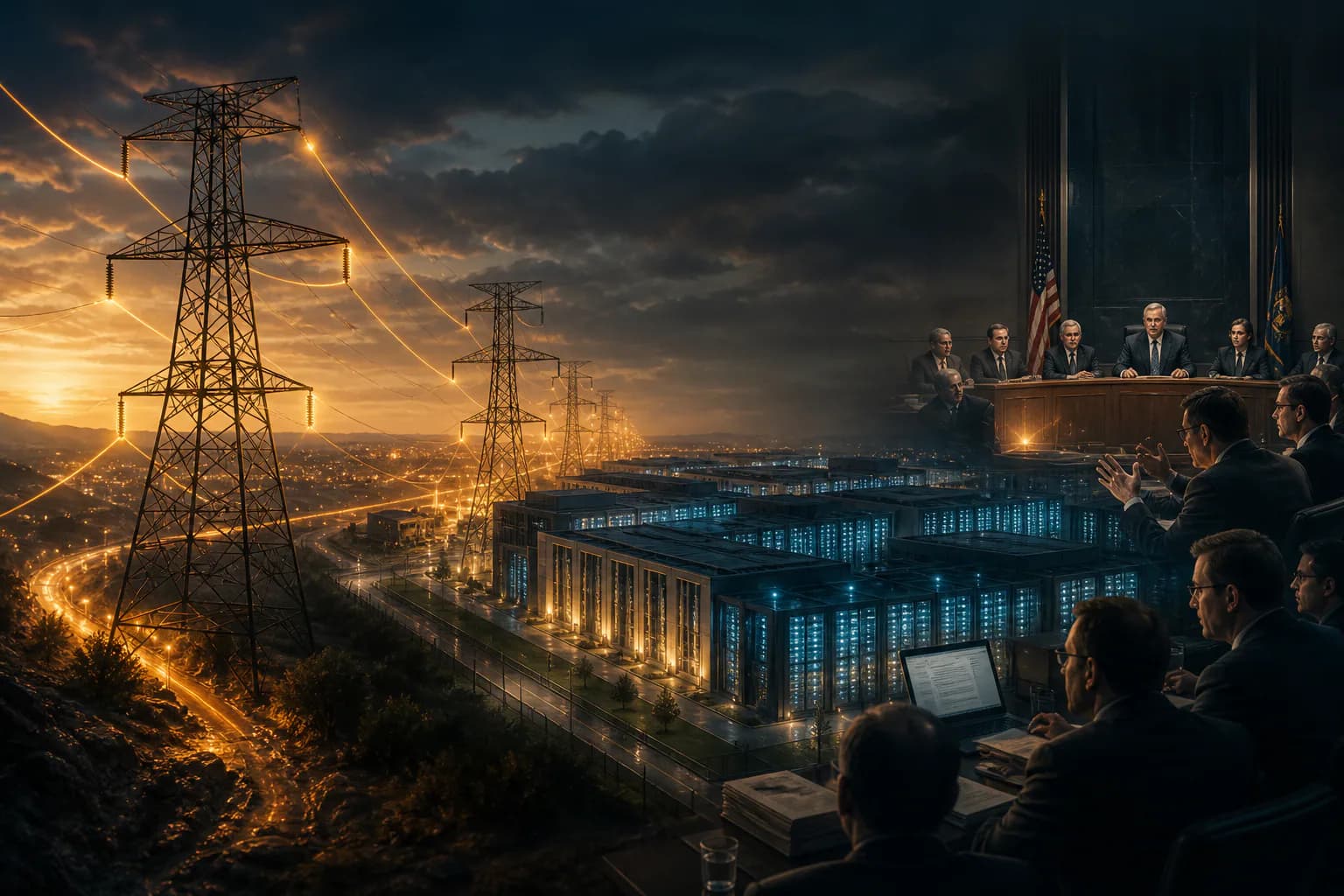
By early 2026, AI data center electricity demand had moved from a projected future concern into a measurable line item shaping utility planning across the United States. Regional grid operators including PJM Interconnection, which serves roughly a dozen mid-Atlantic and Midwest states, saw wholesale capacity auction prices rise sharply in 2024 and 2025 auctions, driven substantially by data center load growth forecasts that utilities had significantly underestimated in planning cycles just a few years earlier.
The mechanism driving the strain was speed mismatch: AI data centers can be built and brought online in roughly one to two years, while new transmission lines, substations, and especially new baseload generation capacity like natural gas plants or nuclear facilities typically require five to ten years from planning to operation, creating a structural gap between data center demand growth and the grid's physical capacity to serve it. Utilities including Georgia Power and Dominion Energy repeatedly revised long-term load forecasts upward through 2024 and 2025 specifically citing data center interconnection requests as the primary driver.
Nuclear power, previously in long-term decline in the U.S. as plants retired faster than new ones were built, became a direct beneficiary: Constellation Energy's agreement with Microsoft, announced in September 2024, to restart the Three Mile Island plant (renamed the Crane Clean Energy Center) specifically to supply a dedicated data center, marked the first planned restart of a permanently shuttered U.S. commercial reactor, and similar restart discussions advanced for other previously retired or mothballed plants, including Palisades in Michigan.
Ratepayer advocacy groups and state utility commissions increasingly pushed back on cost allocation: the central contested question in rate cases across multiple states became whether the cost of new transmission and generation capacity built specifically to serve data centers should be spread across all utility customers or borne directly by the data center operators and their technology-company tenants, with several states moving toward special 'large load' tariff classes requiring data centers to pay a larger, more direct share of dedicated infrastructure costs.
Coverage of AI's energy footprint through 2024 and 2025 focused heavily on aggregate figures — total electricity consumption projections, water usage for cooling — that made for striking headlines but understated the more consequential and localized reality: specific regional grids, interconnection queues, and rate cases where the actual political and economic fights over who pays for AI's power were being decided county by county and utility commission by utility commission, largely outside national news coverage.
Renewable energy developers found themselves in an unexpected competitive position: some data center operators, unable to wait years for new gas or nuclear capacity, signed long-term power purchase agreements directly with wind and solar projects paired with battery storage, occasionally accelerating renewable buildout in regions where it had previously stalled for lack of a large, creditworthy buyer willing to sign a multi-decade contract.
Gas turbine manufacturers including GE Vernova and Siemens Energy reported order backlogs stretching several years by 2025 and into 2026, as utilities and data center developers alike sought new natural gas generation capacity as the fastest available option to meet near-term demand, complicating state and federal climate targets that had assumed a continued shift away from gas generation rather than a renewed buildout driven by AI demand.
Data-center load growth forced utilities to reopen peaker plants, accelerate interconnect queues, and renegotiate nuclear restarts. AI training clusters compete with electrification of cars and heat for megawatts. Local politics now pits tax base against noise, water, and rate impacts.
Hyperscalers sign behind-the-meter and renewable PPAs that redesign grid planning assumptions. Energy scarcity — not model architecture — may pace AI deployment in several regions. The grid became an AI product constraint hiding in plain sight.
Ratepayers ask why their bills fund someone else’s model training. Grid operators ask who signs the firm capacity. AI’s energy hunger makes climate and compute policy the same conversation whether legislatures admit it or not.
The durable inheritance is that data center electricity demand has become a permanent, named variable in U.S. energy and climate policy rather than a temporary anomaly to plan around: utility integrated resource plans, state renewable energy targets, and nuclear policy debates now explicitly model AI-driven load growth as a baseline planning assumption, a shift in energy policy's core variables that occurred within roughly three years and shows no sign of reversing.
Century Signals note: Utility IRP and EIA load forecasts; data-center energy journalism; corporate PPA and nuclear-restart announcements. Editorial judgment about what still structures the present — not a comprehensive history.