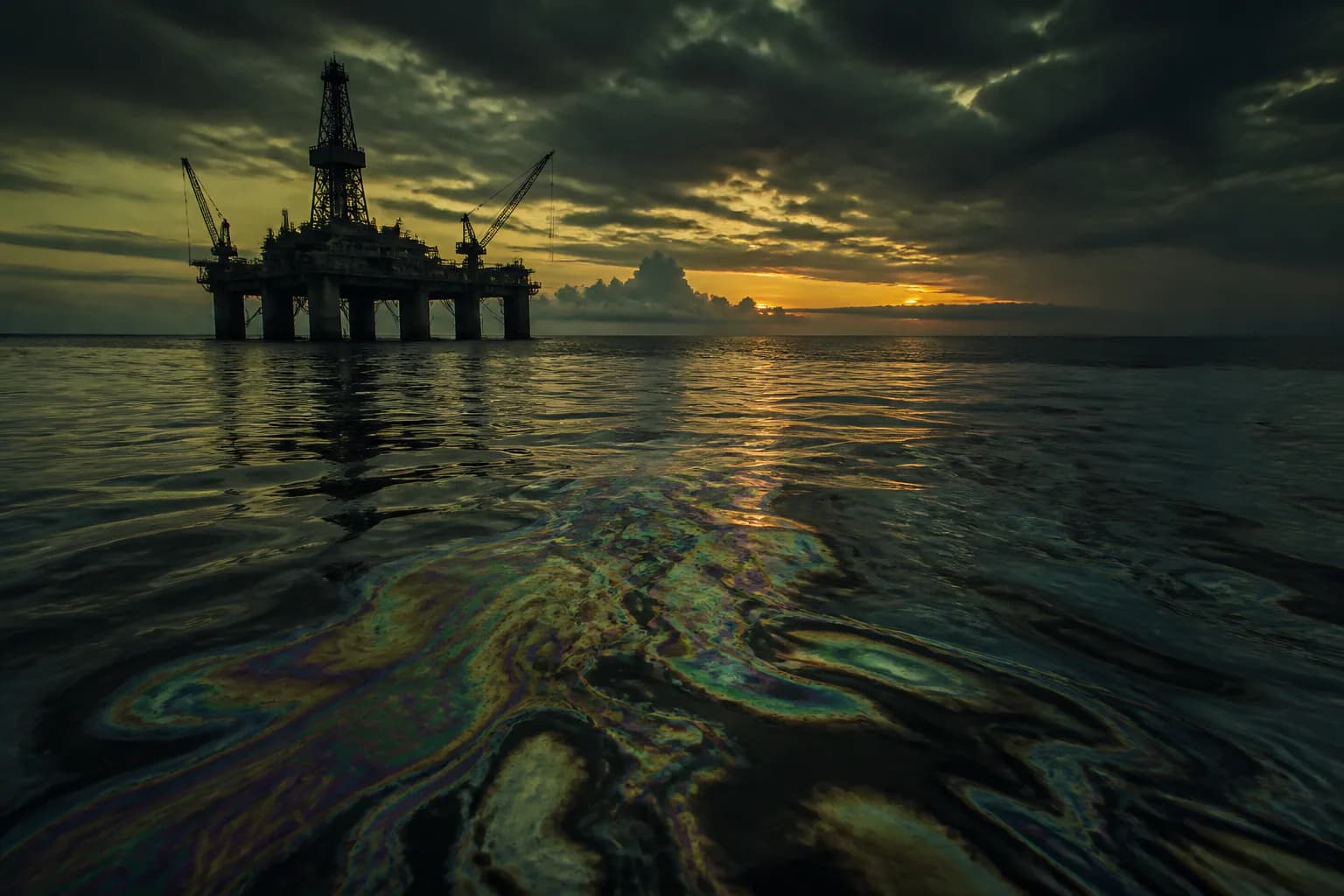
On April 20, 2010, a blowout on BP's Macondo well, drilled by the contracted rig Deepwater Horizon roughly 40 miles off Louisiana, killed 11 workers and triggered a spill that ran uncapped for 87 days, releasing an estimated 4.9 million barrels of oil into the Gulf of Mexico — the largest marine oil spill in U.S. history.
The blowout preventer, a stack of valves meant to seal the well in exactly this scenario, failed to function correctly; live underwater video of oil gushing from a mile below the surface, broadcast for weeks as engineers tried and failed with a series of named fixes — “top kill,” “junk shot,” containment domes — turned technical failure into a nationally watched symbol of an industry that had drilled farther and deeper than its safety systems had kept pace with.
The mechanism was misaligned incentives compounding technical risk: lease economics and schedule pressure at multiple contractors — BP, rig operator Transocean, and cement contractor Halliburton — rewarded speed on a well already behind schedule, while safety audits and blowout-preventer testing had become routine paperwork rather than genuine stress tests, a gap the presidential investigative commission later attributed to systemic industry and regulatory failure, not a single company's negligence.
BP ultimately paid more than $65 billion in cleanup costs, fines, and settlements, including a record $20.8 billion Clean Water Act settlement in 2015; Gulf Coast fishing and tourism industries lost a season of income and, in some cases, a generation of consumer trust in Gulf seafood. The federal Minerals Management Service, which had regulated offshore drilling while also collecting its royalties — a conflict of interest widely cited afterward — was dissolved and split into three separate agencies in 2011.
Investigators later traced the immediate trigger to a faulty cement seal at the bottom of the well, poured by Halliburton using a slurry design that internal tests had flagged as potentially unstable, combined with misread pressure tests on the rig that crew members interpreted, incorrectly and under time pressure, as evidence the well was secure — a chain of small misjudgments rather than one obvious failure. A relief well finally intersected and permanently sealed Macondo on September 19, 2010, nearly five months after the initial explosion, by which point independent flow-rate estimates had already revised the spill's severity upward several times over BP's early, much lower figures.
Coverage tracked oiled pelicans, President Obama's beach visits, and BP CEO Tony Hayward's widely mocked comment that he'd “like his life back” — vivid, but secondary to slower investigative work on the actual decision chain aboard the rig and the gap between modeled worst-case spill scenarios, which understated the real event by orders of magnitude, and what the industry was actually prepared to contain.
The Obama administration's six-month deepwater drilling moratorium, new well-design and blowout-preventer certification rules, and the creation of the Bureau of Safety and Environmental Enforcement all trace to Macondo, as does the routine practice, now standard across the industry, of maintaining pre-staged capping stacks near major offshore fields rather than improvising containment after a blowout begins.
The Macondo well blowout killed eleven workers and released oil for eighty-seven days into the Gulf of Mexico. Blowout-preventer failure and cementing decisions became case studies in high-reliability organization failure. BP's liability, claims processes, and coastal restoration funds stretched for years.
Moratoria on deepwater drilling, new BSEE oversight, and industry safety-case reforms followed. Energy markets priced a temporary supply scare; coastal communities priced a longer ecological and livelihood shock. Offshore risk governance never returned to pre-2010 casualness — even as drilling resumed.
Coastal wetlands and fisheries carried damages that settlement dollars only partly translated. Energy firms updated safety cases while still chasing deepwater barrels. The spill’s present tense is a stricter permission structure for failure — and a public that remembers oil on beaches when executives cite probabilistic models.
Claims processes created a second bureaucracy of proof for fishers and hoteliers. Corporate pledges on safety culture met inspector skepticism. Deepwater remains profitable and permanently on probation in the public mind.
Every subsequent argument about offshore drilling expansion, Arctic leasing, and the pace of the energy transition now carries Macondo as a reference point for what “worst case” actually looks like, and ESG scrutiny of energy majors' safety records draws its methodology substantially from the post-spill audits Congress demanded.
Century Signals note: National Commission on the BP Deepwater Horizon Oil Spill; Coast Guard/CSB investigations; contemporaneous Gulf reporting. Editorial judgment about what still structures the present — not a comprehensive history.