Chinese AI startup DeepSeek, backed by the quantitative hedge fund High-Flyer, released its R1 reasoning model on January 20, 2025, an open-weight model that independent benchmarking found competitive with OpenAI's o1 model on several reasoning and mathematics tasks. The company's accompanying technical paper claimed the final training run cost roughly $5.6 million, a figure far below the hundreds of millions to billions reportedly spent training frontier models at OpenAI, Google, and Anthropic — a claim that sparked immediate debate over what costs it did and did not include, such as prior research runs and underlying hardware investment.
The mechanism that rattled markets was the challenge to a core Silicon Valley assumption: that frontier AI capability required massive, expensive compute clusters built on the most advanced chips, an assumption that had justified hundreds of billions of dollars in planned AI infrastructure spending by U.S. hyperscalers. DeepSeek's engineering choices — including more efficient mixture-of-experts architecture and lower-precision training techniques — suggested capable models might be achievable with meaningfully less compute than the industry's dominant scaling narrative implied, raising doubts about whether existing Nvidia GPU demand projections could hold.
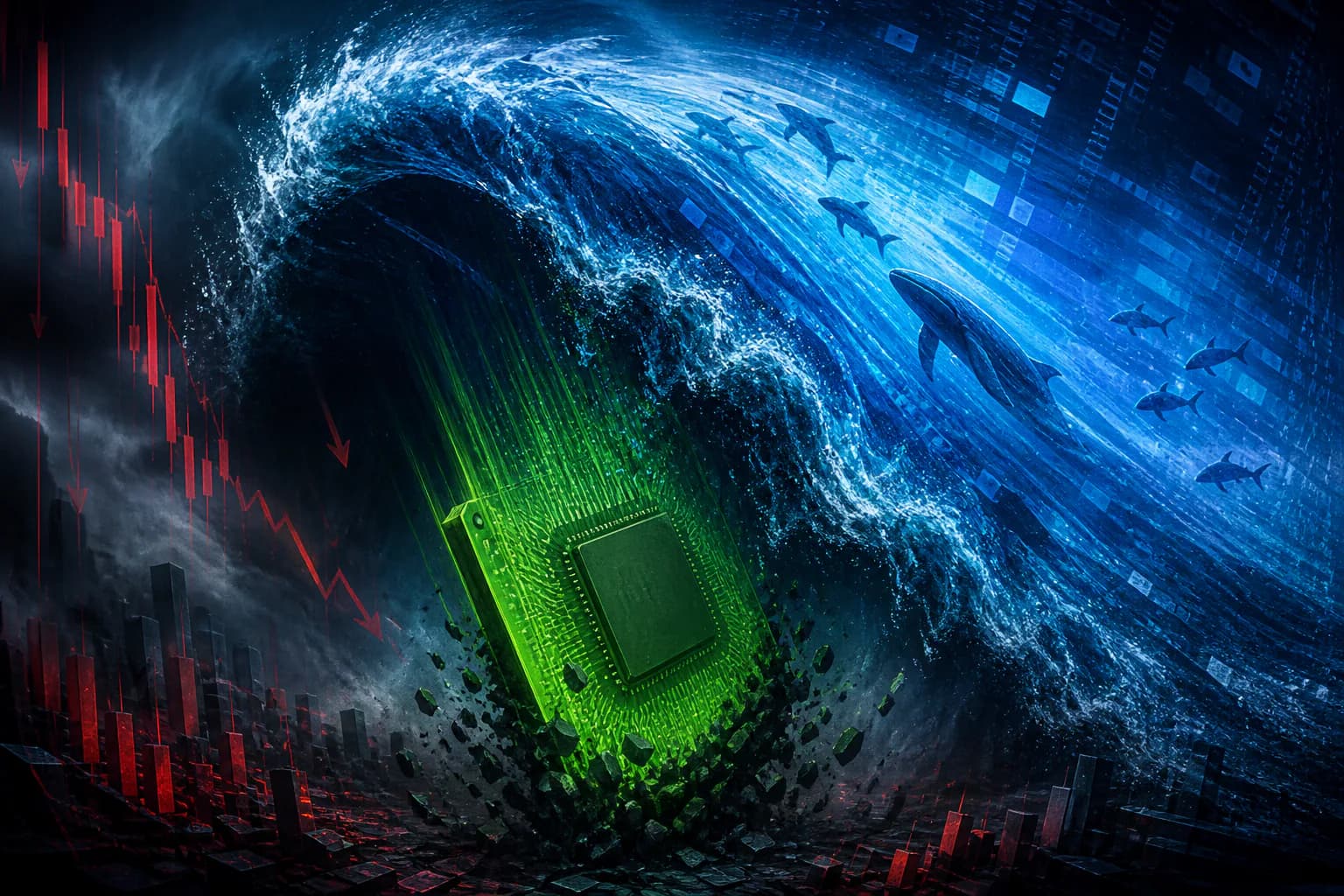
Nvidia's stock fell approximately 17 percent on January 27, 2025, erasing roughly $600 billion in market capitalization in a single trading session, the largest one-day dollar loss for any company in U.S. stock market history, as investors reassessed AI infrastructure spending assumptions across the sector. Other AI-infrastructure-adjacent stocks, including power utilities and data-center suppliers that had rallied on AI capital-expenditure expectations, fell alongside it.
DeepSeek's app became the top free download on Apple's U.S. App Store within days of release, demonstrating consumer-facing distribution reach for a Chinese AI product inside the U.S. market despite existing chip export controls aimed at slowing exactly this kind of capability development. U.S. policymakers and export-control advocates who had championed the 2022–2023 chip restrictions faced immediate scrutiny over whether the controls had meaningfully slowed Chinese AI progress at all, or had instead incentivized more efficient, workaround engineering that achieved comparable results with fewer advanced chips.
Coverage in the days after the crash emphasized market panic and the U.S.-China competitive framing almost exclusively. It underweighted the more durable technical question DeepSeek's release actually raised: whether continued scaling of compute spending was still the dominant path to AI capability gains, or whether algorithmic efficiency gains could substitute for raw compute in ways that would eventually make chip export controls a weaker lever than policymakers assumed.
DeepSeek's decision to release its model weights openly, under a permissive license allowing commercial use and modification, also distinguished it from the closed-weight approach OpenAI and Anthropic had favored, and researchers worldwide could independently verify and build on its architecture within days — an openness that spread its influence on subsequent open-source model development faster than a closed release could have.
Nvidia's stock recovered over subsequent months as major U.S. AI labs and hyperscalers reaffirmed massive planned capital expenditure on AI infrastructure regardless of DeepSeek's efficiency claims, suggesting the market's initial panic overcorrected on the assumption that efficiency gains would substitute for, rather than complement, continued compute scaling. Chinese AI labs following DeepSeek's approach continued releasing competitive open-weight models through 2025, normalizing China as a credible frontier competitor rather than a perpetual follower.
DeepSeek's competitive model releases at claimed lower training cost challenged the assumption that only U.S. hyperscalers could field frontier-class systems. Markets repriced AI chip demand narratives overnight; open-weight distribution widened access beyond API gatekeepers.
Export-control strategists confronted the possibility that efficiency innovations blunt hardware chokepoints. Western labs answered with faster release cycles. The disruption's core lesson: capability leadership is a moving target measured in months, not decades.
Researchers debated distillation and data quality as much as raw cluster size. Policymakers faced an awkward update: controls slow rivals, they do not freeze physics. Open-weight releases keep forcing the question of who the customer of AI safety is.
The episode's lasting inheritance is a permanent asterisk on AI infrastructure investment theses: every subsequent capital expenditure announcement from hyperscalers building AI data centers has since been weighed against the possibility that algorithmic efficiency gains could reduce compute requirements faster than demand grows, a risk factor that did not feature prominently in AI infrastructure discourse before DeepSeek's release forced the market to price it in.
Century Signals note: DeepSeek release technical reports and contemporaneous market reaction coverage; export-control and open-weight policy analyses. Editorial judgment about what still structures the present — not a comprehensive history.