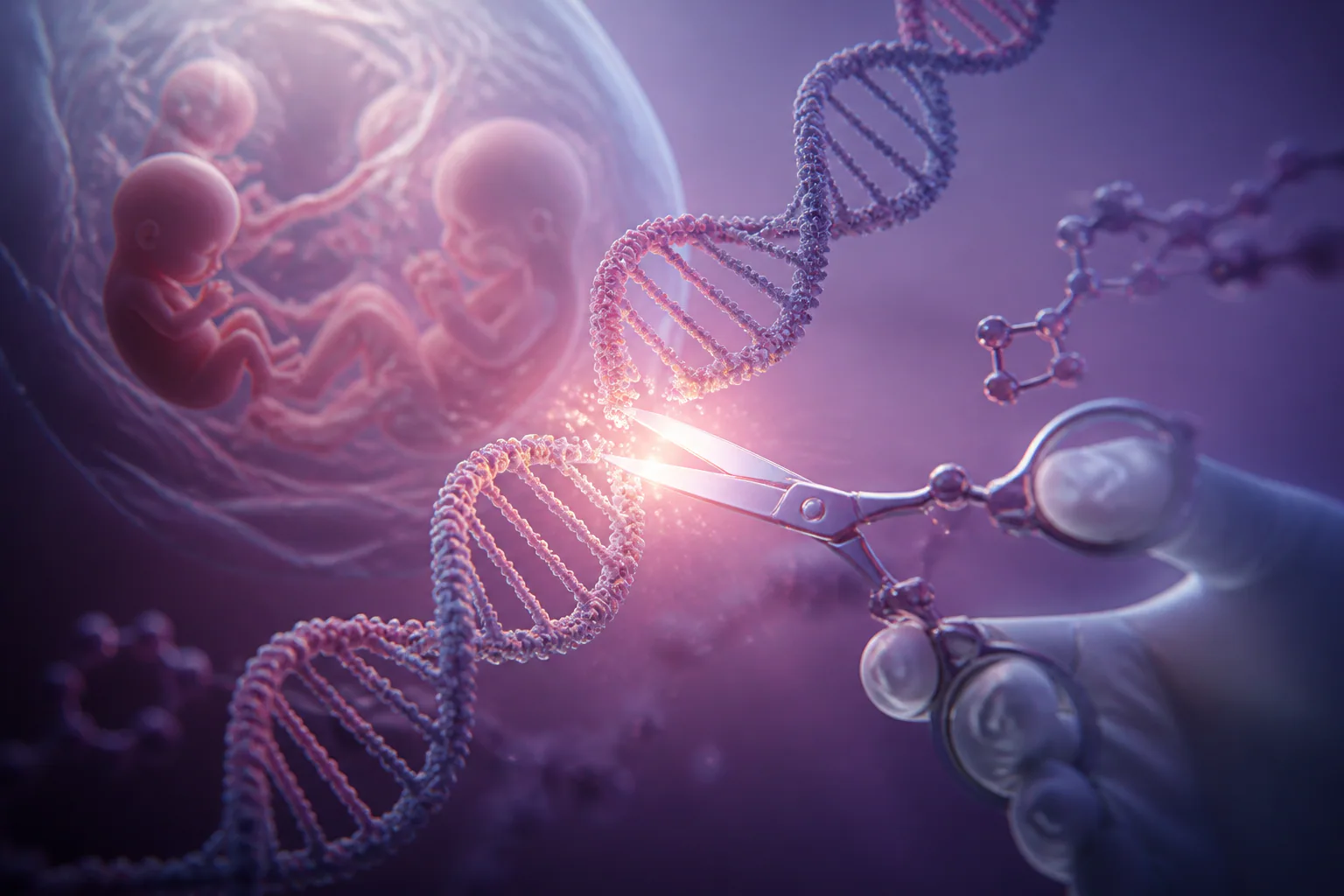
In November 2018, Chinese researcher He Jiankui announced at the Second International Summit on Human Genome Editing in Hong Kong that he had used CRISPR-Cas9 gene editing on human embryos to create twin girls, given the pseudonyms Lulu and Nana, who were born that October at a Shenzhen hospital. He said he had disabled the CCR5 gene, which HIV uses to enter cells, aiming to make the girls resistant to the virus their father carried, using a rationale most geneticists immediately called scientifically unnecessary given existing, safer methods to prevent HIV transmission from father to child.
The mechanism He exploited was regulatory rather than purely scientific: while CRISPR gene editing was well established in labs by 2018, having been developed as a genome-editing tool starting around 2012, virtually every national scientific body and the 1997 UNESCO Universal Declaration on the Human Genome had treated germline editing — edits that pass to future generations — as off-limits pending broad societal consensus that had never been formalized into binding international law, leaving the restriction resting on norms rather than enforceable statute.
He conducted the work with limited institutional oversight, later found by Chinese investigators to have used forged ethical review documents from a hospital that denied approving the research, and recruited couples through an HIV support organization, offering free IVF treatment in exchange for participation, according to subsequent investigation by Chinese authorities and independent reporting.
The immediate scientific community response was near-universal condemnation; more than 100 scientists signed an open letter within days calling the experiment reckless and premature, and He's employer, Southern University of Science and Technology, suspended him and later terminated his position. He was sentenced by a Shenzhen court in December 2019 to three years in prison and a fine of 3 million yuan, having been convicted of "illegal medical practice" alongside two collaborators who received shorter sentences. A third CRISPR-edited child, born to a different couple in He's study, was later confirmed to exist as well, bringing the total number of known gene-edited children to three.
Coverage at the time leaned heavily into the dramatic, dystopian framing of "designer babies" evoking science-fiction comparisons, and underweighted the more consequential institutional failure it exposed: that no binding global mechanism existed to prevent a single well-funded scientist from unilaterally crossing a bright line the field had assumed would hold through informal consensus alone, without any single regulator having clear jurisdiction to stop him in advance.
In the aftermath, the U.S. National Academies and the World Health Organization each convened new expert panels within months; the WHO established an international registry for human genome editing research in 2019 requiring researchers to register clinical trials involving heritable editing, and China itself introduced stricter regulations on gene-editing research and reproductive technology in 2021, including new criminal liability provisions for unauthorized human genetic experiments that had not previously existed in Chinese law.
He Jiankui was released from prison in April 2022 and, in a move that alarmed many bioethicists, announced plans to continue gene-editing research focused on rare disease prevention, drawing renewed scrutiny over whether the institutional guardrails built since 2018 were sufficient to prevent a repeat of his original unauthorized experiment.
He Jiankui's announcement of gene-edited twin girls crossed a bright ethical line from somatic therapy debates into heritable human genome editing. Scientific summits had warned against it; a rogue experiment made the warning concrete. Prison sentences and research bans followed in China.
The episode hardened international calls for moratoria and oversight while accelerating legitimate CRISPR medicine under stricter review. Bioethics ceased to be conference language alone. Capability had outrun consensus — a pattern AI safety advocates later cited by analogy.
Scientific self-policing looked insufficient next to national prestige incentives. Journals and funders tightened genome-editing statements. The episode remains the bioethics fire drill for every next dual-use biology leap.
Legitimate somatic gene-therapy trials had to re-explain their ethics in the scandal’s glare. Public trust is sticky once burned. Heritable editing remains the bright line most academies still refuse to cross.
The episode remains the reference point for germline-editing governance debates: whenever CRISPR-based therapies advance toward clinical use, or new embryo-editing techniques emerge, He's case is the cautionary example institutions invoke to justify why oversight needs to be built into research approval before an experiment happens, not after.
Century Signals note: He Jiankui announcement coverage; national academy summit statements; Chinese court reporting; CRISPR clinical-trial oversight materials. Editorial judgment about what still structures the present — not a comprehensive history.