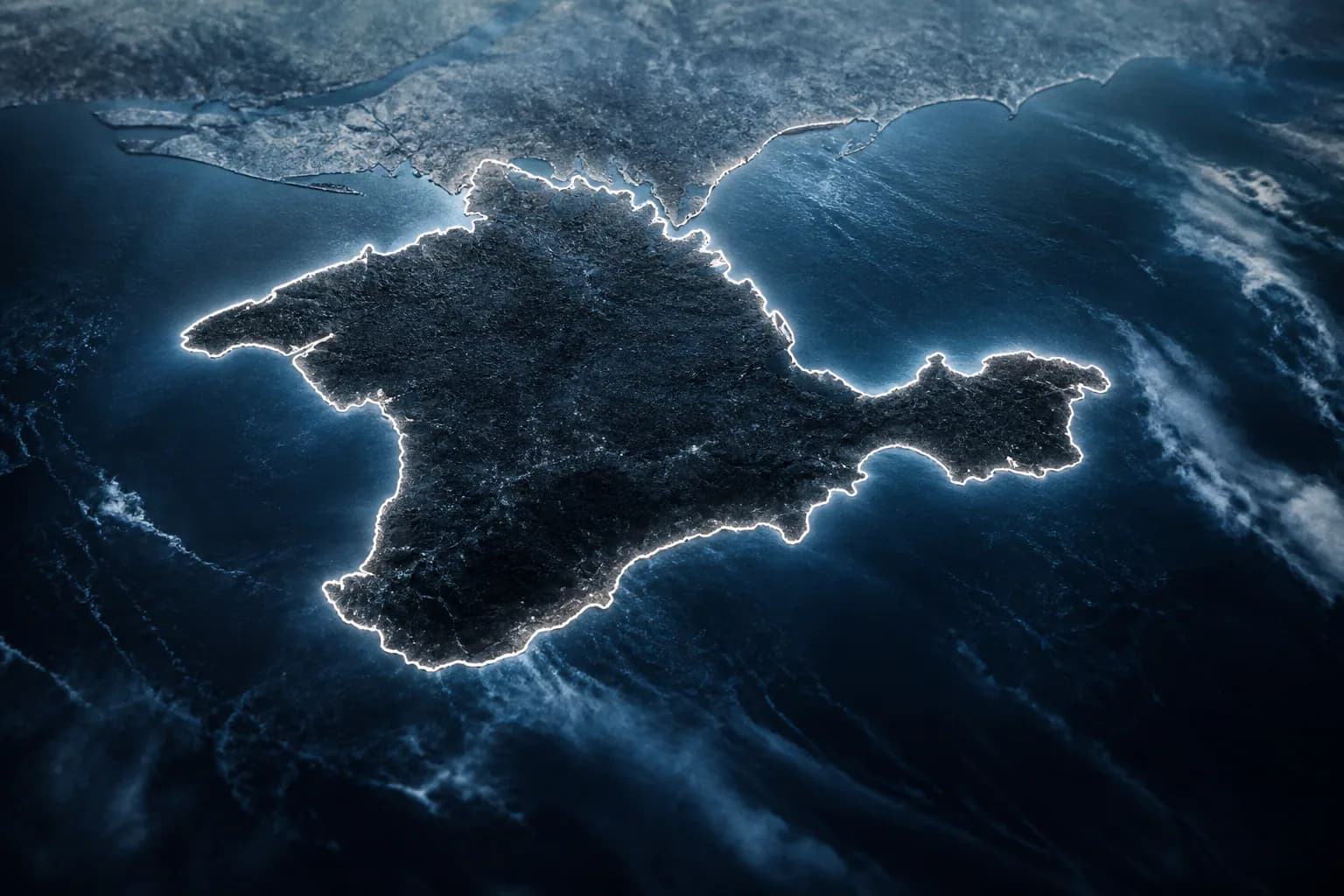
In late February 2014, armed men without insignia — soon nicknamed "little green men" — seized Crimea's parliament building, airports, and key infrastructure across the peninsula, days after Ukraine's president Viktor Yanukovych fled Kyiv following months of Euromaidan protests that had left more than 100 people dead. Russia's government initially denied the soldiers were its own, a fiction President Putin dropped only weeks later, once the takeover was complete and irreversible.
The annexation ran through a deliberately compressed timeline: local authorities installed under military pressure scheduled a referendum for March 16, 2014 — just over two weeks after the takeover began — giving voters a ballot with two options, both amounting to leaving Ukraine, and no option to preserve the status quo. Russia's parliament ratified annexation within days of a reported 97 percent vote in favor, a result Western governments, the UN General Assembly, and independent observers did not recognize as free or fair.
The operation depended on infrastructure Russia had cultivated for years: its Black Sea Fleet basing rights in Sevastopol under a lease with Ukraine gave it a legal pretext for troop presence already on the ground, while a sympathetic ethnic-Russian majority in Crimea and a weak, transitional government in Kyiv, still assembling itself after Yanukovych's ouster, reduced the odds of armed resistance to something close to zero.
Russia gained a peninsula it had wanted since the Soviet collapse and secured its Black Sea naval position for decades to come. Ukraine lost roughly 10,000 square miles of territory and, functionally, its Crimean population and naval infrastructure overnight, including much of its own navy, which Russia seized in port. The G8 responded by expelling Russia, turning it back into the G7 for the first time since 1997, and Western governments imposed sanctions targeting individuals and select sectors — measures that curtailed some investment but left Russia's core energy-export economy intact and its stock market recovering within a year.
Coverage in 2014 emphasized the referendum's staged legitimacy and the diplomatic theater of G7 expulsion, while underweighting how limited and reversible the sanctions regime actually was. Few outlets asked directly whether a response calibrated to avoid escalation was also calibrated to avoid deterrence — a question that mattered enormously once Russia tested the West's appetite again less than a decade later.
The annexation also normalized a specific playbook: deniable forces, a manufactured legal pretext, a rushed vote, and a bet that the cost of a muted international response would be tolerable. Crimea's occupation was never reversed, and its infrastructure — including the 12-mile Kerch Strait Bridge completed in 2018, connecting the peninsula directly to Russia — was built out as if the annexation were permanent, which in practical terms it became.
Simmering conflict in Ukraine's eastern Donbas region, fueled by Russian-backed separatists using the same deniable-forces model tested in Crimea, continued for eight years under the fragile 2015 Minsk agreements, which never produced a durable settlement, left more than 14,000 dead by most tallies, and left both sides rearming rather than reconciling.
Little green men, a disputed referendum, and rapid legal incorporation into the Russian Federation shattered post-Cold War assumptions that European borders were settled. Sanctions regimes and SWIFT debates entered tools of statecraft for Western capitals that had preferred trade interdependence as peace theory.
Ukraine lost strategic naval geography; NATO's eastern flank rediscovered deterrence urgency. Minsk agreements managed a frozen conflict that never truly froze. 2014 was the rehearsal year for the full-scale war that followed — ignored at peril by those who called it a regional quarrel.
Energy pipelines and oligarch asset fights became parallel fronts to the map. Western publics debated Ukraine fatigue years before the full-scale war forced clarity. 2014’s unfinished business was not a frozen footnote — it was a burning fuse misfiled as diplomacy.
Passportization and ruble conversion tried to make faits accomplis feel administrative. Sanctions lists lengthened in annual rituals. The peninsula’s seizure normalized map revision as a twenty-first-century European tool.
That unresolved conflict, and the West's underestimation of Russian intent it reflected, both scaled up dramatically in February 2022, when Russia launched a full invasion of Ukraine using many of the same justifications rehearsed in 2014. The much harsher sanctions, NATO rearmament, and energy-market disruptions that followed the larger invasion were, in large part, corrections to how mild the 2014 response had been.
Century Signals note: UNGA votes and OSCE reporting; contemporaneous annexation coverage; sanctions-program documentation. Editorial judgment about what still structures the present — not a comprehensive history.