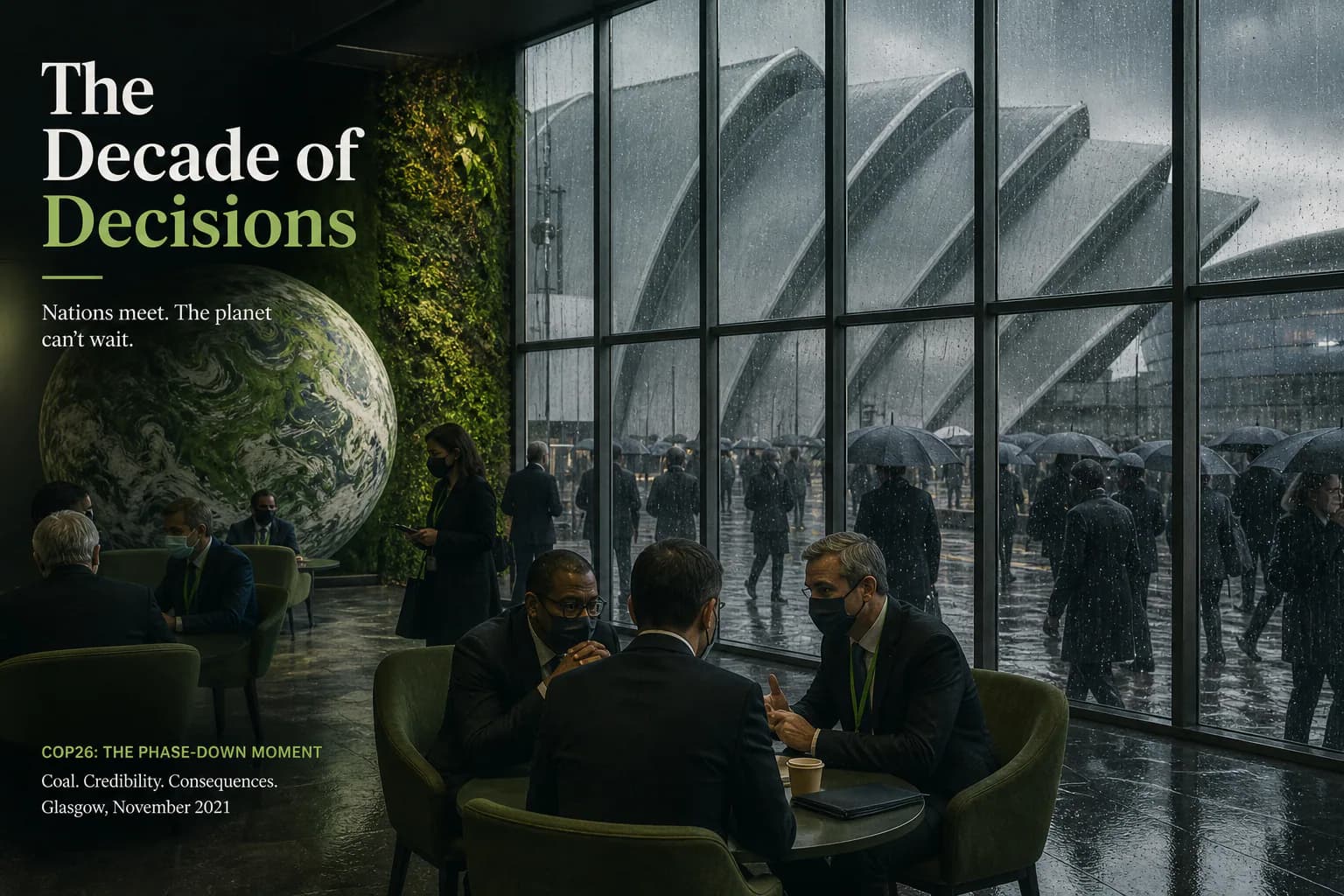
The 26th UN Climate Change Conference, held in Glasgow in November 2021, produced the Glasgow Climate Pact, the first COP agreement to explicitly reference coal and fossil fuels in its text after 25 prior conferences avoided naming them directly. In the summit's closing session, India's negotiator objected to language calling for a coal 'phase-out,' and the text was amended live on the floor to 'phase down,' a change China supported and that visibly frustrated COP president Alok Sharma, who apologized to delegates for the last-minute weakening.
The mechanism worth tracking was less the headline pledge than the negotiating architecture beneath it. More than 100 countries signed the Global Methane Pledge, committing to cut methane emissions 30 percent by 2030 from 2020 levels, targeting a gas with outsized near-term warming impact from oil and gas leaks, landfills, and agriculture. A separate declaration on forests, also signed by over 100 countries including Brazil and Indonesia, pledged to end deforestation by 2030 — a target with no binding enforcement mechanism, resting instead on national reporting and voluntary finance.
Negotiators also finalized the rulebook for Article 6 of the Paris Agreement, the section governing international carbon markets, after six years of failed attempts at prior summits. The rules set accounting standards to prevent double-counting of emissions reductions across countries, a technical fix that determined whether carbon offset markets could function as a credible mechanism at all rather than a bookkeeping fiction.
Fossil fuel producers and heavy industry in developing economies that rely on coal for cheap power, India and China prominent among them, secured softer language than climate-vulnerable island nations wanted; the Alliance of Small Island States pushed for stronger finance commitments and lost. Wealthy nations again fell short of the $100 billion in annual climate finance for developing countries they had first pledged in 2009, a shortfall that shadowed every subsequent summit's credibility.
Coverage in November 2021 fixated heavily on the 'phase down' versus 'phase out' drama and on protests outside the venue, including demonstrations led by Greta Thunberg, which generated more press attention than the methane pledge's mechanics or the Article 6 rulebook — the parts of the agreement with the clearest path to measurable effect. Underweighted almost entirely was adaptation finance, which vulnerable countries argued mattered more immediately than mitigation pledges decades from payoff.
Atmospheric CO2 concentrations continued rising through the years following Glasgow, and global coal consumption hit a record high in 2023, underscoring how far pledges outran physical trends. Still, the methane pledge produced measurable follow-through: satellite monitoring of methane leaks expanded significantly in subsequent years, and the U.S. EPA finalized new methane emission rules for oil and gas operations building directly on the Glasgow commitment.
Developing nations that had pushed hardest for a loss-and-damage finance mechanism to compensate for climate harms already occurring left Glasgow without one; that fight carried forward for another year until COP27 in Sharm el-Sheikh finally established a loss-and-damage fund in 2022, a direct sequel to the unresolved finance argument that dominated Glasgow's final, contentious hours.
Glasgow's negotiated cover text nudged coal language and finalized Paris rulebook pieces on carbon markets. Leaders' pledges on methane and deforestation generated headlines; implementation gaps generated the sequel. Youth and Global South delegates staged the moral contrast inside the venue.
Net-zero corporate pledges proliferated alongside scrutiny of offsets. Finance mobilization remained the binding constraint. COP26's mechanism was procedural completion plus pledge inflation — useful scaffolding, insufficient physics.
Finance ministers mattered as much as environment ministers; draft text brackets were combat. Activists called it failure, diplomats called it progress, scientists called the emissions gap unchanged. COP theater persists because no harder venue yet replaces it.
Side deals on cars, methane, and forests tried to outrun the negotiated text. Implementation dashboards later showed the gap. Glasgow’s value was stacking pressure mechanisms, not a single magic paragraph.
Article 6's carbon market rules now underpin a growing, if still contested, voluntary and compliance carbon credit market, and the phase-down language — however watered down — became the baseline that subsequent COPs built on, including the 2023 Dubai summit's call to 'transition away from fossil fuels.' Glasgow's real inheritance is procedural: it set the diplomatic template of incremental, contested language that every following climate summit has followed rather than exceeded.
Century Signals note: UNFCCC COP26 outcomes documents; contemporaneous negotiation reporting; subsequent pledge-tracking analyses. Editorial judgment about what still structures the present — not a comprehensive history.