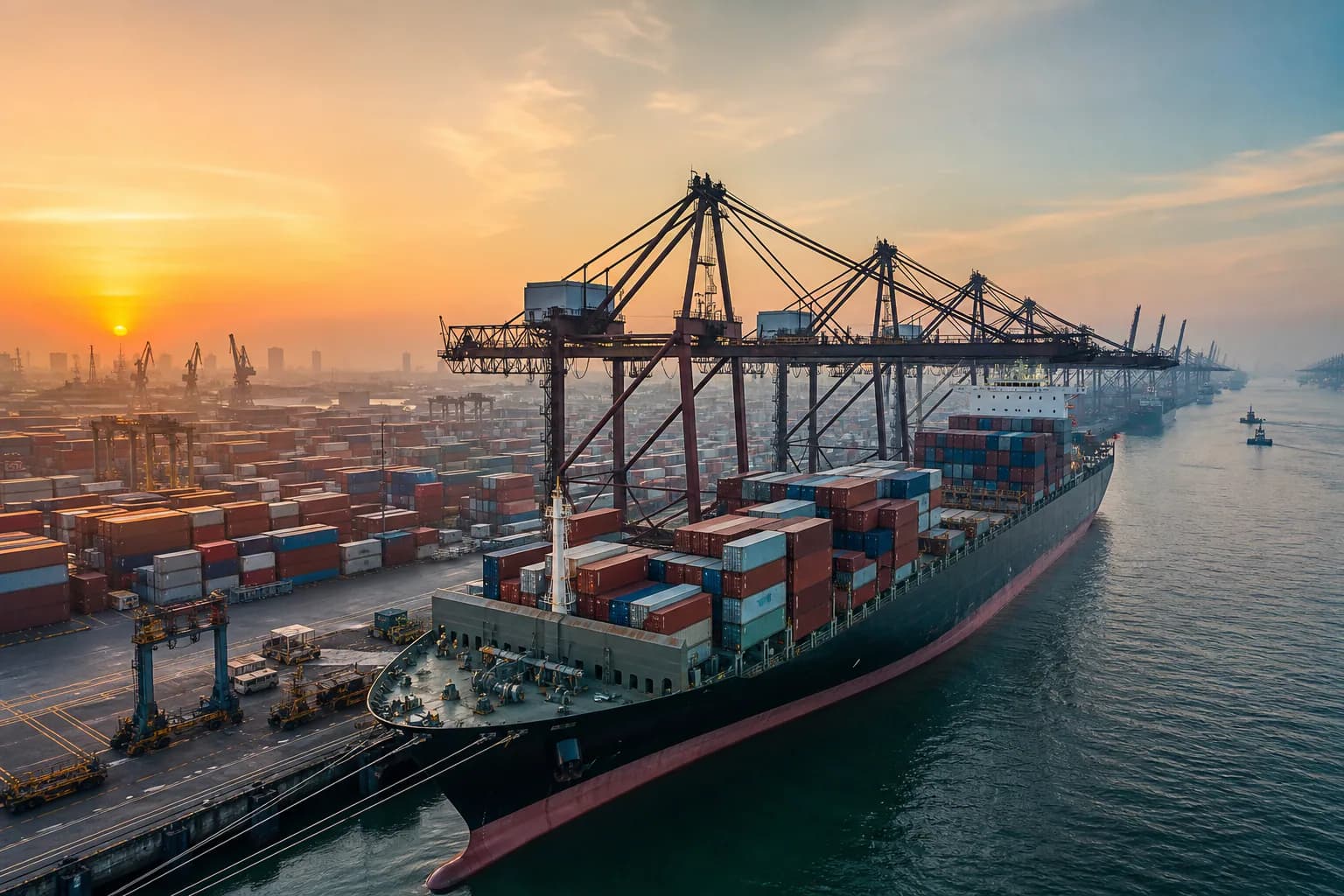
China formally joined the World Trade Organization on December 11, 2001, after fifteen years of negotiation, following the U.S. Congress's 2000 vote to grant Beijing permanent normal trade relations — removing the annual congressional reviews that had, since the Tiananmen crackdown of 1989, let American politicians threaten tariff increases over human-rights concerns each year.
The operative mechanism was access, not ideology. Multinational manufacturers gained the ability to build at Chinese scale with predictable, bound export tariffs and access to WTO dispute-resolution mechanisms, while Chinese producers gained stable, low-tariff entry to the world's richest consumer markets, particularly the United States and European Union. Capital followed that legal certainty, not the ceremony surrounding accession itself.
Special economic zones around Shenzhen, Dongguan, and the broader Pearl River Delta absorbed low-margin assembly work first, then climbed steadily into component manufacturing, electronics, and logistics as supplier networks deepened over the following decade. Within roughly ten years, moving a factory out of China meant rebuilding an entire supplier ecosystem from scratch, not just relocating a single building — the switching cost that made 'China plus one' a defensive diversification strategy for Western firms rather than an initial design choice.
American and European consumers gained meaningfully cheaper manufactured goods across categories from electronics to apparel, and multinational shareholders gained expanded profit margins. Manufacturing workers in the U.S. Rust Belt and comparable industrial regions of Europe lost jobs at a pace economists later termed the 'China shock,' with landmark research by David Autor, David Dorn, and Gordon Hanson published in 2013 and 2016 estimating that Chinese import competition cost the United States roughly one to two million manufacturing jobs directly.
Coverage at the time centered heavily on whether Beijing would honor its specific WTO commitments and whether expanded trade would gradually liberalize Chinese domestic politics — a bet that mostly did not pay off, as China's one-party governance model remained essentially unchanged two decades later. Few analysts anticipated how quickly infrastructure investment, worker training, and accumulated manufacturing know-how would create the kind of supplier depth that made China's centrality to global production genuinely difficult to reverse through policy alone.
The supply-chain shocks exposed by the COVID-19 pandemic in 2020, the U.S. CHIPS and Science Act of 2022 aimed at reshoring semiconductor manufacturing, and tariff escalations under both the Trump and Biden administrations targeting Chinese goods are all downstream reactions to this two-decade concentration of manufacturing capacity.
China formally joined the World Trade Organization on December 11, 2001, after years of bilateral negotiations, notably with the United States. Tariff schedules, market-access commitments, and dispute-settlement exposure were supposed to lock in reform. In practice, accession accelerated export-led manufacturing while leaving state ownership, industrial policy, and capital controls as ongoing points of friction with trading partners.
Firms from Walmart to electronics contract manufacturers redesigned supply chains around coastal Chinese production clusters. The 'China price' became a boardroom constraint in Detroit, Milan, and Osaka alike. Later political backlash in the West — tariffs, reshoring talk, friend-shoring — still assumes the dense interdependence that WTO entry helped cement rather than invent from nothing.
Accession protocols required tariff cuts and market-access schedules that multinationals used as investment green lights. Coastal special economic zones densified into export megaclusters; inland provinces became feeder labor markets. Western manufacturers discovered they could redesign BOMs around Chinese suppliers within a single product cycle.
Dispute settlement at the WTO became a new arena for steel, IP, and subsidies arguments. Neither side treated accession as the end of industrial policy — a reality later U.S. and EU tariffs implicitly admitted when they reached for national-security and overcapacity frames outside pure tariff schedules.
Corporate earnings calls from the mid-2000s treated China sourcing as pure upside until quality scandals and IP leakage complicated the slide. The political backlash arrived later than the operational dependency. By the time tariffs returned as a tool, the factory floor had already moved — and moving it back would take a decade of industrial policy.
WTO accession did not simply add one more member to a trade body; it moved the default physical location of the world's factory floor toward the Pearl River Delta and beyond, and Western industrial policy is still spending hundreds of billions of dollars trying to partially move it back.
Century Signals note: WTO accession protocol documents; contemporaneous trade reporting 2001–2005; later economic analyses of China shock manufacturing effects. Editorial judgment about what still structures the present — not a comprehensive history.