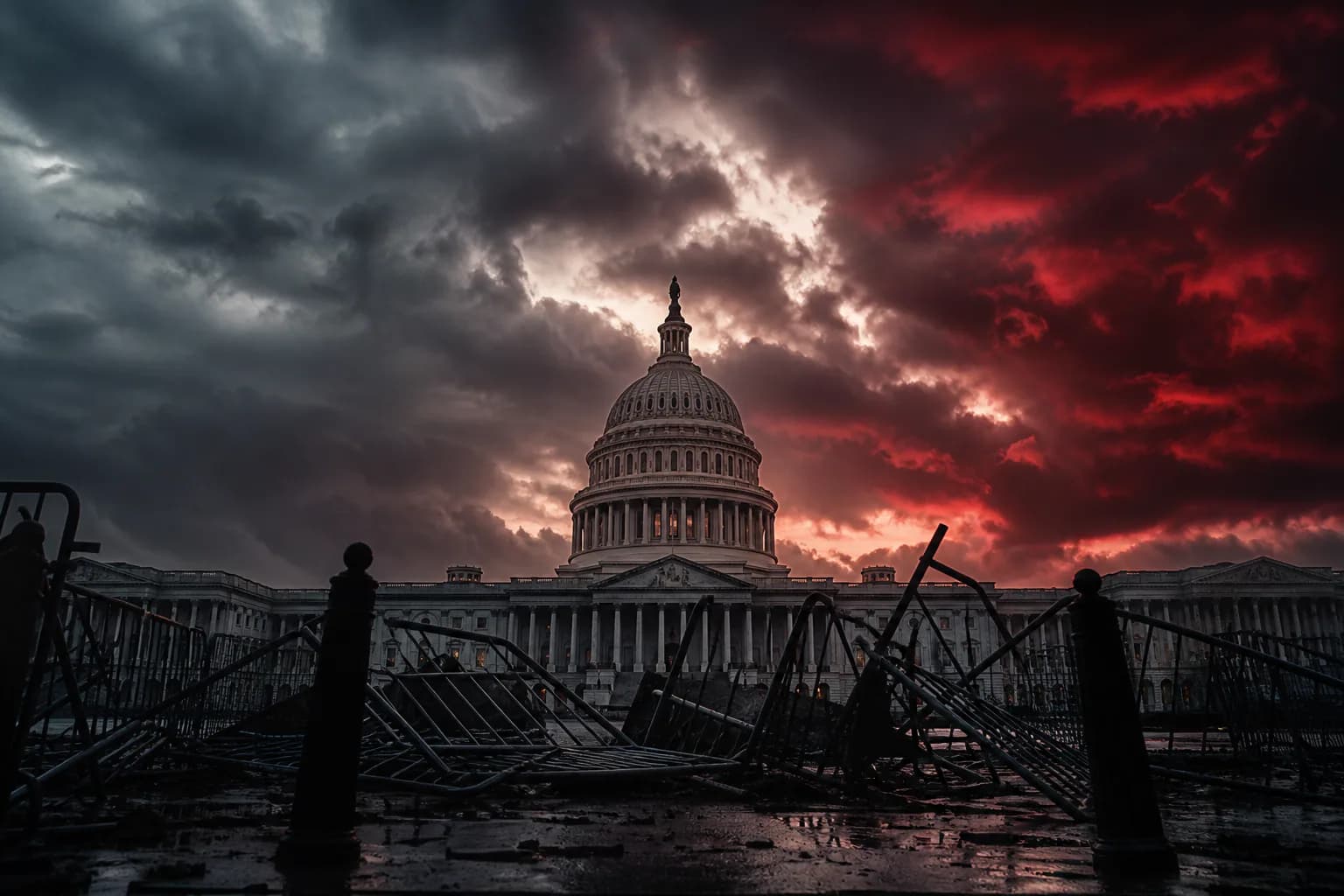
On January 6, 2021, thousands of supporters of President Trump gathered near the White House for a "Stop the Steal" rally where he repeated unfounded claims that the November 2020 election had been stolen through fraud, claims that had already been rejected in more than 60 court cases, including by judges he had appointed, and by his own attorney general William Barr, who publicly stated the Justice Department found no evidence of fraud on a scale that could have changed the outcome. A crowd then marched to the Capitol, where a subset broke through police barricades and entered the building while Congress was in the midst of certifying Joe Biden's 306-232 electoral college victory.
The breach forced an evacuation of the House and Senate chambers and a lockdown lasting several hours, the first time the Capitol had been overrun since the British burned it in 1814. Rioters ransacked congressional offices, including Speaker Nancy Pelosi's, and five people died in connection with the events, including a Trump supporter, Ashli Babbitt, shot by Capitol Police while climbing through a broken window, and an officer, Brian Sicknick, who died the following day from injuries sustained during the confrontation; roughly 140 police officers were injured, several severely, according to subsequent congressional testimony.
The mechanism enabling the breach combined years of eroding trust in election administration, amplified through social media misinformation about voting-machine fraud from Dominion Voting Systems that had no supporting evidence and later resulted in Fox News paying $787.5 million to settle a defamation lawsuit over its broadcast of those claims, with a specific organizing infrastructure — rally logistics, chartered buses, and coordination on platforms including Facebook and the alternative platform Parler, which was removed from Apple's and Google's app stores within days and briefly taken offline entirely after Amazon Web Services withdrew hosting.
Congress reconvened that same evening and certified Biden's win in the early hours of January 7, preserving the peaceful transfer of power despite the delay. Vice President Mike Pence, who presided over the certification and refused sustained pressure from Trump and his allies to attempt blocking or delaying it based on a legal theory most constitutional scholars considered baseless, drew both praise from constitutional scholars across the political spectrum and lasting anger from parts of Trump's base for that refusal, an anger some rioters expressed directly by chanting for Pence's hanging outside the Capitol that day.
Coverage in the riot's immediate aftermath emphasized the shocking imagery of the breach itself, and somewhat underweighted the months-long organizing and legal-pressure campaign that preceded it — the fake-elector schemes coordinated across seven contested states and pressure campaigns on state election officials, later detailed extensively in the House January 6 Committee's 2022 hearings and 845-page final report, which included a criminal referral of Trump to the Justice Department.
The Justice Department charged more than 1,500 people in connection with the riot in the years that followed, the largest single criminal investigation in FBI history, with several hundred pleading guilty or convicted of felony charges including seditious conspiracy against leaders of the Oath Keepers and Proud Boys militia groups, several of whom received sentences exceeding 15 years. Trump was impeached a second time by the House on January 13, 2021, for "incitement of insurrection," the fastest impeachment in U.S. history, but the Senate acquitted him on February 13 after he had already left office, with 57 senators voting to convict, short of the two-thirds threshold required.
Trump was separately indicted by a federal grand jury in August 2023 on charges related to his efforts to overturn the 2020 election results, a case that was later dismissed following his 2024 election victory under Justice Department policy against prosecuting a sitting president.
January 6, 2021 turned a certification ritual into a security failure broadcast live. Lawmakers evacuated; officers were assaulted; the electoral count resumed the same night — institutional continuity under physical threat. Prosecutions and congressional investigations followed at historic scale for the modern era.
Platform bans, radicalization debates, and 'stolen election' narratives persisted beyond the day. Future certifications now plan for violence as a design constraint. The event proved that democratic procedure can be attacked in the capital itself — and that recovery is legal and political work, not a single speech.
Security planners redesign certifications with barricades and contingency presidents pro tempore in mind. Political tourists and organized actors blurred in the footage, complicating simple narratives. Democracies elsewhere studied the day as a vulnerability demo, not a uniquely American curiosity.
The events reshaped how social platforms handle sitting officials, prompting Trump's temporary removal from Twitter and Facebook, and left a durable partisan divide over how the day should be characterized that resurfaced directly when Trump, upon returning to office in January 2025, issued clemency to a large number of those convicted or charged in connection with the riot on his first day back in office — a decision that remains a live point of dispute over what accountability from that day ultimately amounted to.
Century Signals note: Congressional January 6 committee materials; DOJ prosecution summaries; contemporaneous video journalism. Editorial judgment about what still structures the present — not a comprehensive history.