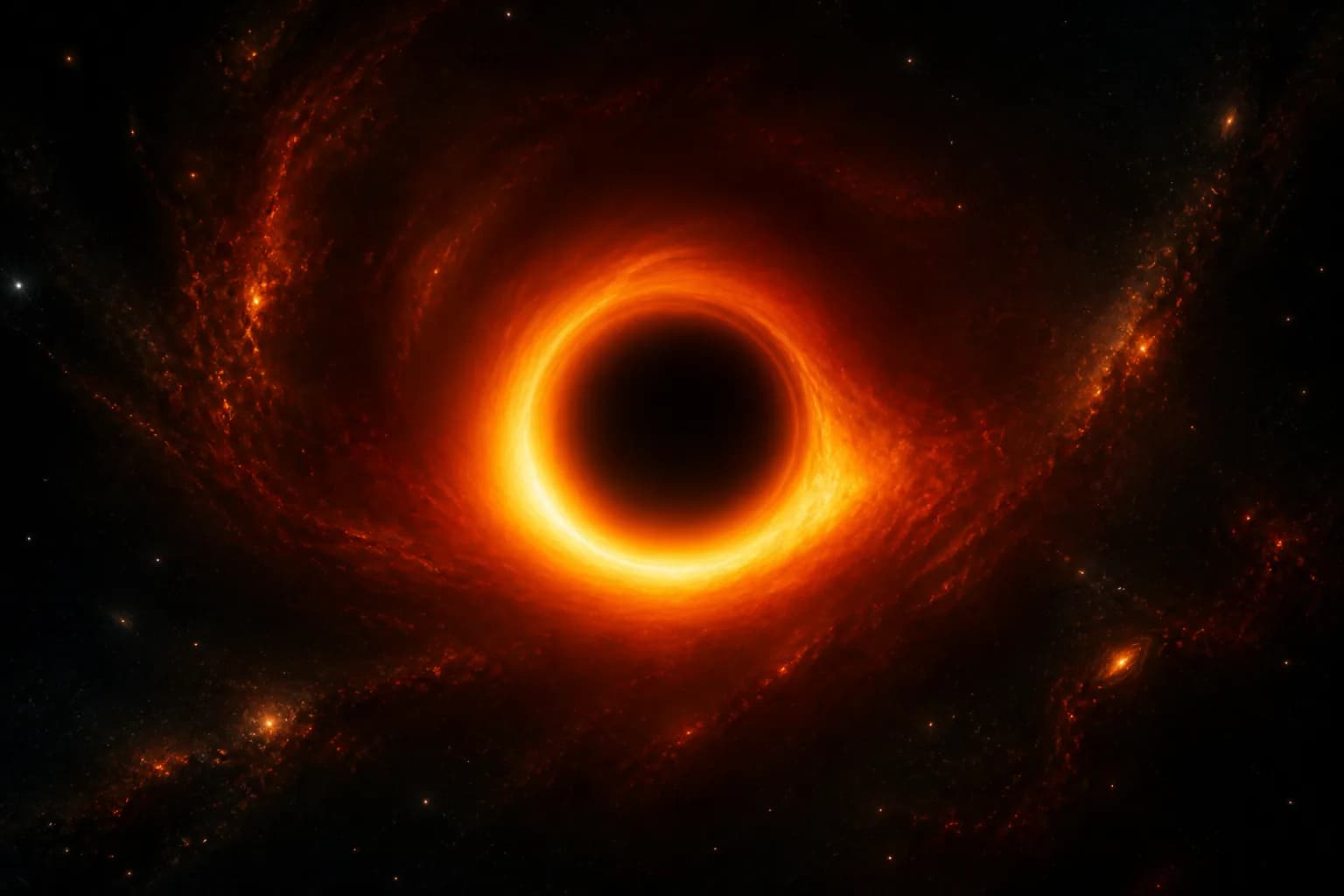
On April 10, 2019, the Event Horizon Telescope collaboration released the first direct image of a black hole: a glowing ring of superheated gas surrounding the event horizon of M87*, a supermassive black hole roughly 6.5 billion times the mass of the sun, located 55 million light-years away in the galaxy Messier 87. The image matched, with striking precision, what Einstein's general theory of relativity had predicted a century earlier, in 1915, for how light bends around such an object.
Producing the image required linking eight radio telescopes across six locations worldwide — from Hawaii to the South Pole to Spain and Chile — into a single virtual telescope roughly the size of Earth, using a technique called very long baseline interferometry, synchronized by atomic hydrogen maser clocks precise enough to time-stamp incoming radio waves to within a fraction of a billionth of a second across thousands of miles of separation.
The raw data, several petabytes collected over multiple nights in April 2017, was too voluminous to transmit over the internet even at modern broadband speeds and had to be physically flown on hundreds of hard drives to processing centers at MIT's Haystack Observatory in Massachusetts and the Max Planck Institute in Germany. Turning that data into an actual image required new computational methods, including an algorithm called CHIRP developed by then-graduate student Katie Bouman at MIT, whose team built imaging techniques capable of reconstructing a picture from sparse, noisy interferometric data without assuming what the result should look like in advance — a deliberate safeguard against confirmation bias in the reconstruction process.
The achievement validated decades of investment in radio astronomy infrastructure and international scientific coordination across more than 200 researchers and 13 partner institutions on four continents; it also made Bouman briefly a public face of the project after a photo of her reacting to the first successful image reconstruction went viral, and, secondarily, a case study in how credit for large collaborative science gets attributed to a single person in media coverage even when the underlying work is deeply collective across teams that had worked on the project for over a decade.
Coverage at the time emphasized the visual spectacle and the human-interest angle around Bouman, somewhat underweighting the underlying methodological achievement: the imaging algorithms developed for the project have since found use well beyond astronomy, in fields requiring reconstruction of images from incomplete or noisy data, including medical imaging research.
The collaboration returned in 2022 with an image of Sagittarius A*, the supermassive black hole at the center of the Milky Way, roughly 27,000 light-years from Earth and much smaller than M87* — a far harder target because gas around it changes on timescales of minutes rather than the days relevant to M87*, requiring new modeling techniques to compensate for that variability and years of additional data processing before release.
The project's total cost, funded largely through the U.S. National Science Foundation and European partners at roughly $60 million over its buildup, is frequently cited in subsequent funding debates as a comparatively modest price for a discovery of this scale, an argument now used to support continued public investment in large, internationally pooled scientific infrastructure amid competing budget pressures.
The Event Horizon Telescope's 2019 image of M87* turned an abstract general-relativity prediction into a visual the public could screenshot. Global VLBI coordination — synchronizing telescopes like a planet-sized instrument — was the engineering miracle behind the glowing ring.
Science communication gained an icon that outcompeted most press releases. Follow-on Sagittarius A* imaging reinforced the method. The signal to culture: the universe's most extreme objects are now empirically pictured, not only calculated.
Classroom posters updated; so did fundraising decks for next-generation arrays. Collaboration across contested borders showed science’s stubborn internationalism under strain. A fuzzy orange ring did more for public physics than a thousand equations.
Calibration debates among radio astronomers became public science process. Funders saw a proof that distributed instruments can deliver icons. The image licensed wonder without promising a gadget — rare and valuable.
The Event Horizon Telescope's model of pooling scarce, expensive, distributed instruments into a single coordinated observation now shapes proposals for the next generation of astronomical infrastructure, including plans for space-based interferometry that would extend the same principle beyond Earth's surface, still working toward the same underlying goal of testing general relativity in the most extreme gravitational environments physics can access.
Century Signals note: EHT collaboration papers in ApJL; NSF/ESO announcement materials; contemporaneous science journalism. Editorial judgment about what still structures the present — not a comprehensive history.