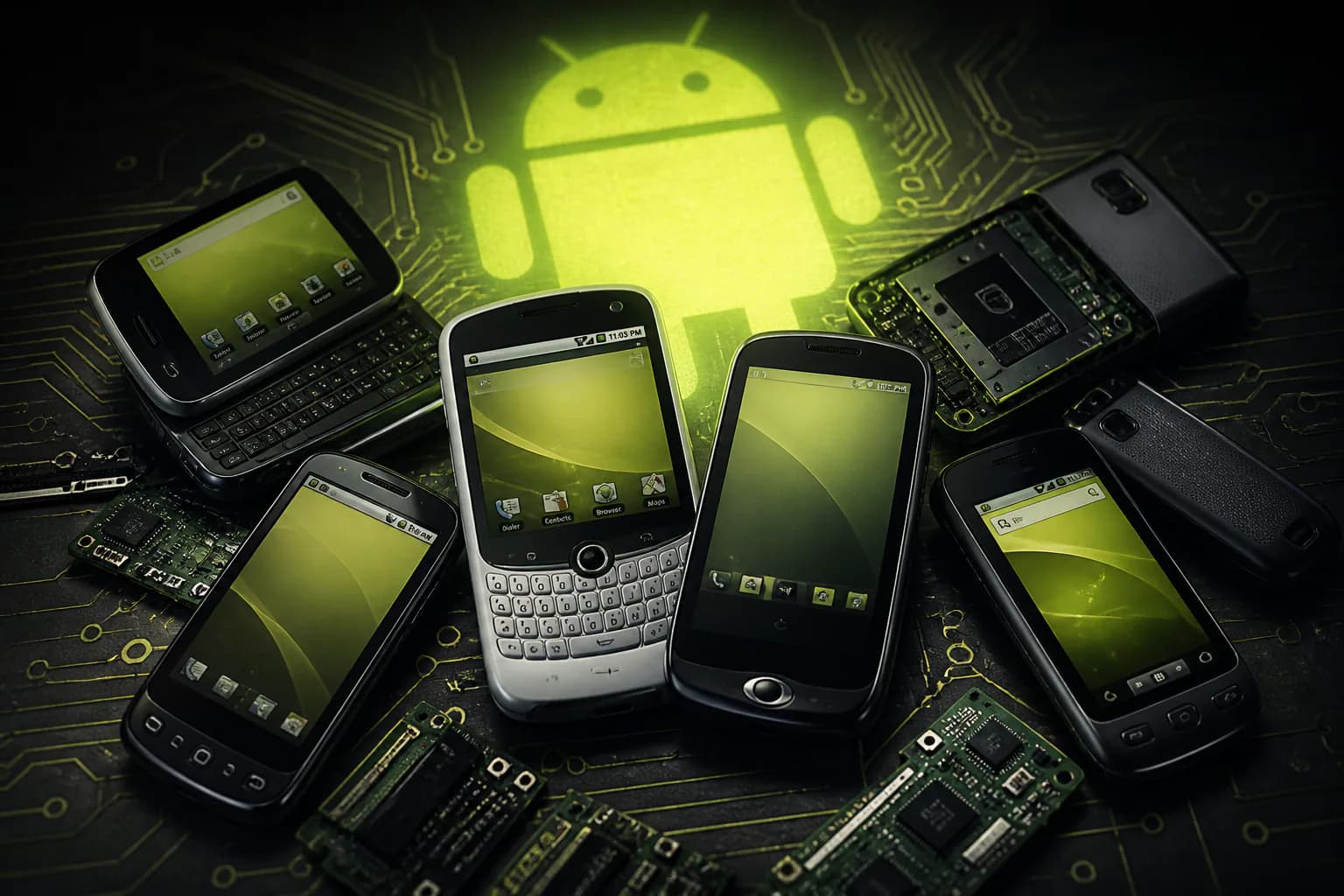
Google quietly acquired Android Inc., a small startup founded in Palo Alto by veteran mobile engineer Andy Rubin, in July 2005 for a reported $50 million, declining to disclose any details of its plans for the company even as curious reporters publicly asked what a search-advertising company wanted with a mobile operating-system engineering team.
Apple's iPhone, unveiled eighteen months later in January 2007, pursued a tightly closed hardware-software integration strategy controlled entirely by one company. Android, formally launched to the public through the Open Handset Alliance consortium in November 2007 and first shipping on T-Mobile's HTC-built G1 handset in September 2008, pursued the opposite strategic bet entirely: a free operating system any manufacturer could freely license, modify, and ship on its own hardware.
The mechanism was platform economics operating at manufacturer scale. Samsung, HTC, Motorola, and later dozens of budget handset makers across Asia could ship new phones quickly by layering a custom interface skin on top of Android's shared open-source core, trading meaningful hardware differentiation for a lasting dependency on Google's bundled proprietary apps, Play Store distribution terms, and security-update release cadence.
Google gained a mobile search and advertising foothold it did not have to design or manufacture its own hardware to defend; by the mid-2010s, Android ran on the large majority of the world's active smartphones, especially outside the U.S. and Western Europe, where its lower price points relative to Apple's devices mattered most to price-sensitive consumers. Handset manufacturers gained real speed to market but lost meaningful long-term control over the core software experience and the user data flowing through it.
Coverage of the original 2005 acquisition was minimal at the time — a brief footnote buried in a Google earnings cycle otherwise dominated entirely by search-advertising growth news. Retrospective industry analysis now treats the deal as strategically essential: it kept Apple's closed hardware model from becoming the only commercially viable smartphone template and made genuinely capable smartphones available across a much wider range of income levels globally.
The European Commission's 2018 record antitrust fine against Google over mandatory Android app-bundling requirements, and ongoing sideloading and app-store commission disputes involving companies like Epic Games, both trace directly back to the specific licensing terms Google quietly attached to what looked, in 2005, like a modest and unremarkable engineering acqui-hire.
Google acquired Android in 2005 and launched it as an open mobile platform with the Open Handset Alliance, reaching consumers with the HTC Dream / T-Mobile G1 in 2008. The strategy countered Apple's integrated iPhone model with OEM diversity, carrier deals, and a Play Store that scaled through hardware fragmentation as much as software elegance.
Android's licensing and app-distribution defaults eventually drew antitrust scrutiny, especially in Europe, but by then the platform had secured the majority of global smartphone shipments. The dual-stack world — iOS for margin and cultural cachet, Android for reach — still defines mobile product planning.
Fragmentation was the price of openness: version delays across OEMs forced developers to support uneven APIs and screen sizes. Google's answer included reference devices, certification programs, and eventually more control over Play services — openness with a gravitational center in Mountain View.
The Open Handset Alliance pitched Android as insurance against a single-company mobile stack after the iPhone's debut. Carriers and OEMs got customization hooks; Google got search and services distribution. Fragmentation was not a bug in that bargain — it was how you bought reach.
Play Services and app-store policies later recentralized control even on 'open' hardware, a tension European antitrust remedies tried to unwind by forcing choice screens. Developers still budget for the dual reality: design for iOS polish, ship for Android volume.
For emerging markets, Android plus cheap hardware was digital inclusion with Google services attached. That bargain spread smartphones faster than any single premium device could. Geopolitics later questioned the services layer; the hardware ubiquity was already irreversible.
App developers learned to budget for OEM quirks and Play policy shifts in the same sprint. Openness distributed hardware; services recentralized control. Users got choice of casing more than choice of gravity.
Android made smartphones cheap and functionally nearly universal worldwide; it also made Google's core identity and advertising systems the default software layer running underneath most of the world's mobile internet use, a deep dependency regulators on multiple continents are still actively working out how to meaningfully address.
Century Signals note: Android/OHA announcements; HTC Dream launch coverage; later EU Android antitrust materials; OEM fragmentation reporting. Editorial judgment about what still structures the present — not a comprehensive history.