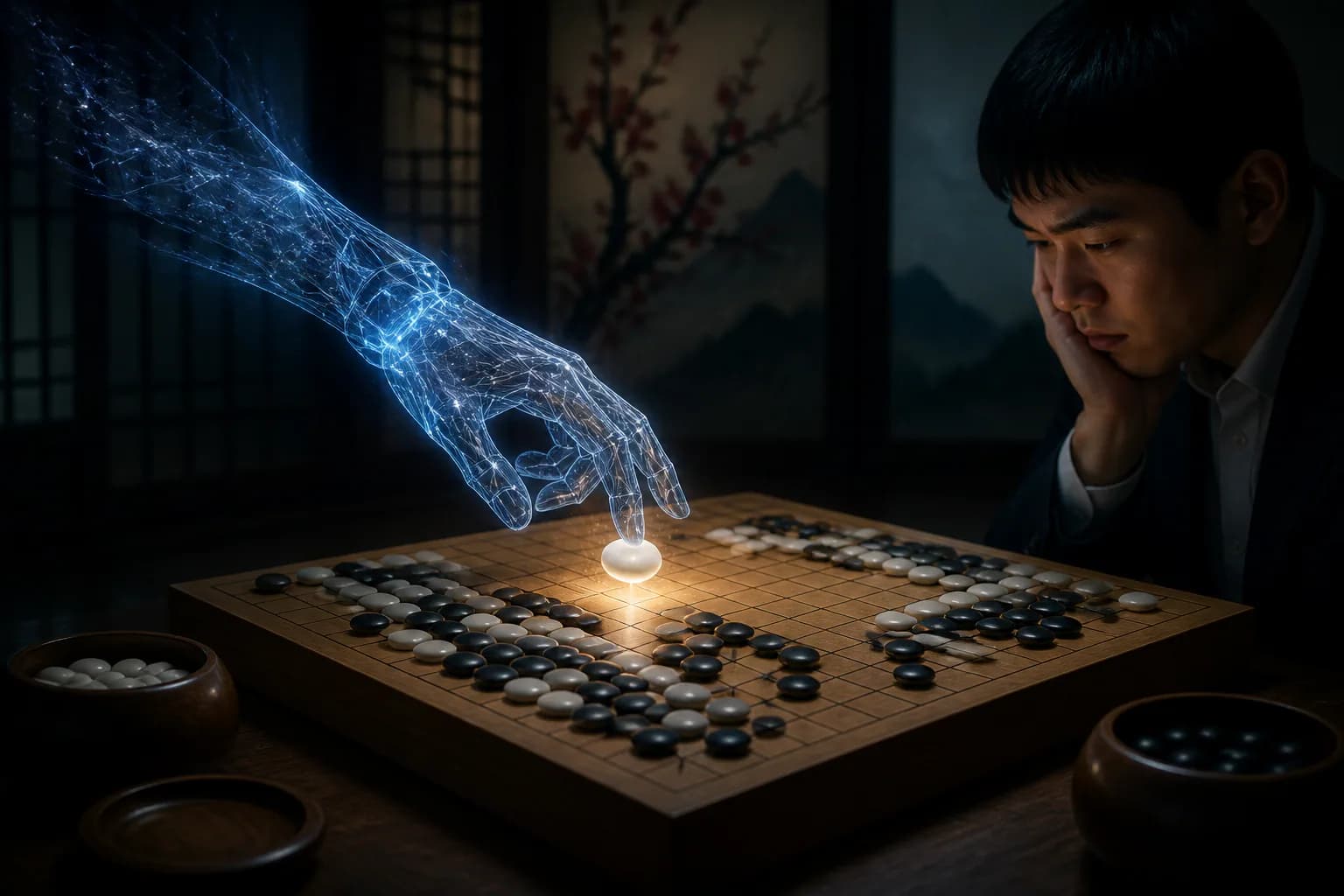
In March 2016, DeepMind's AlphaGo defeated South Korean grandmaster Lee Sedol, a 9-dan professional with 18 international titles, four games to one in a match held in Seoul and watched by an estimated 280 million people worldwide. Go, with its roughly 10^170 possible board positions — vastly more than chess — had long been considered the game where brute-force computing would fail and human intuition would hold out for years, if not decades, longer than it did against chess, which IBM's Deep Blue had already conquered in 1997.
AlphaGo's mechanism combined deep neural networks trained on 30 million moves from human expert games with Monte Carlo tree search, letting the system evaluate board positions the way strong players describe intuition rather than exhaustive calculation. In game two, AlphaGo's 37th move — a shoulder hit on the fifth line that no professional would have played, and that commentator Michael Redmond initially thought was a mistake on the broadcast — was so unconventional that it took analysts hours to appreciate why it worked, before it proved decisive in that game.
The victory depended on infrastructure DeepMind had built specifically for the challenge: reinforcement learning techniques refined through self-play across thousands of parallel games, custom TPU hardware developed by Google, and a training pipeline that let the system improve beyond the human game data it started from — the same self-play approach that produced AlphaZero within a year, mastering chess and shogi from scratch in under 24 hours with no human data at all.
Lee Sedol, who won the series' lone game in a result he called one of the most satisfying of his career precisely because of the opponent, retired from professional Go in 2019, saying that even becoming the top human player would leave him "unable to win" against AI opponents that had since surpassed AlphaGo itself. DeepMind gained enormous credibility and research funding, and a trajectory that led directly to AlphaFold, which later solved the 50-year-old protein structure prediction problem for nearly all known proteins. Go itself changed: professional players now study AI-generated opening strategies previously outside human convention, and rankings shifted as younger players who trained alongside AI tools outperformed veterans who had not.
Coverage in 2016 focused heavily on the human-drama narrative of Lee Sedol's loss and underweighted the more consequential signal: that reinforcement learning through self-play could generalize far beyond Go, a capability that within three years moved from board games into protein folding, and within a decade into the large-scale reasoning systems reshaping software, science, and search.
The match also reset public and institutional expectations for how quickly AI capabilities could jump. Governments and research labs that had treated general AI progress as a multi-decade horizon began funding AI safety and policy work with far more urgency, a shift visible in the founding or expansion of dedicated AI institutes across the U.S., U.K., and China in the years immediately following, including the UK's AI Safety Institute and comparable bodies elsewhere.
DeepMind itself, acquired by Google in 2014 for a reported $500 million, became one of the most valuable research organizations in the world following AlphaGo's success, and its founder Demis Hassabis went on to share the 2024 Nobel Prize in Chemistry for AlphaFold — a direct institutional line from the Go match to a Nobel-recognized scientific breakthrough eight years later.
Lee Sedol's loss to AlphaGo in 2016 was a cultural earthquake in East Asia and a technical proof that deep reinforcement learning could master a game once thought to require ineffable intuition. Move 37 entered lore as machine creativity under search.
DeepMind's later AlphaZero generalizations hinted that the method transferred. Go federations and AI labs recalibrated timelines; the public gained a visceral demo that 'AI' was not only classification. The match made neural nets feel like rivals, not tools — a framing that generative models later inherited.
Go communities mourned and then studied AI variations as new joseki. Investors treated the match as a timeline update for automation. Symbolic losses matter in AI history; they recalibrate what societies believe machines can touch.
That recalibrated timeline still shapes how seriously institutions treat AI capability forecasts today: AlphaGo is the reference case cited whenever experts warn that a field considered safely distant from automation can compress to months once the right architecture and training method arrive.
Century Signals note: Nature papers on AlphaGo; contemporaneous match coverage; later DeepMind research releases. Editorial judgment about what still structures the present — not a comprehensive history.