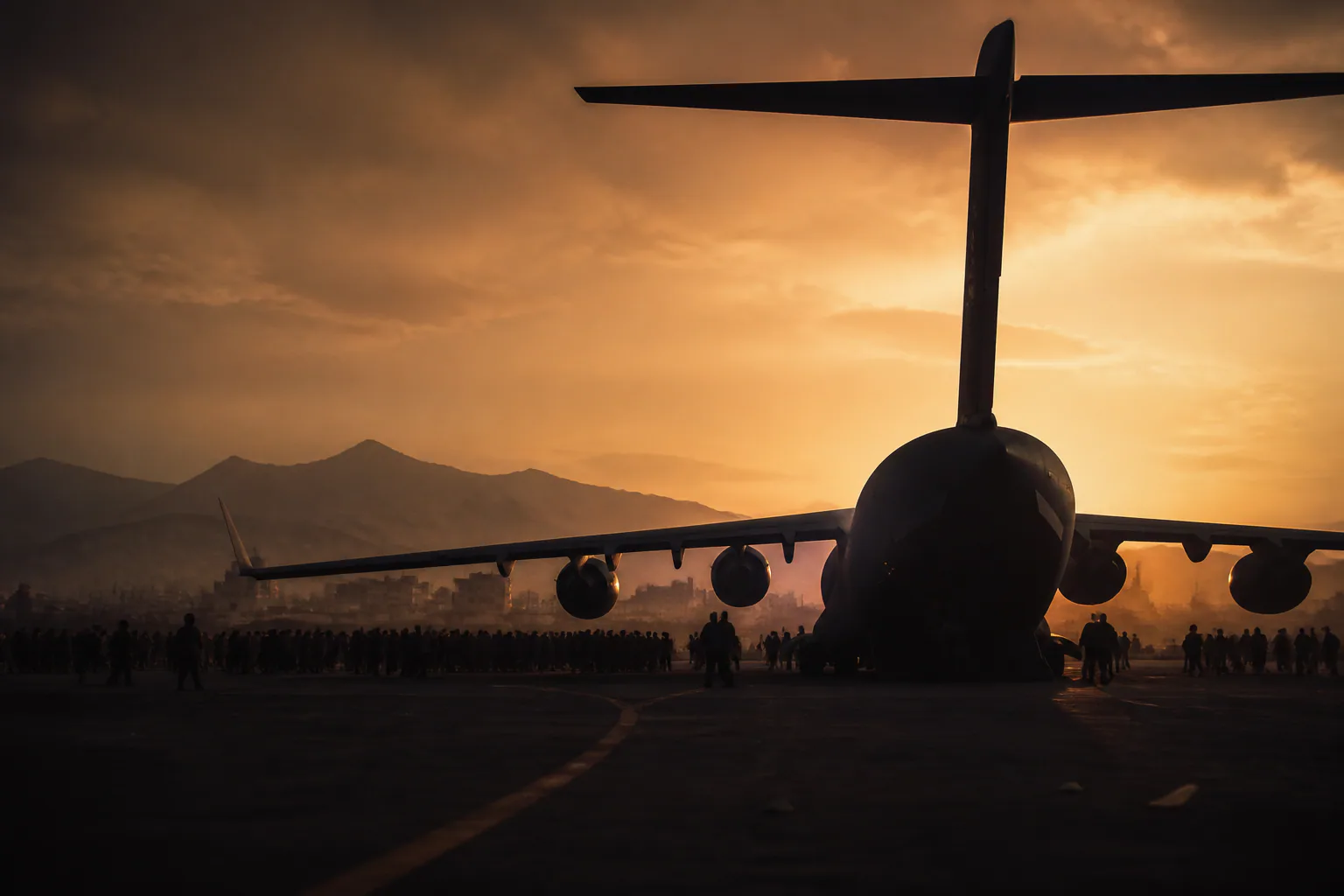
On August 15, 2021, President Ashraf Ghani fled Kabul as Taliban forces entered the capital, eleven days before the U.S. troop withdrawal deadline that President Biden had set after inheriting the February 2020 Doha Agreement negotiated by the Trump administration. The Afghan security forces the U.S. had spent roughly two decades and more than $80 billion training and equipping largely dissolved without sustained fighting, collapsing a government that intelligence assessments had projected could hold for months, not days.
The mechanism behind the collapse was less military than institutional: Afghan army units had been propped up by U.S. contractor maintenance, air support, and payroll that vanished as American forces drew down, and provincial deals with the Taliban had been underway for weeks before Kabul fell. The airlift that followed evacuated more than 120,000 people through Hamid Karzai International Airport in roughly two weeks, the largest noncombatant evacuation operation in U.S. military history, run under crowd-control conditions with no functioning host government.
On August 26, a suicide bombing at the airport's Abbey Gate, claimed by the Islamic State–Khorasan Province, killed 13 U.S. service members and an estimated 170 Afghan civilians, the deadliest day for American troops in Afghanistan since 2011. The bombing occurred even as U.S. forces coordinated evacuee movement with Taliban checkpoints outside the perimeter, an arrangement that itself became a point of controversy in later congressional testimony.
Afghans who had worked as interpreters, contractors, and civil society partners faced the steepest losses: the Special Immigrant Visa backlog, already years long before the withdrawal, left tens of thousands without evacuation slots, and many who did not reach the airport were left to Taliban rule. The U.S. froze roughly $7 billion in Afghan central bank assets held in New York, deepening a humanitarian and banking crisis inside the country. European and other NATO allies, who had deployed alongside U.S. forces since 2001, learned of the final withdrawal timeline largely through American decisions rather than joint planning.
Contemporaneous coverage concentrated heavily on the images at the airport — people clinging to departing aircraft, the chaos at the gates — and on partisan blame over the exit's execution. It underweighted the multi-administration nature of the failure: intelligence assessments under both Trump and Biden had underestimated how quickly Afghan forces would fold once foreign air support and contractor logistics disappeared, a planning failure that predated any single president's exit deadline.
Congressional investigations that followed, including hearings held once Republicans took the House majority in 2023, focused heavily on assigning blame for the Abbey Gate bombing and the withdrawal's final weeks, producing extensive testimony from military and State Department officials but little consensus on accountability, since the underlying planning failures spanned two administrations with different parties in office.
The withdrawal closed America's longest war, one that had cost, by government accounting, more than 2,400 American service members' lives and over $2 trillion since 2001. It also marked a hard stop to the post-9/11 nation-building doctrine that had guided U.S. foreign policy for two decades, pushing Washington toward a more explicit framework of great-power competition with China and Russia rather than counterinsurgency.
Kabul's fall in August 2021 compressed twenty years of state-building into airport chaos and Taliban reoccupation. Allies evacuated under fire; interpreters and partners faced abandoned-risk realities. Strategic narratives of 'responsible end' collided with images of clinging to aircraft.
Great-power competitors read American will; domestic politics absorbed blame fights that outlasted the news cycle. Counterterror 'over the horizon' promises replaced presence. The withdrawal reset regional diplomacy and refugee flows — and taught that exit logistics are strategy, not an afterthought.
Allied trust took a hit that diplomatic language only partly repaired. Terror groups gained a propaganda victory even if governance capacity lagged. Withdrawals will be judged forever against the airport footage — strategy reduced to a single indelible week.
The trust deficit proved durable. European officials cited the withdrawal for years afterward when weighing how much unilateral latitude to grant U.S. decisions on troop posture, most visibly in early debates over Ukraine policy. The Taliban government that took power has never been formally recognized by the United States, and Afghanistan's isolation from the international financial system remains a direct legacy of the frozen assets and severed aid relationships from August 2021.
Century Signals note: SIGAR assessments; contemporaneous evacuation reporting; allied government after-action materials. Editorial judgment about what still structures the present — not a comprehensive history.